
Julieta Aranda wants to send a message through several channels saying in different ways that exits and entries are part of the same door: the imagination. While the mechanisms of imagination can allow us to escape from what we perceive to be our limitations, they can also propel us in the opposite direction. Imagination can be curbed by the inherited materialistic notions and false restrictions imposed by the world.
Most people would describe this as a contradiction that must first be resolved if one wants to move forward. But, what would happen if such a contradiction was just the natural order of things and one decided to incorporate such condition into the nature of one’s artistic creation and in an exhibition? With this in mind, Julieta Aranda, one of the influential voices of the e-flux project (e-flux.com)—a platform created in 1998 for collaborative exchanges among artists, projects, and people interested in the art world—created a series of objects for an exhibition titled Swimming in Rivers of Glue (An Exercise in Counterintuitive Empathy) at the James Fuentes Gallery in New York City. From beginning to end, the diverse works, strategies, and titles—words—invoked conceptual situations destined to channel entrapment and liberation.
Two central elements of the exhibition were displayed on two large adjacent walls. The physical central axis was a video-collage projection titled Stealing One’s Own Corpse (An Alternative Set of Footholds for an Ascent Into the Dark) Part 2—Swimming on the Rivers of Glue—The Perspective of Perspective (2016). It consisted of images, texts, and voice-over combined to serve as the central communication system of Aranda’s philosophy. The general message appeared to be about our deep-rooted sense of limits, invisible need for physical structure or platform that always accompanies us even in realms of imaginary freedom. This transformed into postmodern rhetoric that will sound familiar to the readers of Michel Foucault, Jacques Lacan, Paul Virilio, etc. It states that the boundaries that limit us, like those established by capitalized culture, construct “our place,” no matter how incorrect the image is. Unfortunately, the volume was set low and some of the things said in voice-over could not be heard, even when the gallery staff was kind enough to turn up the volume for me.
Mounted on the adjacent wall, the amplified vertical and horizontal lines of a crossword puzzle were arranged over a black background. The upper right corner showed the small squares generated by digital pixilation, the bitmap is shown when an image is enlarged to take a closer look—one of Aranda’s objectives. The title indicated the purpose of a great part of the exhibition: Produced (A Point of Reference Slowly Draws in Semantic Meaning to Provide the World With a Fixed Border, Fixed Dimensions, Fixed Weight) (2016). The words in the crossword puzzle were the main titles of many of the works in the exhibition and key ideas associated with Aranda’s project, including cognition, undetermined, premise, possibility.
I thought that the content in one of the vertical lines of the crossword puzzle—the 38 vertical line—was very interesting. Instead of a word, it contained numbers and letters: 9.8MIS2. Once deciphered, one realized that it represented the so-called “gravity velocity” (9.8 m/s2, better known as the velocity of gravitational waves). A rather arcane reference that if understood in broad terms represented a guide to Arana’s exaggerated vanguardism: if one changes things—the distribution of energy, the moment of matter, or people’s minds—then any realm changes, whether gravitational or cultural.
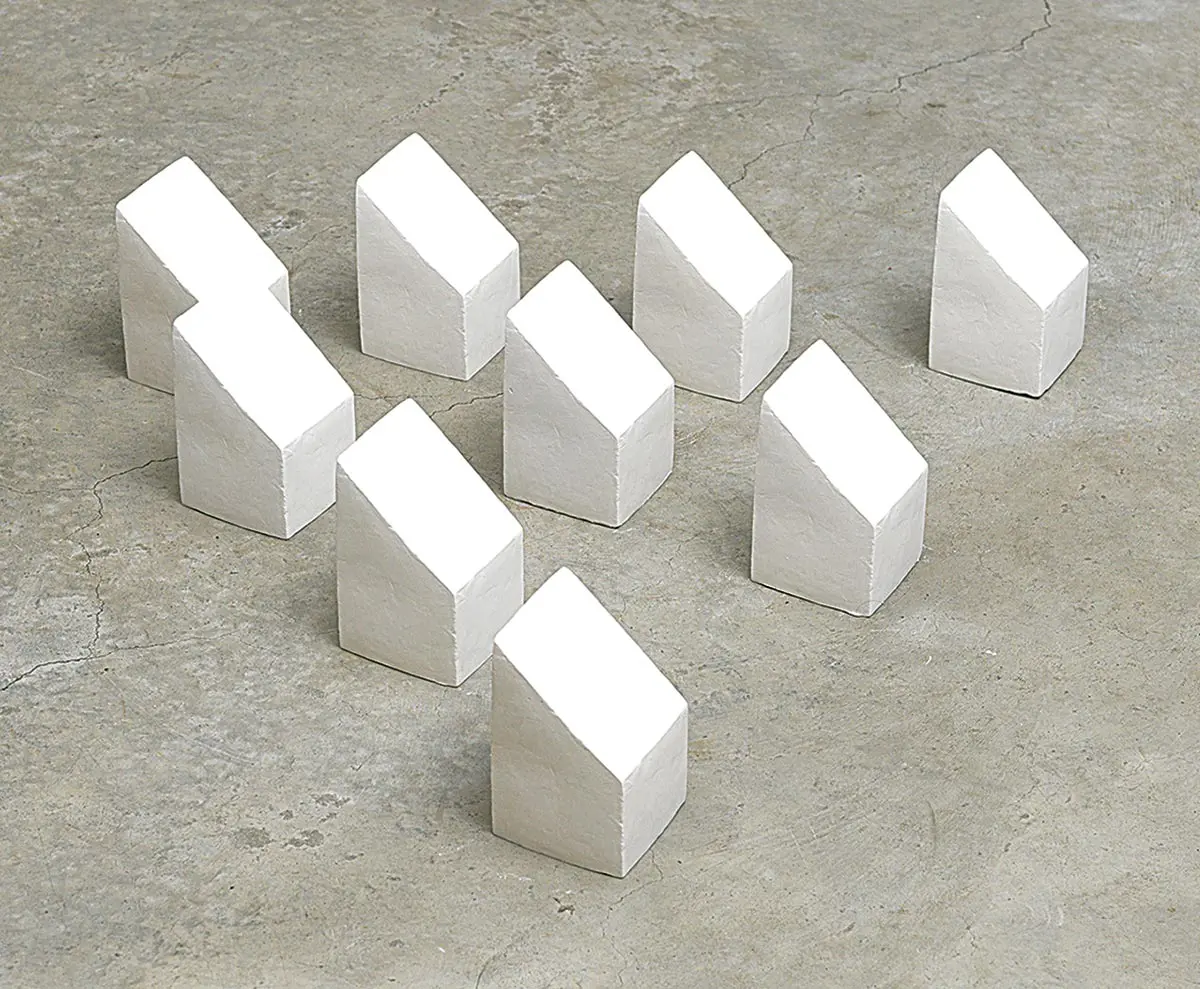
Much of what Aranda creates in the form of objects works in several levels and somehow refers to the basic principles of her world vision, according to which individual parts are connected to broader structures. For instance, the numerous small white forms grouped in different ways on the gallery floor under the generic title of Placement (City Variations) There Is No Substitute for a Man on the Ground (2016), initially appeared to be modernist forms of geometric abstraction. But they were actually plaster models of different barriers used in many cities to keep people—mostly the homeless, but also the general public—from relaxing in public spaces. There was a more complete commentary on the subject in the plaster and foam construction of a life-size white bench designed to accommodate a resting body; a promising prospect if it were not impeded by the squares that protruded from its surface. As if to state the purpose of the piece in no uncertain terms, there was also a human figure made of blue latex on the bench that looked like a deflated ball and had part of its body hanging from one side, in an effort to prevent a twisted interpretation of the meaning of the word “public.” (Existence. Passing Through, Being Marked and to Some Extent Damaged by the Geography of the Present, 2016).
Everywhere viewers were bombarded by false images, interpretations, and convictions. Even rationality concealed psychotic crises. The enormous web made with Paracord (cord used in the manufacture of parachutes) hanging from one side to the other side of the gallery, represented the record of famous scientific experiments performed during the end of the 1940s (and repeated by NASA during the 1990s) on spiders that wove their webs while under the influence of drugs. It appeared to have been created under the effects of marijuana. (Relationships. Expect to Be Changed a Lot: A Real Interaction Is More Akin to Demonic Possession Than to Data Collection, 2016). The collective title of the web fragments created with stained glass and hanged in frames across a wall, pointed into the direction of Aranda’s door: Survivability. I Had No Idea of What I Was Supposed to Want, but I Knew Better That to Admit It, 2016.
RICHARD LESLIE