
The galería Jorge Mara-La Ruche in Buenos Aires presented a new exhibition by Kirin titled Diderotica. An Appreciation of Denis Diderot.
Kirin is an artist that carefully selects his approaches for each exhibition. If in the 2015 show—also at the same gallery—titled Between the Lines the line was predominant throughout the entire labyrinthine proposals, in the current exhibition the works are painted red or in a variation of red: vermilion, cadmium, scarlet, and maroon. They are paintings or inks on paper or canvas, and, in many cases, the canvases are printed.
Instead of relying on the color on the support as contrast, as he usually does, in these images Kirin introduces reproductions taken from Encyclopédie and, in one of the works, includes a reproduction of Diderot’s face, which appears to be pushing through the foreground’s imposing reds.
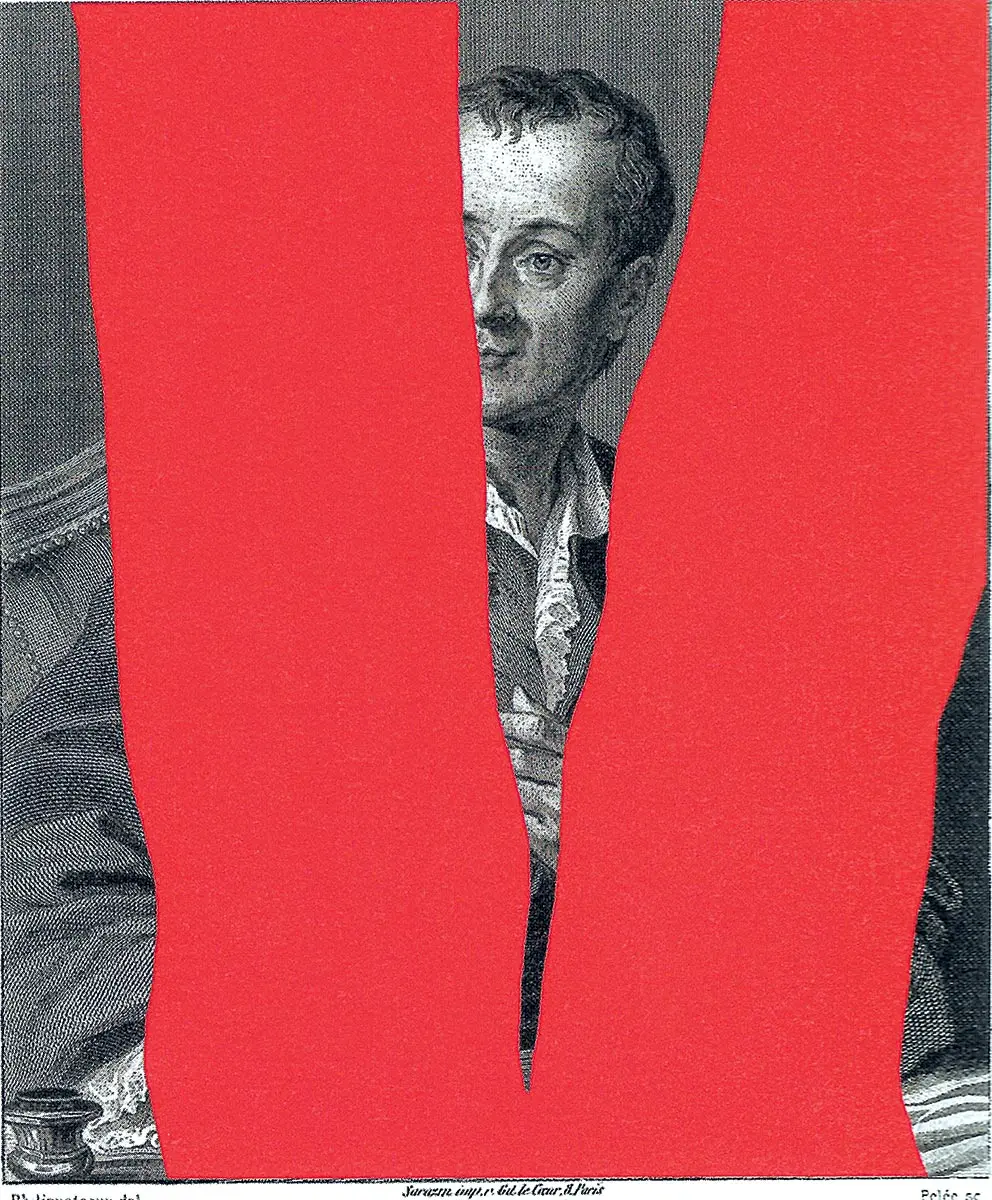
In this manner, Kirin pays tribute to the Encyclopédie, ou dictionnaire raisonné des sciences, des arts et des métiers (Encyclopedia, or a Systematic Dictionary of Sciences, Arts, and Crafts), which was organized and edited by, among others, Diderot himself. Consisting of 3,000 plates, it was as much a theoretical and informative monument as a visual one; a moment when the Revolution was searching for its own iconography, its own visual style.
Does Kirin want to contrast with his reds a background in which reason dominates the scene? Is it with this intention that he superimposes the flaming reds of his overwhelmingly sensorial irregular forms?
I believe that Kirin enjoys secretly playing with ambiguities. His reverence for the power of knowledge is undoubted, as is his homage to one of the first art critics of modern art, who—according to Martin Jay—challenged the traditions of painting, scenography, and perspective.
Because Diderot was not a proponent of Cartesian ocularcentrism. Instead, his challenging and inquisitive mind led him to explorations that reaffirmed the importance of touch as a powerful source of knowledge. These steps towards the imbrication of the senses would eventually be introduced in the proposals of later philosophers.
Is this exaltation of an intellectual who happened to be open to nuances, doubts, and the adoption of other paths to knowledge a mere humorous game? Most likely, Kirin’s semi-geometric forms and poignant use of color embrace Diderot as a brilliant person traveling on the same path.
Kirin’s appreciation of Diderot is corroborated by the name of the exhibition: Diderotic, which is another play on words incorporated into the language of this Argentinean artist as well as another way of paying tribute to the French intellectual.
Indeed, Denis Diderot showed great interest in the research of the relationships between perception and language, the connections between visual and linguistic forms; a realm that Kirin explores with the title of this exhibition, as he has done so on other occasions.
In the group of works that do not have impressions on those themes, similarly dimensioned red fragments are articulated like writing. These pieces invite us to observe the work left-to-right and top-to-bottom. Some displayed together and others separated, the pieces are like signs from ancient cultures.
They transform as they are aligned and reiterated, most of them with imprecise outlines that seem almost hesitant. They appear to be encouraging us to ask questions, even if we know that there will be no answers. Kirin (Carlos Dell’ Agostino) was born in Bahía Blanca, in the Buenos Aires Province, in 1953.
The Galería Jorge Mara-La Ruche published an accompanying catalog designed by Manuela López-Anaya that includes beautiful illustrations.
NELLY PERAZZO