
Rejecting the idea that art evolves like a living organism is commonplace today. Nevertheless, we understand the meaning of ISSOÉOSSODISSO (THATISTHEBONEOFTHAT), the title of Lenora de Barros’ recent solo exhibition. The title’s beautiful Portuguese alliteration does not refer to the origins of the work in terms of the genius, creativity, or growth involved, but in terms of its crude structure (bone), taking us immediately to the idea of the process and to the image that is formed with the infallible help of words. Characteristically, Barros’ work continuously substitutes language actions—writing, erasing, speaking, and even swallowing (an action that takes linguistic shape in the special case of Brazil)—for specifically visual types such as photography, video, and collage. Curated by Priscila Arantes, the selection for this exhibition focused primarily on works from the 1990s to the present and had a cyclical idea and a performative character as its communicating thread.
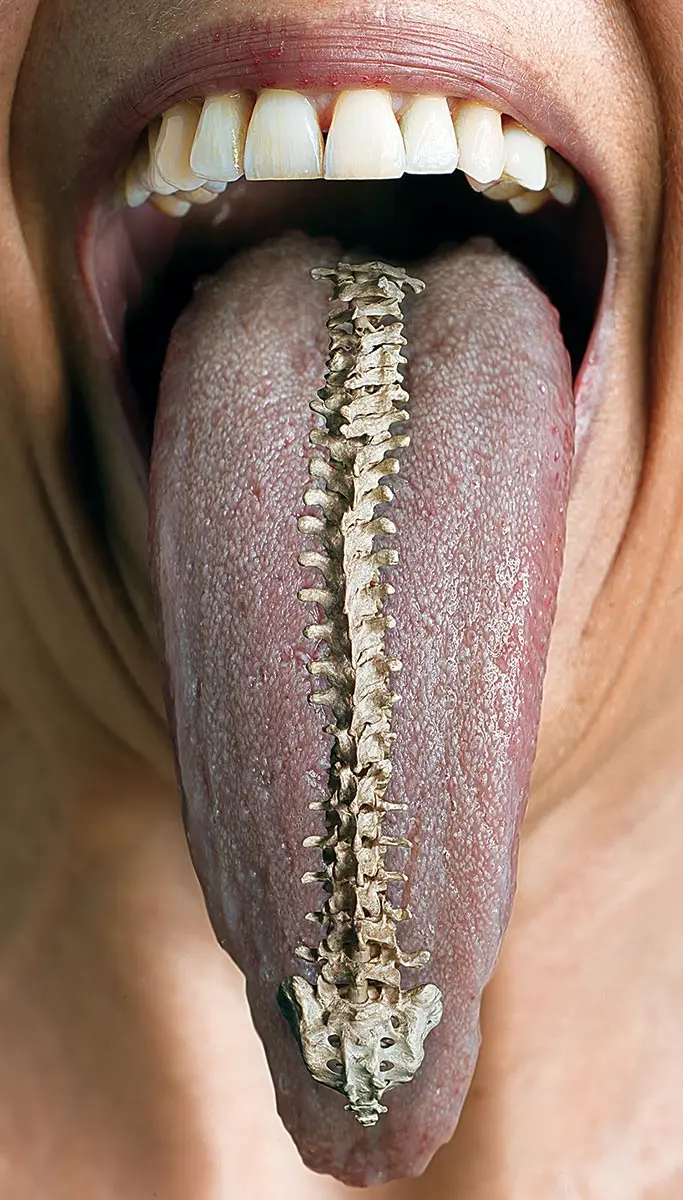
Already in the 1920s, Brazil saw the emergence of a concept that would become emblematic in its arts: antropofagia (anthropophagy). Launched in manifestoes (and, with regard to the literal, wild act of cannibalism, attested by more than one explorer), this slogan made it possible for poets and painters to position themselves in favor of a radical and obsessive appropriation of other cultures—in symbolic terms, of course. A dual quality appears, then: the modern (civilized), anthropophagically interpellated by its Other (uncivilized). This opened a conceptual parenthesis so vast that the issue has yet to exhaust itself even today, either for tourists or for intellectuals. In the photograph Lingua vertebral (Vertebral Tongue), Lenora de Barros refers to two organs, one in charge of digestion and speech—as demonstrated by the concept of the cannibalistic—and the other quintessentially structural (the spine), and superimposes them to indicate an aprioristic identity. Similarly, in her video-performance No país da língua grande, dai carne a quem quer carne (In the Country of the Large Tongue, Give Meat to Whoever Wants Meat), which uses the sound and a close up of her own tongue tasting, the bizarre act reaches all the way back to the historic manifesto by means of parody, when she cites “the country of the large boa”, a phrase taken from indigenous Amazonian knowledge. Closing this nucleus in the exhibition we encounter, among other works, Poema (Poem), from 1978, a photograph composed of sequences in which the artist uses her tongue to actuate the keys of a traditional typewriter. The images become a potential text, a tactile text, not only signaling towards the elements that connect her more recent works but also encompassing all the senses and weaving them in infinite synesthesias. Quick and direct identifications impose themselves, helped by the austerity of black and white photography.
As Barros has said in more than one occasion, her work must begin with the Joycean concept of the verbivocovisual, which establishes a parallel between three worlds, the verbal, the vocal, and the visual. Of course, putting this into practice was—with the exception of Barros—the exclusive domain of the Concrete poets Haroldo and Augusto de Campos, with whom her work was always in the dialog. One cannot obviate the fact that Lenora is the daughter of the photographer and designer Geraldo de Barros, one of the leading figures in the São Paulo Concrete movement. The continuity of those legacies, as well as the debate around Gestalt principles in the service of everyday reality, gains another element in the work of Lenora de Barros: the materiality of Concrete poetry.
The other large nucleus of this exhibition is the video-performance room, a black cube where a sequence of such works is on view. In the first one, we see the artist from different angles, breaking a human skeleton all the way through its spine (this is the work from which the exhibition takes its title.) In another one, Há mulheres (There Are Women), Barros’ face is hidden behind two needles knitting, as the artist recites a poem-construction based on the nouns woman, body, and idea and the verbs to be [there] and to think, which she weaves together using all kinds of prepositions, again in connection with a minimalist aesthetic and concern with femaleness. The roots of this poem are perhaps in “…Unas”, the column that Barros published in twenty-three editions of the newspaper Jornal da Tarde. Intervening in this space that she considers her ready-made resulted in free experiments where we not only find quotes by Yoko Ono, Cindy Sherman, and Lygia Clark but later see them unfold into multiple works, some of which are featured in the exhibition.
In broad terms, this exhibition comments on Barros’ leaps, from the frame by frame of photography to the ready-made in the 1990s and her experiences with anthropophagy. In her most recent video-performance, technology and action seem to swallow all previous periods. In the meantime, her proposals—particularly provocative for their interactivity with the audience—invoke these specific signs that today we can see gluing together her entire career.
XENIA BERGMAN