
Macaparana is the name of an artist from Pernambuco whose visual approach is guided by geometric order and who has been renovating his vocabulary since the 1980s, driven by a visual approach that energizes the constructivist current in Brazilian art. With an important presence in national and international exhibitions, the constructivist learning tendencies of his proposals contain historically articulated elements guided by a Latin American geometric personality that relies on the ruler and compass.
Macaparana’s creations recently found a new reaffirmation point in the exhibition titled Macaparana, organized by the Dan Galeria in São Paulo. Presented during the months of June and July of this year, the grand exhibition was composed of nearly fifty works on painted wood, mixed media on cardboard, stainless steel, pigments, and acrylic ink. The exhibition showcased the trajectory of his current production.
Creator of a vocabulary influenced by the compositional mark left by the geometric-conceptual awareness of Torres García, Alfredo Volpi, Willys de Castro, Hércules Barsotti, and Antonio Maluf, among other teachers and colleagues, Macaparana pursues an inventiveness that has fueled the uniqueness of creations for more than three decades.
The exhibition environments for his creations integrate a panorama constructed with memorable interventions in historic spaces consecrated to Brazilian art, including the Museu de Arte de Sao Paulo, the Museu de Arte Brasilera, the São Paulo Biennial, and the Pinacoteca do Estado de São Paulo, among others.
For this recent exhibition, Macaparana reaffirmed the time of maturity of the works, the structuration of geometric cut-outs, and the reasoning of a worker that establishes the basis for his understanding of matter through the mastery of continuous and silent practice.
The works exhibited explore geometric currents through calculated formal compositions that establish a silent and solemn dialogue with the constructivist-based neo-concrete legacy and render history with colors, and the cracks and cut-outs of the supports.
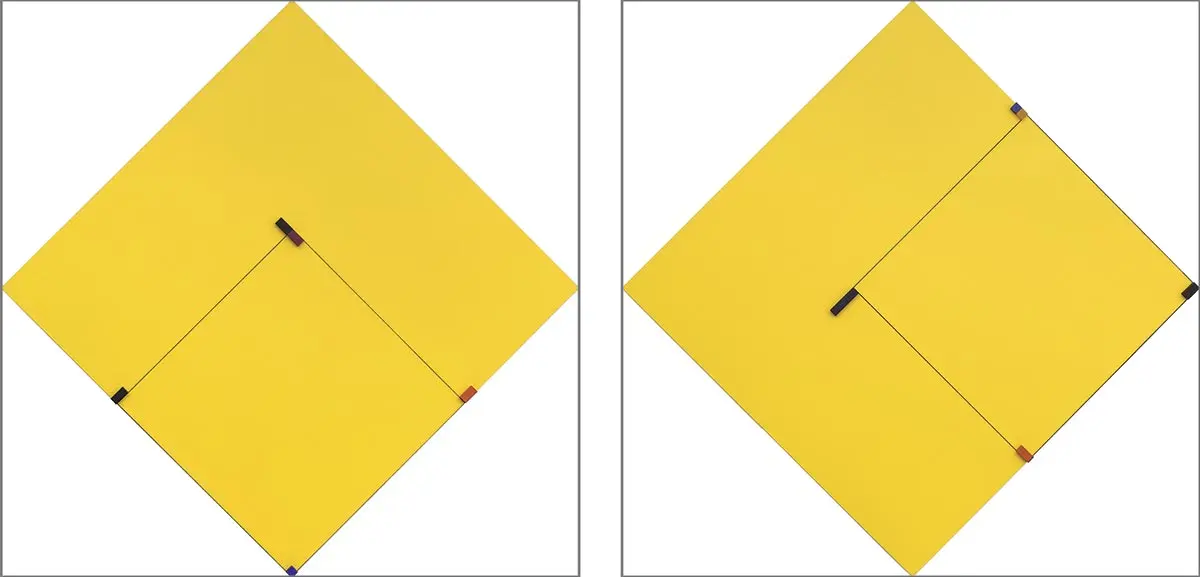
Among these creations, the diptych Sin Título (Untitled, 2014), a pigment and acrylic ink on a plaque, announced the role of the color yellow, which, emerging as a constructive element, acquired the consistency of matter through its chemical-physical attributes.
This yellow also contained thin black lines; regular and millimetric traces that rendered quadrangular areas in the two pieces. No breaks occurred at the angles of the physical demarcations of the plane, for those lines continue uninterrupted towards the back of the plaque that serves as support.
Another work that stood out in the exhibition was Sin Título (Untitled, 2012), a mixed media on cardboard piece consisting of almost continuous traces rendered on a black background and interrupted by circular geometric matrixes that structurally organize the empty pictorial field.
It is worth mentioning that the catalog that complements the exhibition (available online at the gallery’s homepage) offers a consistent chronology organized by Cuban historian Osbel Suárez for the presentation of Macaparana and his work to the public.
The online edition of the chronology—which must be understood as an educational tool for the exhibition—resulted from the extensive research by Suárez about Macaparana’s life and work. The author likens the creations of this artist to the work of a searcher of Latin American art. It is a document that results from thorough biographical based research and exposure to Macaparana’s work.
Also noteworthy was the launching of the book titled Macaparana concurrent with the exhibition. It includes texts by Ferreira Gullar and Theon Spanudis, along with an essay and chronology by Osbel Suárez. The edition centers on a body of work developed for over three decades through tireless research work.
Hard to miss as part of the artistic trajectory of this artist from Pernambuco, his first solo exhibition of 2011, presented at Galerie Denise René in Boulevard Saint-Germain, in Paris, already outlined a sophisticated recognition of his clear constructive inclinations. Another recent exhibition, in March of this year, at the same gallery, resumed this artist-gallery relationship and generated great interest.
Of Macaparana’s trajectory, we know a figuration that found its first public exhibitions in Recife, the capital of Pernambuco, where several cultural institutions welcomed and fostered the development of many artists. When he moved to Rio de Janeiro, and then to São Paulo—a common trajectory in Brazilian art—he discovered a circuit that would affirm his recounted geometry.
Currently, constructivist reasoning establishes new working fronts in the work of Macaparana, activating forms of articulation and hybridization between the three-dimensional and two-dimensional realms through asymmetrical compositions in which the line plays a central role throughout the entire process.
Given the recognition of the structural thinking involved in his creations—something that makes his work unique in Brazilian contemporary art—it is true that because of the reaffirmation of his insistent thesis on the visual and structural order of his formal compositions, on a personal geometry, Macaparana has with his particular style a clearly consistent place in Latin American geometry.
CLÁUDIA FAZZOLARI