
An important show opened in Bogotá featuring the work of two artists who decided to exhibit the art that emerged from their dialog, on the basis of their joint workshop Universidad Nacional de Colombia, where they both teach. The exhibition presents a shared effort in which these two artists decided to superimpose a series of concepts and forms, ranging from individual to collaborative work: drawing and sculpture give shape to a grand installation where the thought is at the core of creation.
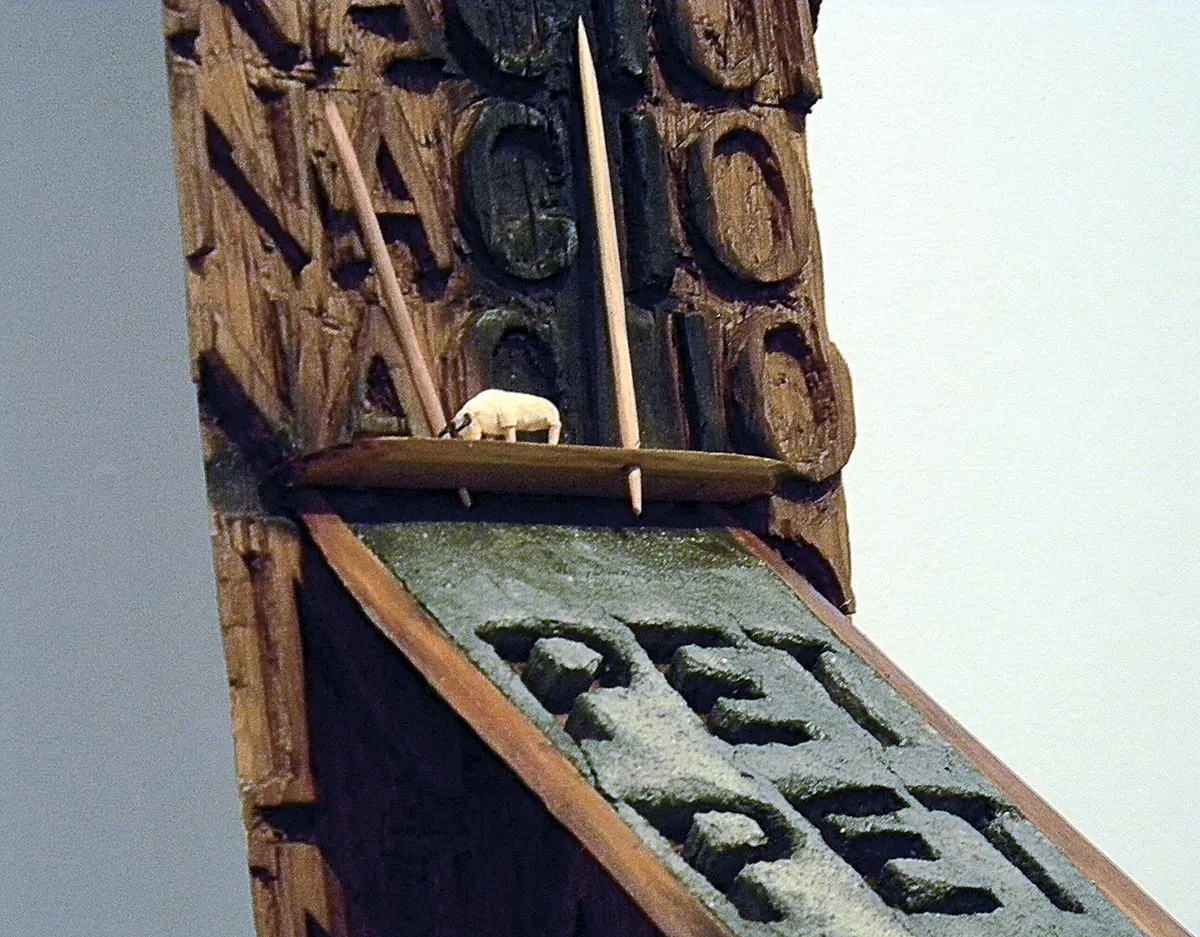
There are several commonalities between the two artists: one is the fact that both came into the expanded and installed sculpture scene in the 1990s with great force, exploring materials that were significant in themselves. While Mario Opazo has continued to exhibit uninterruptedly since then, achieving great international recognition, Ramón Uribe kept silent to the art world, in an almost Duchampian manner, while all the while continuing to work. And now he surprises us in this dialog, where both artists were able to bring into the terrain of representation and presentation what is best, in my judgment, about contemporary art—among so much bad, screen-screeching art (of the new-media kind, which is not so new anymore) and the unexpected turn towards ecological art, with so much shrubbery everywhere, work like this was needed in the local scene to again problematize the proper use of materials with conceptual significance and force.
As I was saying in the beginning, this exhibition must be connected with collaborative processes of creation and pedagogy. Ramón Uribe says: “We like to ‘build’ from a different perspective, in a pedagogical spirit; this experimentation allows us to incorporate innovative dynamics into the creation processes’ practices.” In that sense, the show is a work in permanent construction, which as a matter of fact is destroyed; this is the case of one of the works created by Opazo, which was taken apart at the end of the exhibition’s run. Works in the process where the final result is far from predetermined.
Wood, wax, cement, and marble create shapes where letters and signs form that particular language, difficult to grasp at first since it refers us to the idea that shapes are formed constantly. And yes, shapes are what is most relevant in this creative terrain: there is a formal interplay, not banal in the least, that enhances our aesthetic experience.
So, Opazo and Uribe exchanged materials that took new shapes on the basis of personal imagination, respecting what the other brought in. Every so often, each artist took with him the material proposed by the other, and in that way, they were able to exchange each moment of creation and contribute to a more complex one.
Space seems to have been composed like a melody, where the artwork, mostly in wood, created a trajectory in which we, the viewers, could not help but try to understand said melody. The result could not be better, especially in circumstances that ever more complex vis-à-vis the perception of the work of art. How can we see things differently? seems to be one of the questions emerging from this aesthetic experience. There is nothing more encouraging than encountering work produced by four hands and two heads, at a time when individuality seems to prevail in the space of contemporary creation.
What is left for us is to follow up on the results of this experience, which will be renewed in upcoming months in a new space, where the work will continue its course; the challenge is posited to see an exhibition that for now shifts, transforms itself, and continues with its evolution—or perhaps its involution—apace, without stopping. I believe, and I don’t think I am wrong, that this creative experience brings into question our models of production and exhibition, something closely connected with an idea already enunciated by Nicolas Bourriaud about postproduction, which impacts, as we said, the canonical models of visualization, exhibition, and, of course, circulation of the work of art. Incompleteness is a key characteristic of human existence is enshrined and exalted here, insisting on its being a virtue, not a flaw. There is something of the margin and the marginal in this poetic adventure, and, as Derrida reminds us, it is in the margin where the unsuspected, the unexpected, that which surprises us takes place. And therein resides, or should, the force of all works of art: in its capacity to surprise and move us; this case Translapo(e).
RICARDO ARCOS-PALMA