
The most striking thing when talking with Miguel Alvear (Quito, 1964) is his disbelief with respect to his status as a person habitually engaged in creative endeavors, an artist, susceptible of being picked apart or spotlighted by critics, institutions, or the media under this or that label. His personal notion of art dismantles the entire circuit—somewhat sinister, somewhat pompous—that many use to shock or seduce, oftentimes with asinine arguments. For Alvear, art-making is as simple as living. He summarizes it as solving problems, managing the production of projects that involve the “unadvised” viewer. This is why he sees himself as a cultural promoter, beyond any other classification.
Like any restless and precocious youth, in his adolescence Alvear developed an interest in the dramatic arts; he began to study film, radio, and TV at the Institut des Arts de Diffusion (IAD) in Belgium in 1987, although he never completed the program. In 1994 he registered for the Bachelor of Fine Arts program at the San Francisco Art Institute, in San Francisco, California. Between 1987 and 1996 he lived in the United States, making, as he tells it, all kinds of maneuvers and contortions to support himself as a student. In the late 1980s and early 1990s, Alvear worked in experimental film, installation, and cultural management. The latter work, an attempt to enhance the fragility of cultural policies in our respective contexts, acquires special relevance in Latin America, especially because of the bureaucratic oversaturation that undermines these spaces.
In the artist’s own words: “I began to generate management projects because surviving from my work as an ‘artist’ was impossible. I have never sold my work in an exhibition context, and since I have a background in film it was a natural transition to think in terms of ‘project’ rather than ‘individual work’. At the beginning, this caused me a bit of conflict. Some colleagues questioned that mode of operating. But then I understood that these projects were, or could be seen as, like an expanded part of my practice even if some of them focused outside of the artistic area. I am thinking for example of the Ecuador Bajo Tierra festival, which presents in theaters films by self-taught filmmakers, or the Cine hecho en casa project, which was a cycle of home-made movies in film format and family photographs. For many years, cultural institutions in Ecuador had very limited offerings, conservative and even mediocre. This has motivated many artists and groups to generate and manage their own platforms.”1

Alvear avoids poses and affectations. He deems the work of curators necessary “but it becomes bothersome when the curatorial activity becomes an end in itself, or when it insistently works for a narrow group of initiatives. I think we have a great debt with audiences that have lost interest in the arts because they see them as undecipherable and empty.”2
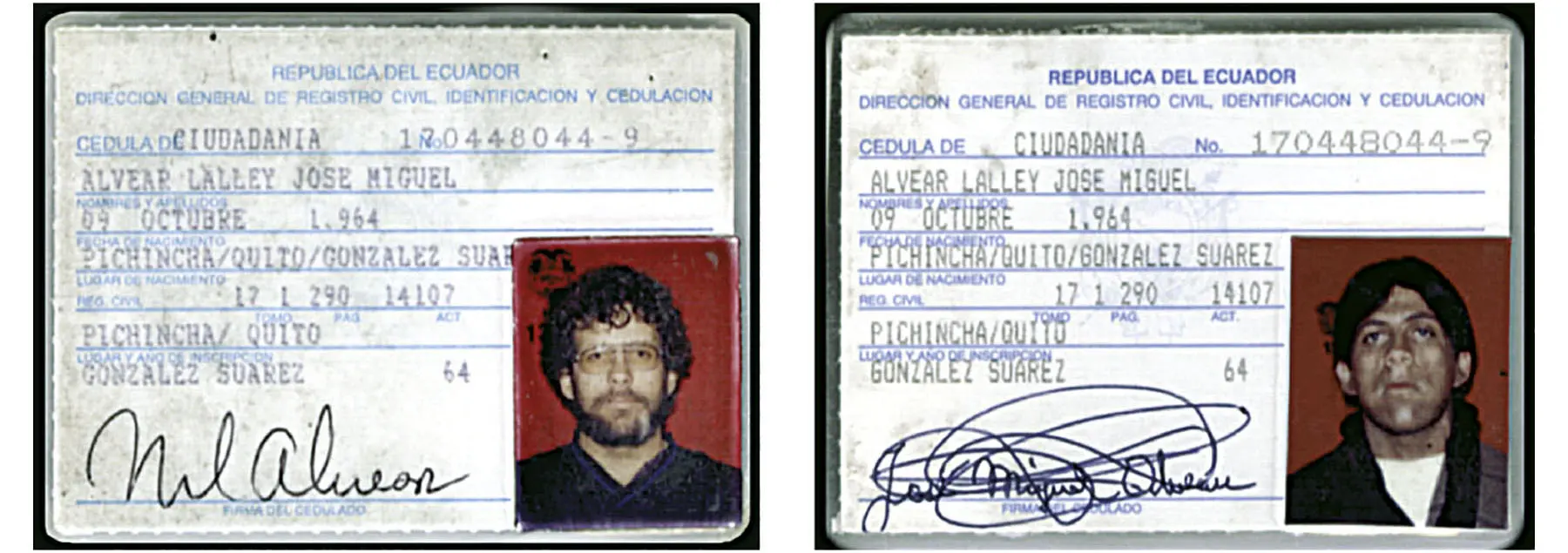
The bureaucratic apparatuses in these lands hide behind its apparently monolithic nature, notable fissures, which come to light in projects like what Alvear exhibited in the show A Dios dando y con mi retrato andando (Cuenca, 1997). Titled Señas Particulares, it attempted to breathe new air into the local photographic genre (rather slavishly attached to conventional shots) and at the same time to sabotage the country’s supposed stability, editing four I.D. cards where he appeared as a black woman, a bureaucrat, an Otavalo Indian, and a common man. The I.D.s were brought together into a proposal he named José Miguel Alvear Lalley. The photographs were taken by common functionaries in different offices of the national identification bureau. Only one, the black woman, had to be done through an intermediary because men cat-called or booed Alvear in the waiting line. The artist is still able to cash checks with the I.D.s of a mixed-race and a white male. His scheme destabilized the thin wall that separates “civilian security” from simulation, by questioning the arbitrary construction of identities not only in Ecuador but globally.

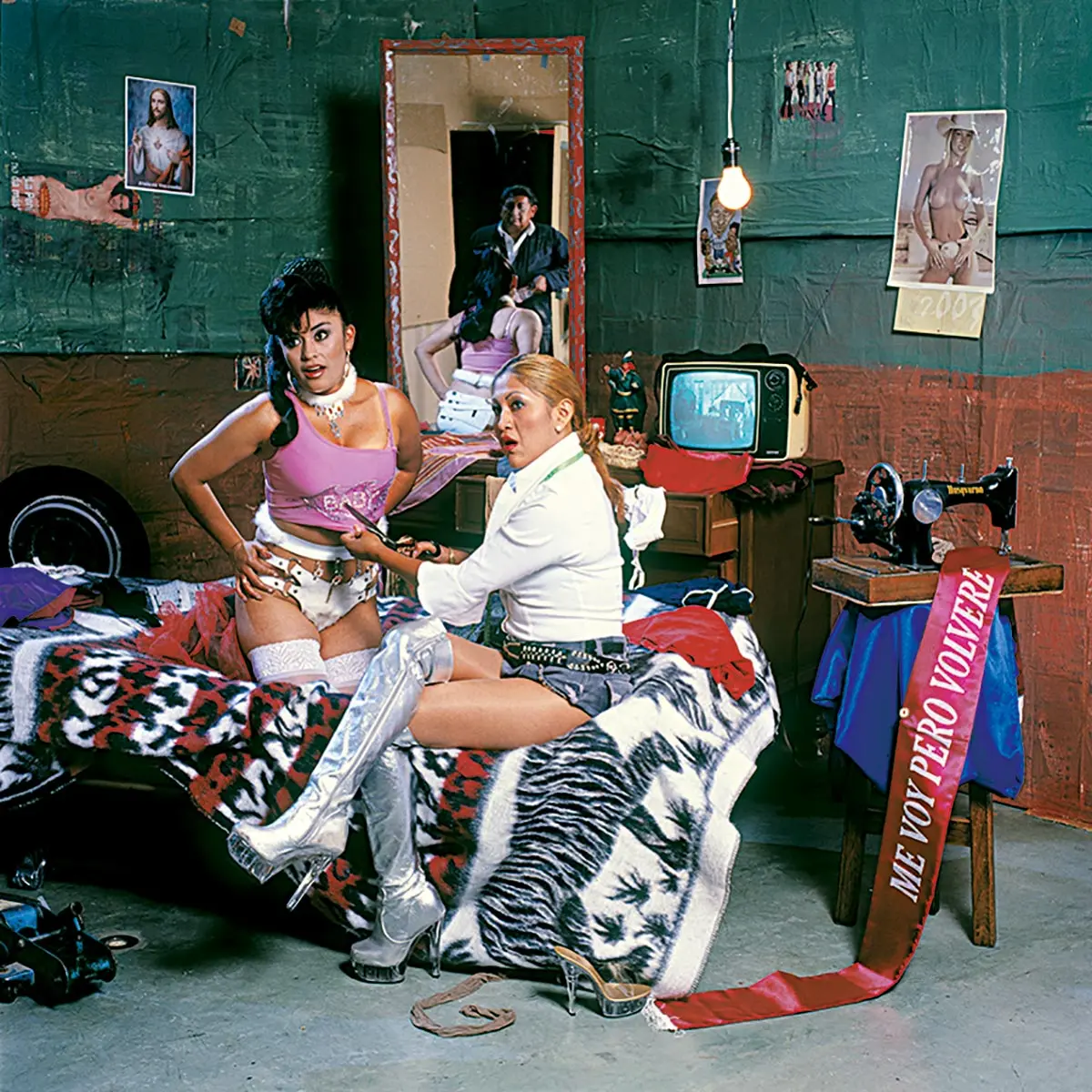
As long as curators and artists continue producing exhibitions as extensions of their alter-egos, we will not be spared the vicious, trite circle of art-curator-initiated audience. And this reflection comes through constantly in Alvear’s projects. He knows how to attract those audiences that so many others leave out of the game. Starting in 2003, Alvear began working in Mec-Pop, a clear gambit for the inclusion and visualization of a subject that in Ecuador is commonly referred to as the cholazo. Technocumbia is a popular genre in Ecuador. You hear it everywhere: buses, schools, cars, parties, as an inseparable element of popular culture. This legacy also involves a specific taste in clothes and accessories: flashy jewelry, hats, miniskirts, hair dyed blond, leggings, high heels, cowboy boots, motorcycles; all of this is in turn connected with a lifestyle that can be clearly identified in so-called “low” culture. Such style labels come hand in hand with a specific language, outlaw behaviors, promiscuous relationships, machismo, and an attention-seeking theatricality on the part of women who dance in bars or nightclubs, or who simply circulate in this system of stereotypes. The discourse is supported by suggestive texts included in the weaving of such stories (not as much narrative, but sensorial) because Alvear’s intention is to give these characters a place in the cultural sphere, propose that they are not as many masters of their own fate as they would wish (“your destiny is to follow me;” “I am leaving but I’ll be back;” “success is reached via a ladder of suffering;” “the driver’s child travels for free!”), and in many cases, the M.O. of “high culture” serves only to rob them of their dignity. What is Alvear’s gamble in these images projected over time and space, so high-voltage in their tone? In what direction is art looking today? After reviewing Alvear’s images, we realize how far we are from supposed closeness to a life of artistic practice, as proclaimed by so many voices.

In 2005, Alvear launched a proposal that gives continuity to the Señas Particulares project. He titled this new project Intercambio Cultural. It resulted from the artist’s time and research in Huaorani lands, in the eastern part of the country. It was included in the show Andén 16. Heterónimos: Lo otros de uno mismo, curated by Magaly Espinosa with the support of the Embassy of Spain’s Office of Cultural Affairs and shown in Havana and Pinar del Rio, Cuba, in 2006. The works in this project consisted of a series of photographic portraits where Alvear, an old Huaorani man, a worker employed by the Green Oil company, and a missionary who worked with Amazon-basin communities, exchange their clothes, bringing to the fore and at the same time questioning the supposedly peaceful, reciprocal, and equitable relationships involved in the euphemistically named process of exchange.
With their simple visual constructions, Alvear’s photographs infuse new meaning into this hackneyed topic, handling it through the same persuasion strategies used by all interventionists in order to convince us of something. In his statement for this work, Alvear reiterates that impoverished migrants from other areas of Ecuador, as well as large-scale, multinational oil and mining concerns, are still bent on occupying territories in the Amazonian region. To this, we must add the complex, violent processes of adaptation undergone by these communities under the aegis of Christianizing missions during the Colonial era, punctuated by account-settling on both parts and by the spread of fatal illnesses brought by European invaders. In Alvear’s words: “The Orient (as this region is known here) is a melting pot in the margins, where intermixing and super-fast ecological shifts are underway, and where cultural, economic, and territorial disputes take place in the vacuum of the State’s intransigence and disinterest, a kind of Amazonian ‘Wild East’.”3

The concept of the non-place is also on the agenda for the Quito-born artist, as part of his consideration of the ongoing process of encounters and misencounters that give shape to memory and to the present in multiethnic, multicultural Ecuador. Hoy encontré un lugar is comprised of six sets of images about the Arab presence in the Andean nation. The proposal is resolved through portraiture, with eleven color photographs of people of Lebanese and Syrian descent settled in Guayaquil. The portraits were produced in collaboration with several Ecuadorean photographers. In them, Alvear presents us with a universe marked by uprootedness, the rearrangement of identities, interactions aligned to the norms and values of the new situation, and the humorous element introduced by altering some Islamic prescriptions, as in Guerra y Paz or Un inmenso jardín, where the photograph’s final result reminds us of a bazaar of the kind that could be found anywhere. In the latter case, Alvear is commenting on the expansionist drive that undergirds Lebanese culture and its ancient Phoenician substratum, expressed in aggressive sales and marketing, commerce, and import/export practices that have permeated the Ecuadorean market.

Any visitor to Ecuador who moves in the art world will soon encounter Blak Mama,4 a film where Alvear and Patricio Andrade (a dancer, choreographer, and dance teacher) propose a hallucinatory essay—the pretext is the feast of the Mama Negra in the Andean city of Latacunga, province of Cotopaxi—that deconstructs the winding paths and interstices of Ecuador’s nationality and mentality, both marked by cultural hybridization. The magnitude and importance of the celebration exceed the boundaries of local intermixing and extends over Latin America as a whole; the authors take advantage of that common denominator to undermine from within the Baroque-like, simulation-based, anachronistic content of our social realities. On the basis of a language that references Surrealism, Dada, action-art, performance art, like an oversaturated and chaotic universe that is obligated to contain us all, the film underscores psychological, political, sexual, transgendered conceptualizations. Blak Mama becomes the apotheosis of play in order to invite us to lucidity. It uses cross-dressing as a metaphor for the double moral standard; here, all recognize each other and all re-enunciate themselves. An inclusive poetics to exorcize falsity. A kind of “spiritual cleansing.”
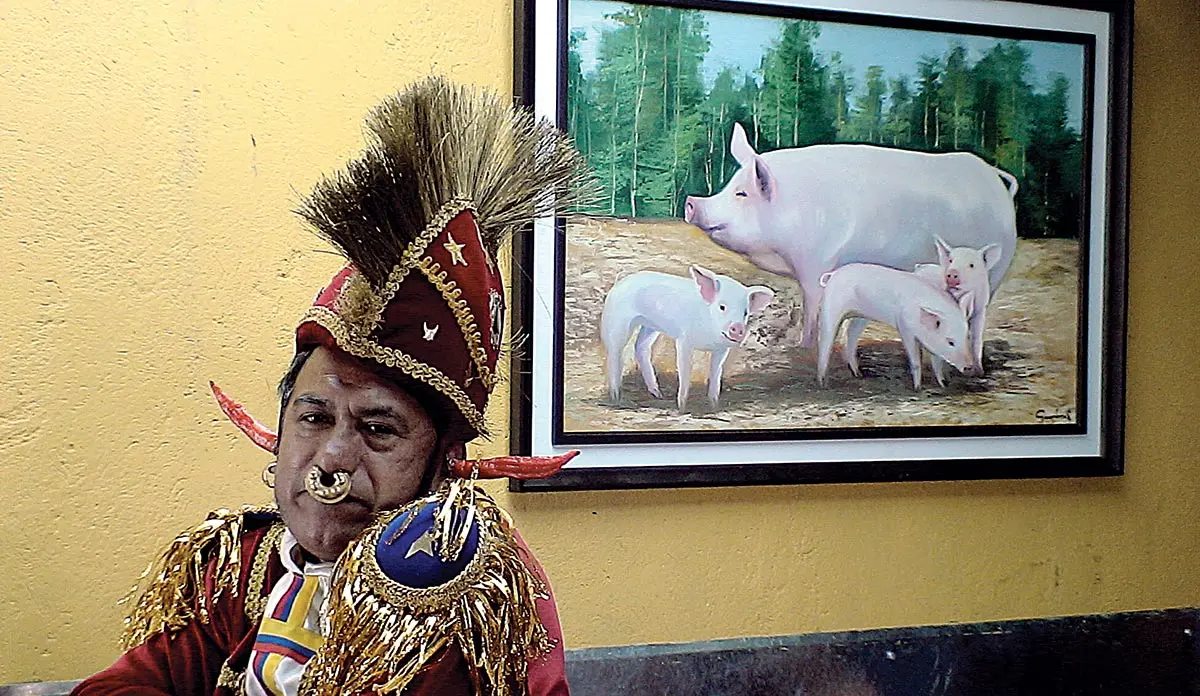
The erotic aspect of the story is associated with a hedonistic post-modern ethos that prevents us from acting rationally, leaving to chance crucial decisions connected to liberty, human rights, life projects, the struggle for civil rights, the anti-war struggle, to mention but a few issues significant for self-determination and personal growth. Blak Mama harks back to Gilles Lipovetsky’s ideas and his concept of hypermodernity. Humor, permissiveness, hedonism, hyperindividualism—such are some of the symptoms of a world culture that absorbs all that is antithetical and enthrones the psi and the zombie, as Lipovetsky would say. The characters in Blak Mama behave in just that way. The film constantly alludes to the impact on our lives of a sensibility derived from media technologies, as these produce a new kind of experience for individuals: the aestheticization of life and the fragmentation of the subject. A text is repeated throughout the film: Vos mismo eres (“you yourself are”). Lipovetsky would translate this as an ego that has become an “imprecise set.”5 The film refers us to a fragmented, residual mentality that chooses playfulness in order to survive, and which, in its implementation, sacrifices even the most sacred creeds. As the French philosopher notes when speaking to the success of Woody Allen’s films, “they are the very symbol of such a hyper-inversion of private space.” As Allen himself says, “political solutions don’t work,” a formula connected to the new spirit of the times and their desertion towards the political.6 The evolution of this culture, which so augments psychological factors, is verified by Blak Mama through the over characterization, erotic-grotesque-playful in nature, of its characters.
This opera prima by Miguel Alvear and Patricio Andrade irreverently mixes dance, theater, music, black humor, and musical cinema, and it possesses a raucous symbolic charge. It invites the many to recognize themselves in a psi discourse that becomes “the new mass ethos.”7
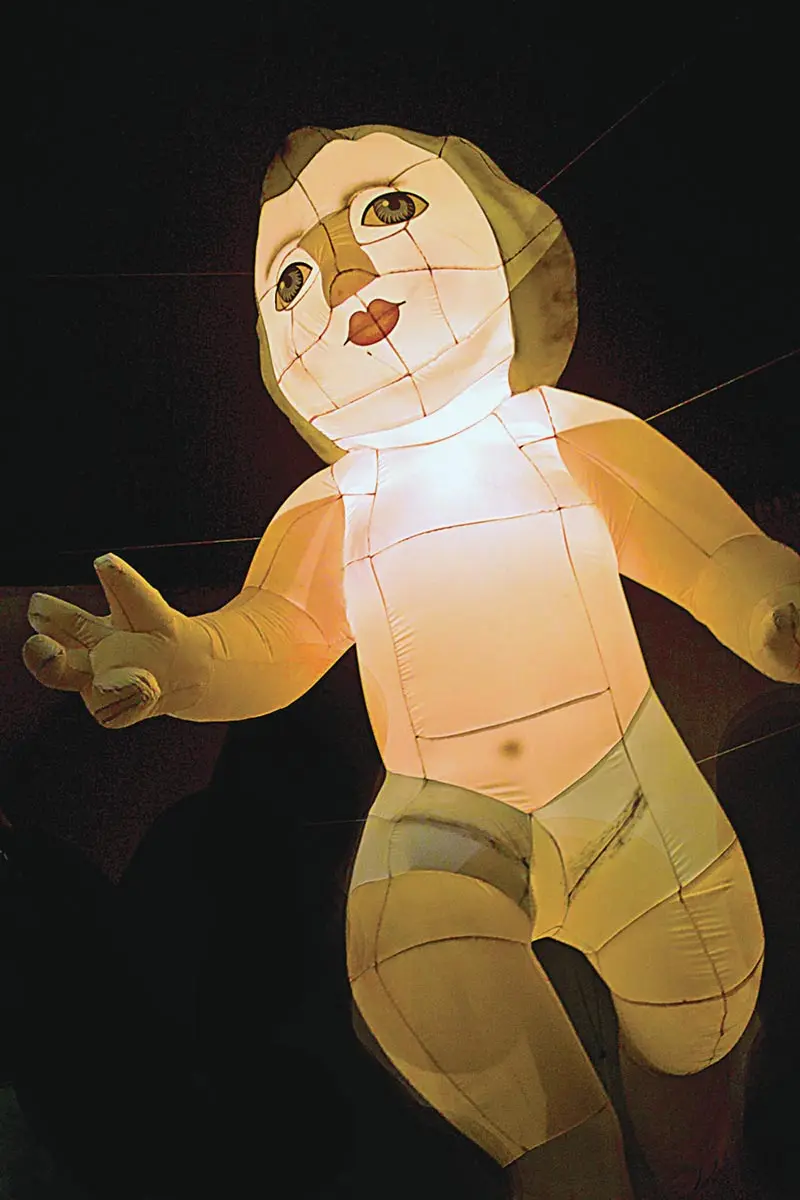
Alvear’s agenda is wide-ranging and committed. El patio de los pecadores, developed in direct dialog with the artisans who rent space in the eponymous location, is not only one of the standouts of Arte en Patios de Quito, a 2010 project, but also a forceful configuration of those voices that are rendered invisible in usual cultural policies. The re-enunciation of the imaginary, the realm in which these individuals eke out their living, a sense of belonging and of complicity with art that opens up to embrace them, becomes a metaphor for the divine image of the Baby Jesus used by Alvear as a pincushion.
Through interviews and conversations with these individuals, Alvear familiarized himself with the inner workings of their trade, displaced and devalued in tourism-centered urban-renewal programs that, against the grain of the best contemporary understanding of how a historic downtown should function, have forced them into a ghost-like, unprotected condition, favoring instead the transit of foreigners—probably, moreover, of the “Coca-Cola for two” kind.
Alvear gives them back their breath, at least for a time, by making them the protagonists of his megalomaniac inflatable Baby Jesus, a kind of epiphany that merely replaces the supposedly unconditional allegiance of a social stratum to its religious and cultural legacy with a seemingly acquiescent mechanism that in reality is loudly proclaiming its anguish. The work, lighted from the inside and with a motor hidden in the back to keep it erect, was suspended over the front patio. On opening day, a priest blessed the image of the Baby Jesus and placed the corresponding potencies around it. Alvear named the local tenants as godparents, securing their commitment to passing that status on to others in a year. According to tradition, if he is not celebrated as is his due, the Baby Jesus may punish the godparents. Reproduced ad infinitum and associated with Christmas celebrations, this image is widely venerated in Ecuador. Despite the image of power, it embodies with its slogan “I Shall Reign,” the image retains the vulnerability of a baby receptive to adoration but unable to perform miracles or exercise command.
That same year, Alvear plunged into the production of Más allá del mal, a polemical TV essay about the oversaturation of the DVD market with informal, pirated movies, to the detriment of the distribution and sale of “professional” productions, influenced by French or Argentinean auteur cinema.
In 2012, Alvear began to prepare an adaptation of the classic A Streetcar Named Desire in collaboration with the self-taught producer Nelson Palacios Cabrera (and a working team formed by Palacios Cabrera’s two daughters). Trici-taxi Deseo, as this project is titled, will be supervised collaboratively by the two producers, a new experience for both. As of 2013, the project remained unfinished due to lack of financing, but interest on the part of Alvear and Palacios Cabrera has not waned.
What we expect from Alvear is what the text for Blak Mama states: “it scares me, but I like it.” We want him to continue to astonish us, the first condition for the ancient art of philosophizing. He tells me about intervention on TV, on a talk show, with a character named Malva Malavar. He honors the phrase “art never sleeps.” In fact, the feature film mentioned above has just been included in the recent Venice Biennale, a step forward in the international visibilization of Ecuadorean art.
NOTES
1. Interview with the author, Guayaquil, May 16th, 2011
2. Interview with the author, Guayaquil, May 16th, 2011
3. Statement for the project Intercambio Cultural.
4. Before producing Blak Mama, Alvear had produced several short films that were seen at Anthology Film Archives, New York; the San Francisco Cinematheque; the Berkeley Independent Video Festival; the Festival de Cine Latinoamericano, Washington, D.C.
5. Lipovetsky, G. L’Ere du vide: Essais sur l’individualisme contemporain. Quotations from Spanish edition, La era del vacío. Editorial Anagrama, Barcelona: 1986, p. 56. The French author refers to the loss of unity by a narcissistic ego due to an excess of attention; its identity hollowed out, it suffers a desubstantialization. Lipovetsky writes that in our era, Narcissus is no longer immobile before his fixed image: there is no image anymore.
6. Ibid., p. 51. Lipovetsky explains that neonarcissism is born from the desertion of the political. It is the end of homo politicus and the emergence of homo psicologicus, seeking nothing but its own being and welfare.
7. According to Lipovetsky, the fracturing of the subject produces a “collective Narcissus” who carries, as Nietzsche also pointed out, a “weak will.”
AMALINA BOMNIN
Curator and critic.