
In 1977, Puerto Rican artist Papo Colo performed Superman 51, a feat of physical endurance that had him running along Manhattan’s West Side Highway, bordering the Hudson River, until collapsing from exhaustion. Tethered to his body with ropes were fifty-one pieces of wood representing the fifty US states and Puerto Rico, which was debating in a plebiscite whether to become the 51st state of the Union. Indeed, in Puerto Rican political lingo, the number 51 represented the country’s final incorporation to the US, known in Spanish as estadidad (statehood.) It is also the minimum number required for a majority, half plus one, in a democratic decision. The pieces of wood were painted in white, blue, and red, the colors of both the US and Puerto Rican flags, and each was engraved with the name of a state. In his performance, recorded in 16mm film, Colo ran, dragging the enormous ballast behind him, until passing out.
This performance remains the Puerto Rican artist’s best-known work, and his solo exhibition at MoMA P.S.1, curated by Klaus Biesenbach, centers around it. Focusing exclusively on a selection of performances from the 1970s, and the curator’s approach denotes a degree of conservatism that contrasts with Colo’s art and with the museum’s mission. Already widely hailed by renowned experts in the field, such as Deborah Cullen, these works were a safe wager. Relegated to the margins are several extensive and varied bodies of work, which include experimentations in painting, drawing, installation, and performance, as well as Colo’s decades-long creative efforts as director of Exit Art, a well-respected alternative space in New York City. There, Colo developed collaborations with artists, dancers, and actors under the title of Trickster Theater.
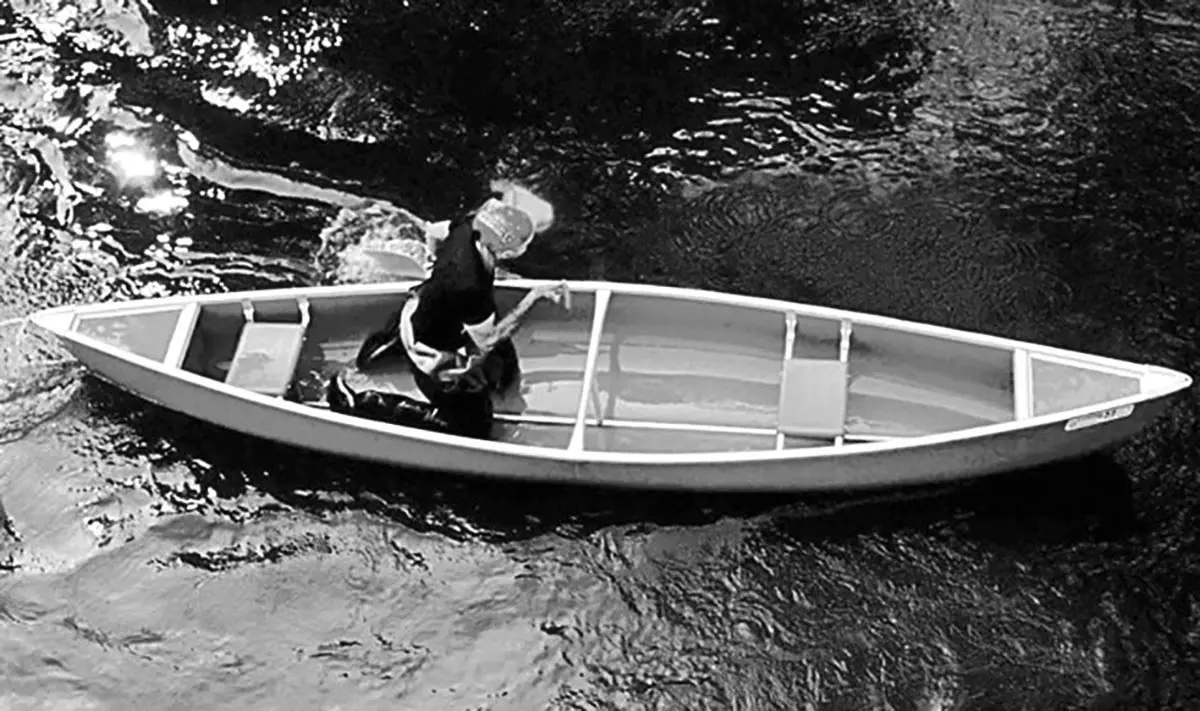
The Superman 51 documentary footage was followed by other performances, compiled by the artist himself. In one of them, Colo paddled a canoe upstream on the Bronx River. In another, he walked around the city carrying some white wooden structures, which he used to create ephemeral sculptures. The exhibition also included photographic prints depicting some of his actions.
In La pelea (The Fight), two individuals wielded and forcefully knocked together wooden baseball bats, as though in a fencing match. After several clashes, one of the bats broke. The winner of the fight—who, incidentally, was Colo—jumped euphorically with his intact bat after a victory perhaps meaningless, but invigorating without a doubt. Baseball, imported from the US after the colonial occupation in 1898, is Puerto Rico’s most popular sport. Many Puerto Ricans have played professionally in the MLB, including several legendary New York Yankees figures. It is in fact in the field of sports that Puerto Ricans have been able to exact revenge on their dominators.
Papo Colo belongs to a group of Puerto Rican artists who sought to take distance from certain nativist positions of the 1950s generation, without abandoning nationalism. Instead of restricting himself to traditional expressions like painting and printmaking, he found in performance an instrument of symbolic political action that had a short history as was not necessarily incorporated into the canon. From the themes and materials to their presentation, every gesture by the artist meant a conscientious positioning with respect to his current situation. For example, his real name is Francisco Colón, but in a decolonizing gesture he decided to erase the final n in order not to repeat the name of the annihilator of indigenous peoples, Cristobal Colón (Christopher Columbus’ Spanish name.) Similarly, his use of wood (planks, paddles and canoes, structures, and bats) makes reference to Puerto Rico’s tropical forests, where Colo is developing his latest project.
After Exit Art closed its doors in 2012, Colo went back to natural spaces as the setting and subject of his work. He developed a residence in the federal forest preserve of El Yunque, in his native Puerto Rico. This made it possible for him to combine his current concerns in a single battlefield. Ecology has provided him with safe passage into this area protected by the US government, and as such expropriated from Puerto Ricans, so that local and international artists can access it via his work. It is a symbolic recuperation of territory commandeered by the United States.
Finally, as part of this exhibition, Colo presented a series of performances in the Manhattan neighborhood of Chelsea, where he obsessively cleaned a section of sidewalk at a specified date and time. In this way, the artist revealed his interest in reorienting the role of the artist towards micropolitical actions that allow individuals to promote effective changes in the socio-cultural and economic situation of their era.
ELVIS FUENTES