
In Paulina Silva Hauyon’s work, the role of literature, autobiographical references, and the tension between amateurism and professionalism are all especially important. On this occasion, the artist’s second solo exhibition at Die Ecke, the private realm becomes public through the free recreation of a room.
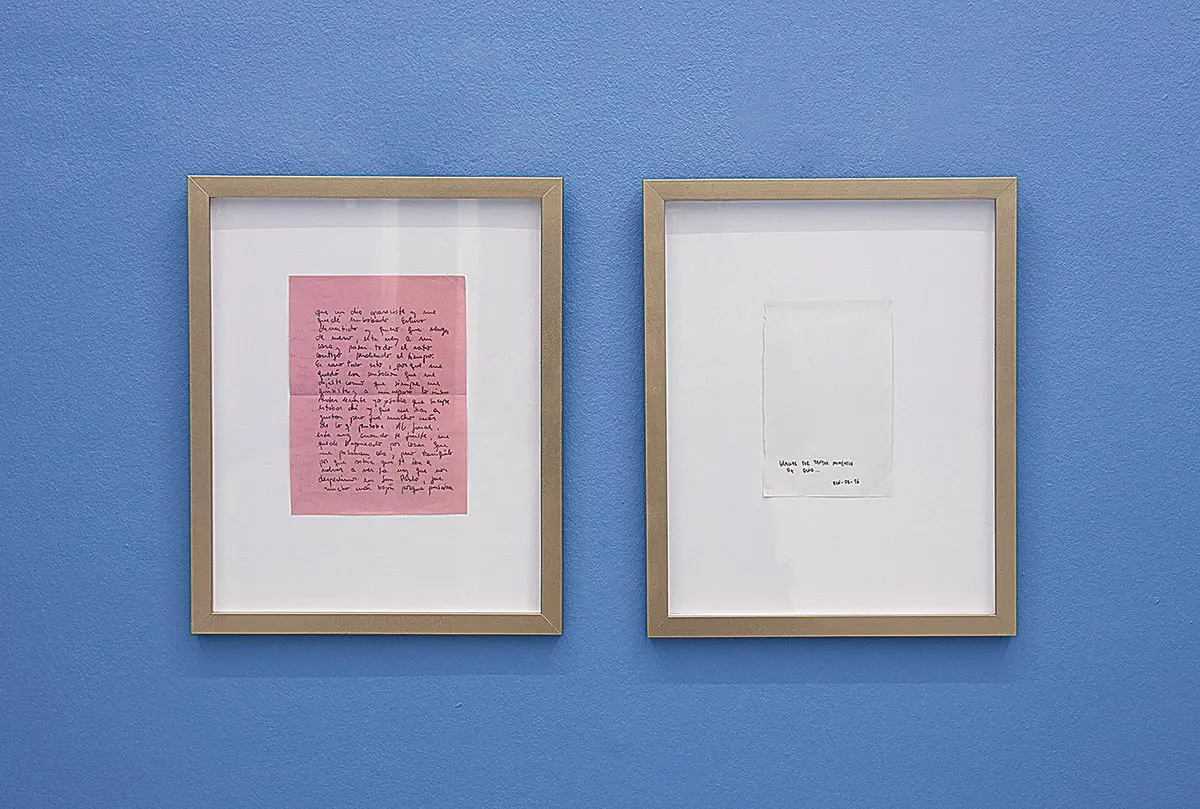
The gallery’s exhibition area has been painted blue, and the works on exhibit—small-format paintings, most of them in black—are arranged at different heights on the walls. Silva presents her art as a unit, taking the exhibition’s design into account as one more element with which to work. Analyzing the items individually—the paintings’ finishes vary, and some (a group of landscapes) are qualitatively different—we conclude that the arrangement combines works by Silva with works by others, or with art she created as a child.
None of this is clarified in the curatorial essay, which talks about references to the work of Karen Kilimnik, an American painter of celebrity portraits in a naïf style. If we attempt to enter the personal space that Silva Hauyon has generated from just a handful of elements, we might not be able to empathize with her proposal. Ultimately, the scene we are visually confronted with—a room adequate for those small-format paintings, combined with works where the color black is dominant—is unable to generate stimulating dialogs.
With regards to the paintings, mostly black in color, we can cite as a precedent the group exhibition Ocupaciones raras (Strange Occupations), curated by Teresa Riccardi in 2014 for Gabriela Mistral Gallery. It already advanced the creation of a black landscape where, thanks to the room’s lighting, scintillations and glimmers revealed the vegetation’s details and gave shape to an interesting way of “perverting” the genre. Texture became the protagonist. The three-dimensionality of the layers of paint took precedence over a clearer or more traditional vision of nature painting. This line of work—more “plastic” and distant from literary pretensions or from difficult-to-access introspective quests—could have been a satisfying exploration. But in El color de mi última habitación (The Color of My Last Room), the color black seems to have been applied to the meaning of the entire set, to the work’s final aspiration, which is left suspended—not necessarily in suspense.
Silva’s intervention on the gallery wall, dividing it with a blue horizon, brings together the various works into space, generating a unified visual trajectory that, not being bound (at least not in any immediately apparent way) to the paintings that comprise the exhibition, is relegated as an exercise in adaptation. A welcome initiative, even though the absence of clues and of coherence between works ultimately achieves is the viewer’s maladaptation.
The introduction of “the written,” of narrative, in a visual exhibition or a display of an artist’s private inner world, is a complex action that must be solidly assembled in order to offer a handle for the viewer, who is a stranger. Included in the room are two framed texts, private in character and difficult to decode. Those unfamiliar with the show’s intra-history will be left at the mercy of the visual experience of the set—something that could indeed be pleasurable in a private room, but in an art exhibition one must take the connection with the viewer into account.
JUAN JOSÉ SANTOS