
In 1998, Roberto Bolaño famously said, “Lemebel does not have to write poetry to be the best poet of my generation.” But in addition to being a chronicler that challenged the fundamentalism of the market, the hegemonic systems of globalization, and the patriarchalism of Chilean society, Pedro Lemebel (Santiago, 1952) was a visual artist who, since after the dictatorship and until his death in 2015, resignified art in the public space through provocative performances and used his books—as their covers clearly demonstrate—as vehicles to disseminate his visual work.
In 2014, three years after being diagnosed with cancer of the larynx and having almost completely lost his voice, Lemebel began to organize a retrospective exhibition of his work in collaboration with gallerist Pedro Montes and poet, bookseller, and gallerist, Sergio Parra. Titled Burn, the exhibition included photographs, videos—many of which were shown to the public for the first time—and two new performances from 2014. First presented at the galleries D21 Proyectos de Arte and Metales Pesados Visual, and at the Museo de la Memoria y Los Derechos Humanos, the exhibition was also presented during the month of June at the Casa del Arte Diego Rivera.
Located in Puerto Montt, a coastal city in the south of Chile, the Casa del Arte Diego Rivera was built over the ashes of the cultural institution destroyed by the 1960 earthquake in Valdivia. Like it had already occurred in 1939—when, after the earthquake in Chillán the Mexican government donated a school whose walls were painted by Siqueiros—this center was financed by Mexico after an earthquake, the biggest in history so far. It is meaningful to consider this genealogy and the Mexican artist to whom this building is dedicated in connection to Burn, where boundaries and the feminine are alluded to through references to, for instance, Frida Kahlo.
Well-known are the performances by Lemebel and Francisco Casas as part of the group Las Yeguas del Apocalipsis. Perhaps their most famous one was the 1989 photograph/performance that references Kahlo’s painting Las Dos Fridas (The Two Fridas, 1939) through the body of two homosexuals whose poses celebrated the proud and defiant version of Frida rather than the suffering one. But Lemebel’s fascination with Frida did not end there. Upon entering the gallery, viewers encounter to their left the pieces Frida I and Frida II (1990), two black and white portraits reproduced separately in two editions of the fifth book of chronicles by Lemebel titled Adiós Mariquita Linda (Goodbye Lovely Fairy, 2004).
First, with his face looking straight at the camera and then slightly inclined, Lemebel poses for Pedro Marinello’s camera to formally imitate a photograph about identity. Dressed like Frida, wearing an iconography in which the excess of downy hairs and eyebrows (now turned into an eagle) meant anti-establishment politics and androgynous expressions of womanhood in post-revolutionary Mexico, Lemebel not only refers once again to Kahlo’s pride as means of political appropriation, but also—and underscored by the venue where Burn is exhibited—to those that “acted as agents of the Revolution by assuming a patriarchal preoccupation for [their] subjects: indigenous peasants, the working class, and women.” In this sense, it is interesting to consider how Lemebel transports Frida’s iconography to a different cultural context—that of Chile during the transition to democracy, when AIDS was already an epidemic and globalization had proved to be a successful agent of neoliberalism—that made viewers reflect on the local patriarchal forms in the public space.
Consisting of video and a photographic series, the performance titled Abecedario (Alphabet, 2014) can be approached from a similar perspective. By writing the Spanish alphabet with dancing letters on the walkway of Avenida Panamericana, Lemebel references the popular slogans written on walls but in connection to femininity and the dignity of poor and working women, alluding to the manner and language taught to him by his mother, Violeta, who is buried in the Cementerio Metropolitano located in front of the walkway.
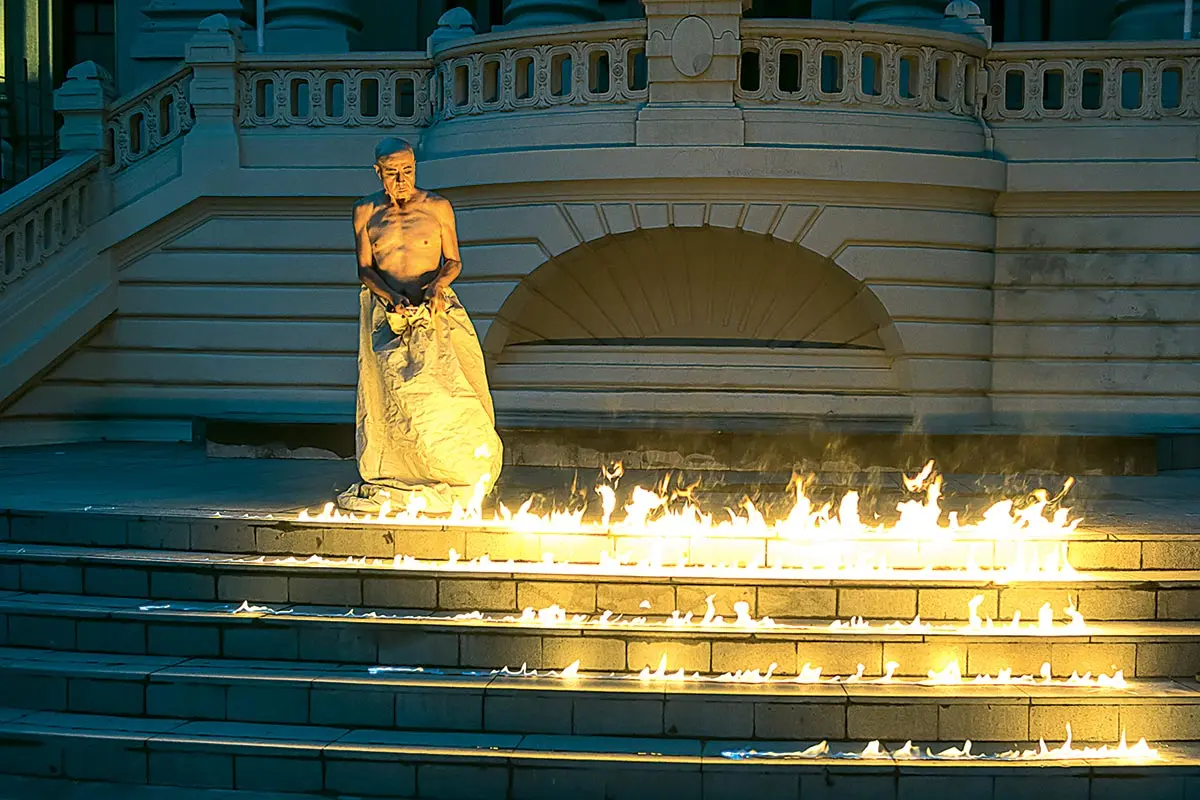
Dressed in black and high heels, Lemebel burned each letter with neoprene, the drug of the poor, pointing to a historic scar that unlike the progressivist program of neoliberalism refuses to forget. Yes, fire is indeed the connecting thread of Lemebel’s visual work, and the curatorship of the exhibition lucidly insists on this. In memory of the victims of the dictatorship—like Sebastián Acevedo, who decided to end his life in Concepción after the disappearance of his children—since 1980, Lemebel exposed his body to fire as a solitary and collective gesture that rejects a present without memory, as demonstrated by his performance titled Desnudo Bajando la Escalera (Going Down the Stairs in the Nude, 2014), which in turn references action from 1989 at the Ochagavía Hospital.
Opening new discursive possibilities surrounding Pedro Lemebel’s visual work, like the use of books as vehicles for dissemination and exhibition, Burn is a very successful first attempt at conceptualizing, historicizing, and promoting the visual work of an artist whose work represents a central referent to understand Chilean art from the perspective of gender, class, race, and disease during the period between the end of the dictatorship and today.
NOTE
1. Adriana Zavala, Becoming Modern, Becoming Tradition: Women, Gender and Representation in Mexican Art (Pennsylvania State University Press, 2010), 7.
FLORENCIA SAN MARTÍN