
After more than twenty years of producing a conceptually rigorous, formally deliberate body of work, Sandra Gamarra has established herself as one of the most important Peruvian artists of the era.
A retrospective look at her oeuvre reveals a common logic threading together different themes and media (painting, installation, video), its main concerns already outlined in the artist’s earliest work. Gamarra’s painting of the 1990s and early 2000s repeatedly depicts objects of the same class distributed in a methodical and regular way, as if following Donald Judd’s famous definition of order: “one thing after another.”
The objects portrayed are often personal, accounting for a domestic universe: shoes (En donde estén [Wherever They Are], 2000; De descanso [At Rest], 2001; De descanso II [At Rest II], 2001); undergarments (La colección: trusas [The Collection: Panties], 2000); family photos (Sin título II [Untitled II], 2000), records (Viniles [Vinyls], 2001); toys (La colección: juguetes [The Collection: Toys], 2000); notebooks (La colección: cuadernos [The Collection: Notebooks], 2000); bed sheets (Sábanas II [Bed Sheets II], 2001); cups (La colección: tazas [The Collection: Cups], 2000); magazines (Entre ellos II [Among Them II], 1999; Entre ellos VII [Among Them VII], 2003). These images, however, do not correspond to a homebound scene as much as to the idea or order materialized and reproduced in private situations.
All of this comes through in the organization of the pictorial space, which centers on storage structures used in the home. In Sábanas II (2001), for example, we see part of the inside of a closet with dozens of folded bed sheets on its shelves, but the context of the image is omitted: Is it a house? A hotel? A store?
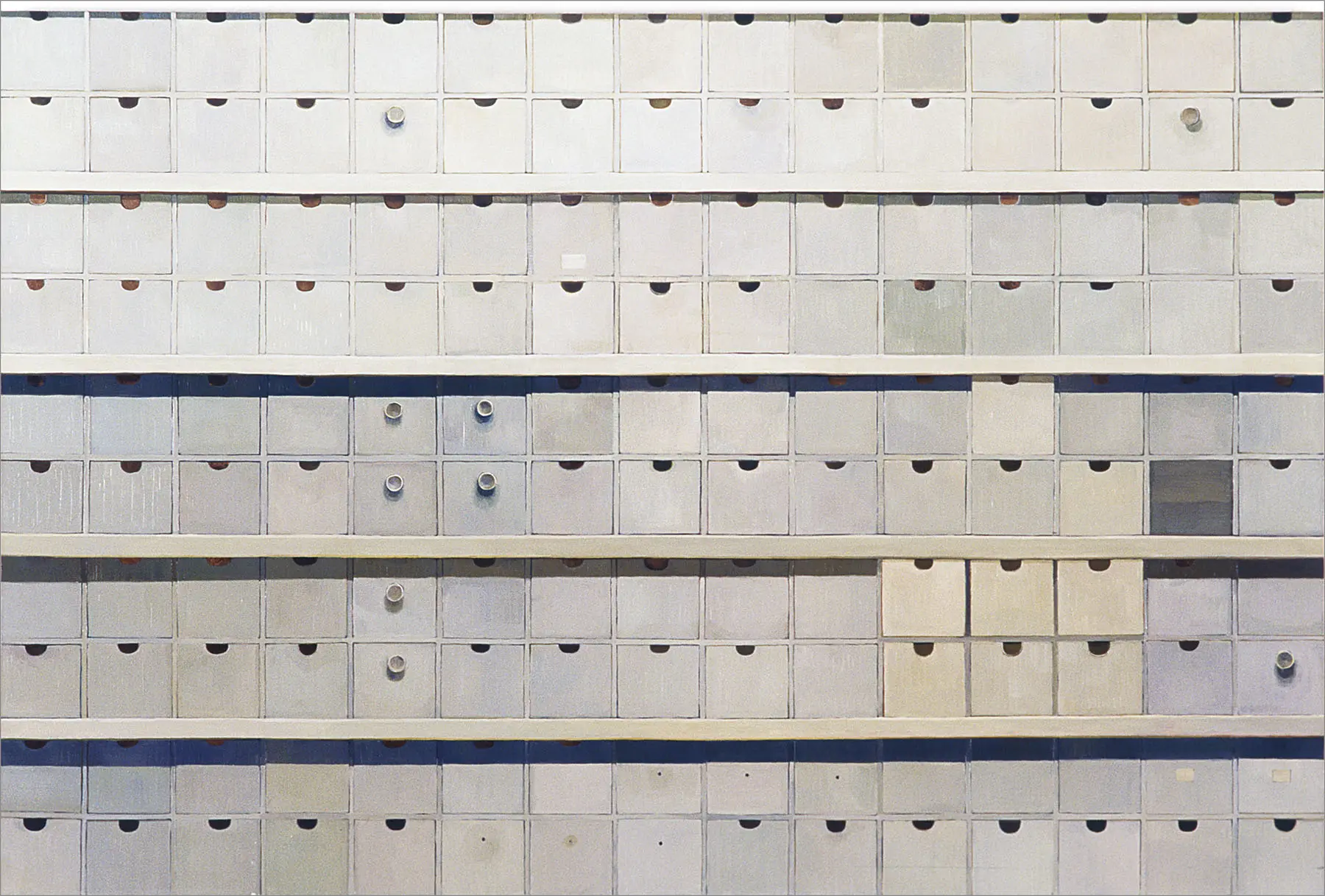
In Casi de memoria (Almost From Memory, 1999), Gamarra again circumscribes her pictorial space to a shelf, presenting us with a grid-like set of drawers and emphasizing their repetitiveness by means of subtle differences in shape and color. With this framing, the artist turns the piece of furniture used as her model into a guideline for the composition of the image. This is to say, the painting’s compositional structure converges with the organizational structure it depicts, as though it were governed by it. At the same time, the upper edge of the canvas begins with a shelf (on which more drawers could be set) and the lower edge ends with a row of drawers (which would have to be set on another shelf.) The structure seems to continue outside the frame, like an order that extends to encompass everything.
Something similar occurs in Cajas I (Boxes I, 1998). A series of virtually identical boxes fill several shelves, covering the entire painting. The boxes are cut off in the upper and lower edges of the canvas so that the object of representation is revealed as larger than the artist’s and the viewer’s field of vision. By exceeding the gaze, a limitless order is insinuated. Not an infinite shelf, but a system reproduced by different devices that administers the Subject’s everyday world.
The expansive character of order is similarly suggested in Del 1 al 26 (From 1 to 26, 1996), comprised of twenty-six small-format paintings (30 x 24 cm) of different kinds of cupboards/cabinets (with doors, doorless, with drawers, with shelves, with objects, without objects, etc.) Installed, the 26 paintings are distributed in rows on the wall, thus implementing for these representations the order of an organizer. But given the nature of the work, it is easy to imagine its expansion: from 1 to 100, to 1,000, to 1,000,000, and so forth. These pieces of furniture can be used not only to store objects but also to hide them. Gamarra explores precisely the capacity of our space-organizing modules, seeking to understand the derivations of the very notion of order.
Casi de memoria represents drawers for storing and hiding objects. The titular allusion to memory is of particular importance since it refers to an archive whose contents are often misplaced: Where is what was stored to be found? How to recover it when we can’t differentiate one box from another? This is hinted at by the interplay between the emphasis on the surface (the painting depicts the front of a relatively flat piece of furniture), the reduced illusion of depth (limited to the few centimeters that a handle or a shelf edge jut out), and the depth, not illustrated, of the interior of the drawers (how deep are they?) as well as their mysterious contents.
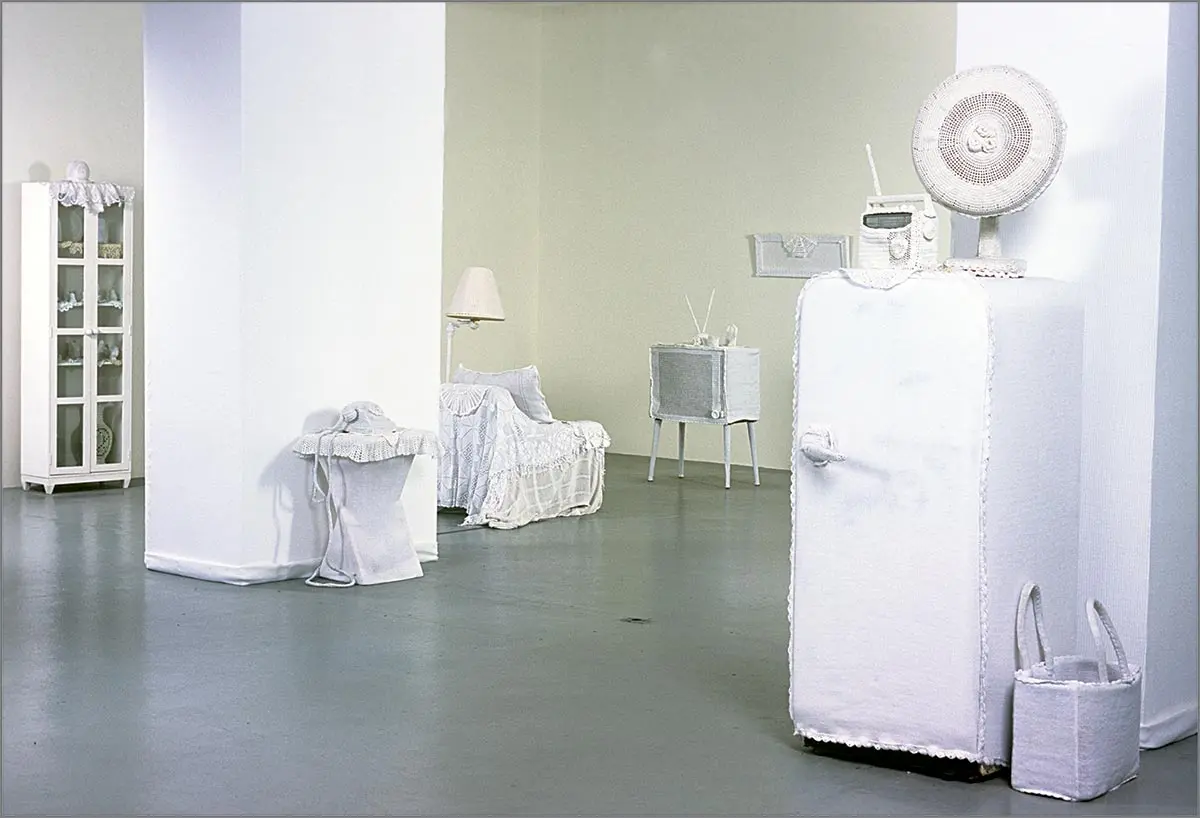
The idea of hidden content also suggests that something to be protected. Caring for emerges, thus, as one of the facets of order; it was given material form in the exhibition Living Room at the Luis Miró Quesada Garland Gallery of the Municipality of Miraflores, in Lima (2001). The installation evoked a home via the presence of a refrigerator, TV, foot lamp, armchair, shelf, plush dolls, painting, ironing board, broom, table, pantry, vases, plates, baskets, and an automobile, among other things. Each object had a white knit cover, made to measure. It articulated domestic space, female-centered textile traditions, and middle-class social customs (the use of knit coverings), highlighting systematicity as one of the characteristics of order: first, by the knitting itself, as a repetitive process; second, by the reiteration of the gesture of covering each of the objects. Yet, that very gesture gave unity to a sundry assortment of objects (TV, automobile, plush toys, broom) and transformed them into representatives of a single category from the perspective of care (and of gender).
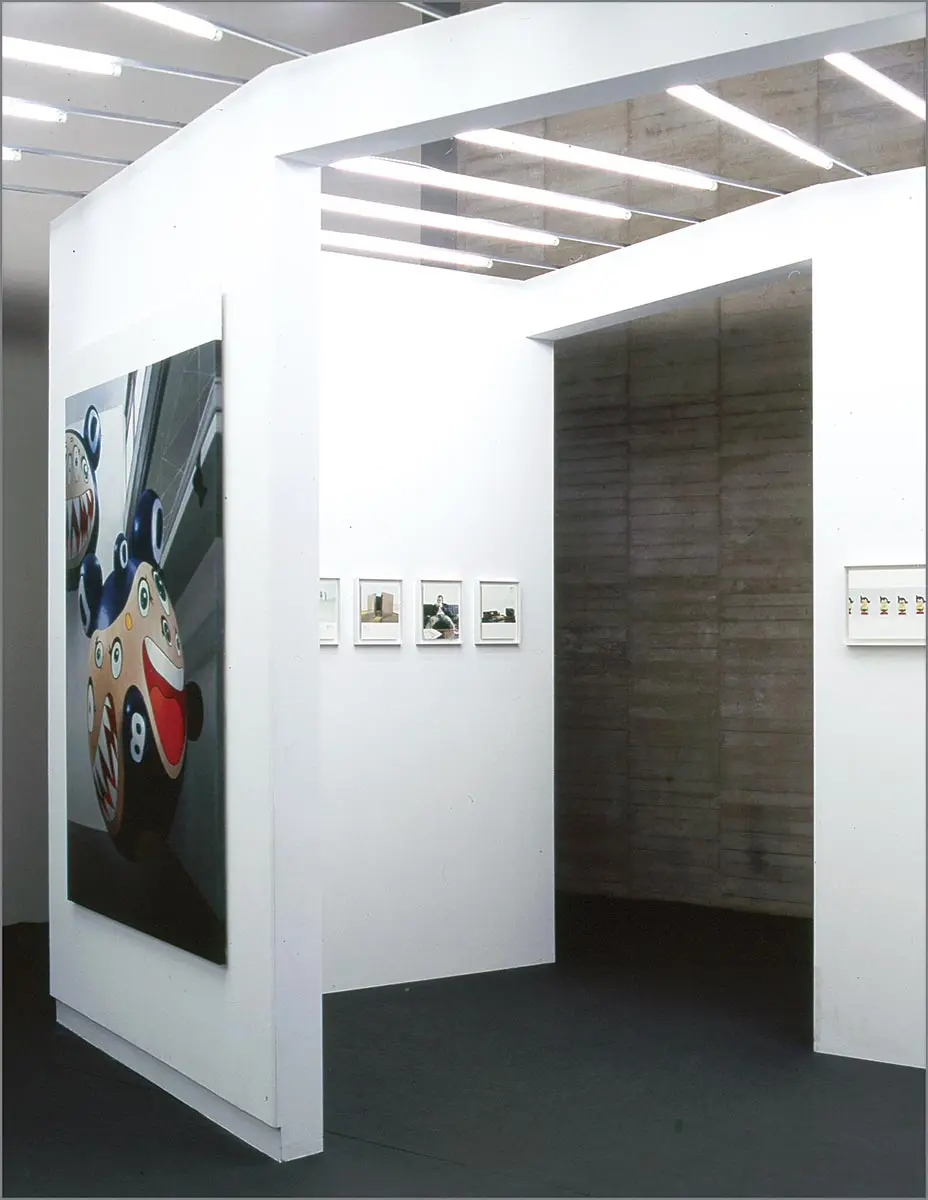
That same year, Gamarra reproduced pages from art catalogs, redoubling the unifying gesture of editorial selection and reproduction with the act of painting the image, as in Visita guiada (Guided Tour, 2001). This spotlighting of the organizational operations of the art field will be exacerbated in the LiMAC project, Gamarra’s fictional Museum of Contemporary Art of Lima, which opened in 2002. Launched as a way of pointing out institutional deficiencies in Peru, the museum projects itself into the world on the basis of its representative elements: web page, catalog, souvenirs, collection, etc., raising the question of what identifies a museum as such.
The holdings of the LiMAC are essentially based on a virtual collection of objects and copies of works of art made by Gamarra, based on reproductions in books (whose titles are the page numbers of the bibliographic source). Exhibited in other museums (MUSAC, for example), Gamarra’s LiMAC highlights the operations of contextualization that are implemented institutionally.
With this project, Gamarra’s explorations of ordering, cataloging, and care focused on the art field; the organization of aesthetic material, its classification (for instance, into original and copy), and its diffusion apparatuses (exhibition, catalog, web page, etc.) became her recurrent themes. Gamarra’s interest in classificatory systems and their arbitrariness—as in her groupings of images based on anecdotal criteria, for instance, Visita guiada masculina (Catálogo Art Basel) (Male Guided Tour [Art Basel Catalog]), 2007, which evinces a gender-based perspective—is sensitive to the way in which those same systems organize and determine the experience of art.
This is what underlies Gamarra’s images of museum audiences and the parallels she suggests between the Christianization of Latin America and art, in series like Los nuevos oradores (The New Supplicants) and Los nuevos peregrinos (The New Pilgrims). By portraying the museum audience in a prayerful pose (for example, Clara, 2008; Ángel, 2008), Gamarra makes contemplation the explicit nexus between religion and art.
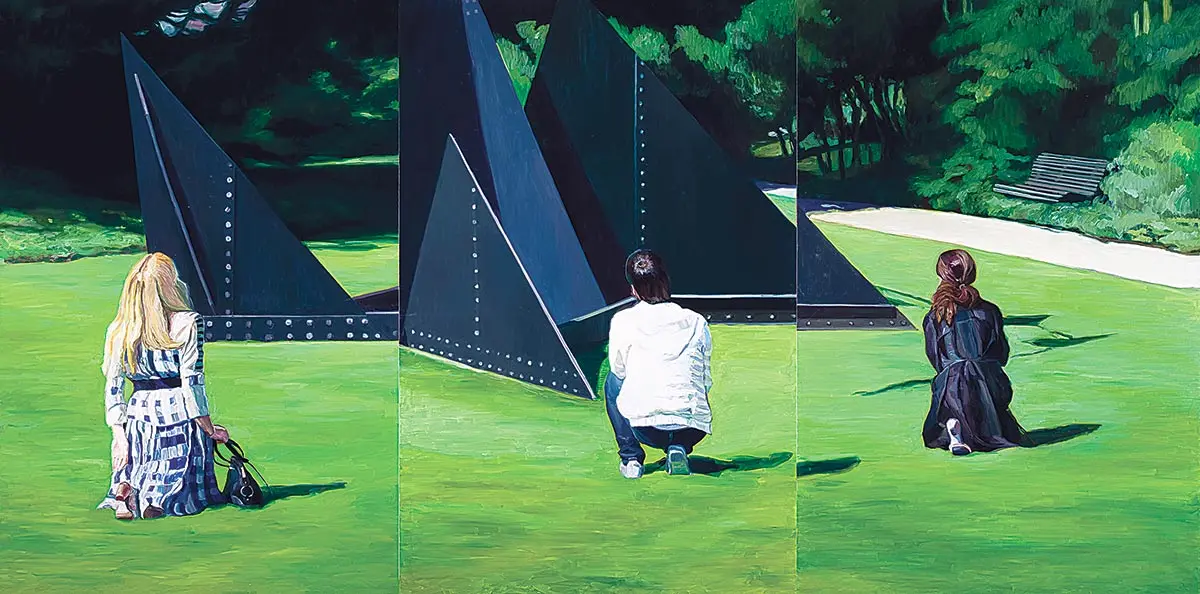
The triptych Fátima (2007) depicts three individuals kneeling before Alexander Calder’s sculpture The Tree in the garden of the Beyeler Foundation, in Basel. The audience’s eyes are focused on a point outside the frame (the title of Calder’s sculpture could remind us of the wood used in the crucifixion.) The triangular shapes at the base of the sculpture allow Gamarra a wink towards the history of Peruvian religious art since in Colonial-era painting the figure of the triangle was used in the simultaneous, syncretic representation of the Virgin Mary and the Apu Wamani, the indigenous mountain deity. Yet, at the same time, its abstract geometry refers us to modern art. In connecting these two domains, religion, and art, the question is raised about the differences between mystical and aesthetic experience, and the modes of contemplation pertaining to each: what allows us to recognize a work of art as such, as opposed to a cult object and, by extension, the entire universe of non-artistic objects?
Such considerations about the perception of different classes of objects are also present in Gamarra’s publication-based installations: canvases that reproduce books and periodicals, respecting their measurements but simplifying the images and rendering the text on their covers abstract.
In her installations for the series Selección natural (Natural Selection, 2009) and in En orden de aparición (In Order of Appearance, 2010), these canvases are arranged in space to outline a trajectory that crosses the gallery’s walls and floor, with some canvases leaning at an angle against each other, like a house of cards. Such ways of mounting her canvases, which are not associated either with the traditions of art or with the publishing world, shift our perception of these paintings as paintings or as the books they represent. The tension between the content alluded to by the painted books and their modes of disposition in space is suggested by the titles of the series, which speak of selection criteria beyond the discursive: Darwinian natural selection and the circumstantial order of the credits in a Hollywood movie.
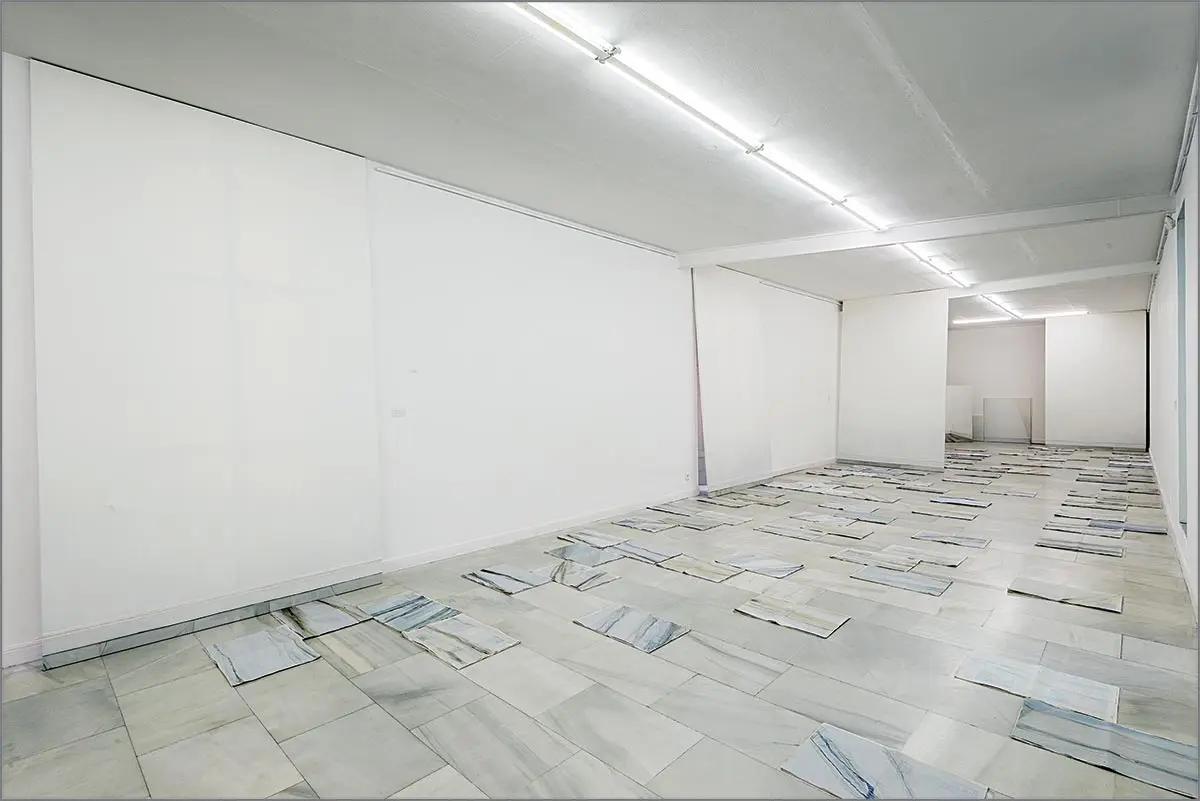
The perception and the recognition of the work of art are also the focus of the exhibition Blanca (White), presented in 2013 at Juana de Aizpuru, in Madrid. Large vertical canvases leaning against the gallery walls reproduce that which they cover: the wall itself, baseboard included (Blanca series). Dispersed on the floor are a few sheets of paper on which the veins of the marble flooring each sheet covers have been painted (Periódico de mármol [Marble Newspaper]).
Here, the object of representation is the gallery itself, a space designed for self-nullification as a perceptual object by means of its physical features, as discreet as they are standard (the famous “white cube”). But the supposed reserve of such spaces as they cede the spotlight to the artwork conceals their power to assign meaning and catalog content. Gamarra highlights this power by repeating the “discretion” of the white cube as she replicates its architecture: the works of art cannot be the protagonists, because they are camouflaged into their environment; they cover the walls but adopt them as a disguise —thus revealing that which they hide— through pictorial representation.
In this way, Gamarra interrogates how we order our different experiences and the role the gallery plays in that process. In other words, these contents that fuse visually into their container prompt questions about the difference between two disparate orders of experience (art/non-art) and the role played by the devices that make it possible to sustain that difference —the devices that allow us to recognize a work of art.
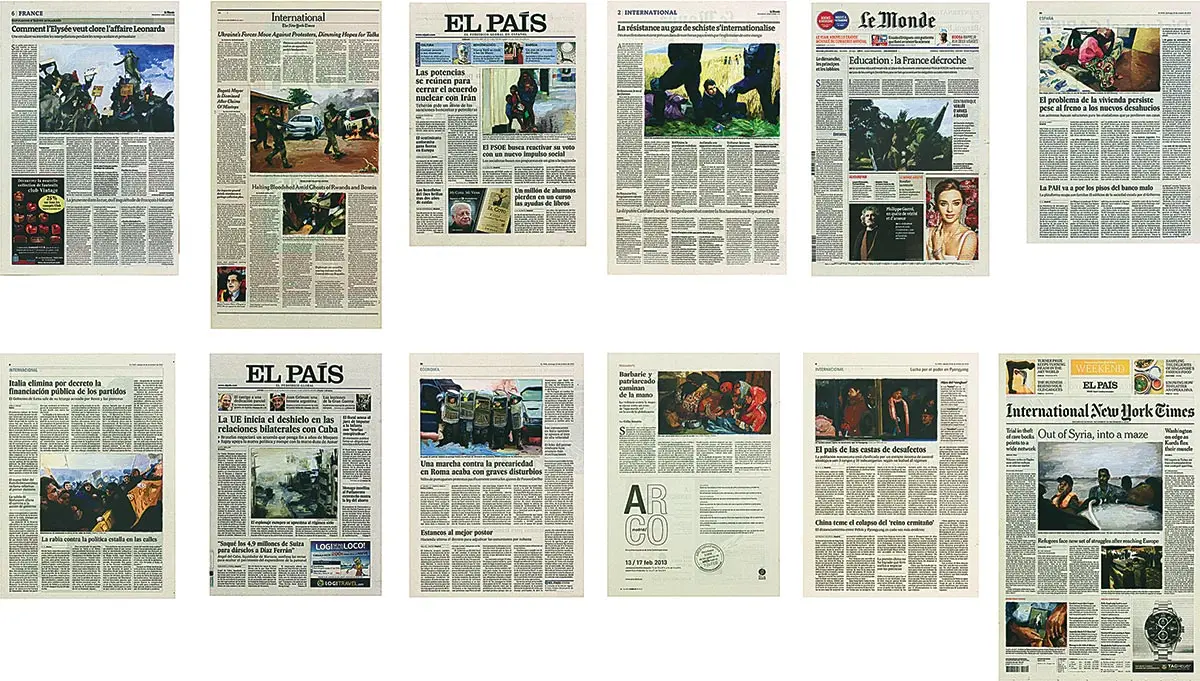
This question about the possibilities of reading and orders of experience also underlies Gamarra’s works on newsprint since 2011. Using newsprint as pictorial support puts into play the physical operation of covering information, something that a number of early works of this kind make emphatically evident. In Autocensura (Self-Censorship, 2011), Gamarra paints canvases that cover, curtain-like, photographs published in newspapers, in an allusion to censorship. And such political censorship is associated with moral censure in works like Autocensura con mantos de modestia (Self-Censorship With Shrouds of Modesty, 2012), which reproduces shrouds from religious paintings (from crucifixion scenes, for example) on newspaper pages, covering the news.
In Génesis 1:26 Entonces dijo Dios: Hagamos al hombre a nuestra imagen, conforme a nuestra semejanza; y señoree en los peces del mar, en las aves de los cielos, en las bestias, en toda la tierra, y en todo animal que se arrastra sobre la tierra (Genesis 1:26 "And God said, Let us make man in our image, after our likeness: and let them have dominion over the fish of the sea, and over the fowl of the air, and over the cattle, and over all the Earth, and over every creeping thing that creepeth upon the Earth," 2013), Gamarra paints over photographs from twelve pages of different newspapers, replicating the images of the news items themselves. Yet, although the information contained there can apparently be the same as in the photograph, its status as information is left in suspense. The images painted lose legibility as news in relation to the printed photographic images and summon other meanings. Gamarra suggests here that the category “information”, associated with journalism, is supported by a series of devices and protocols that codify its content.
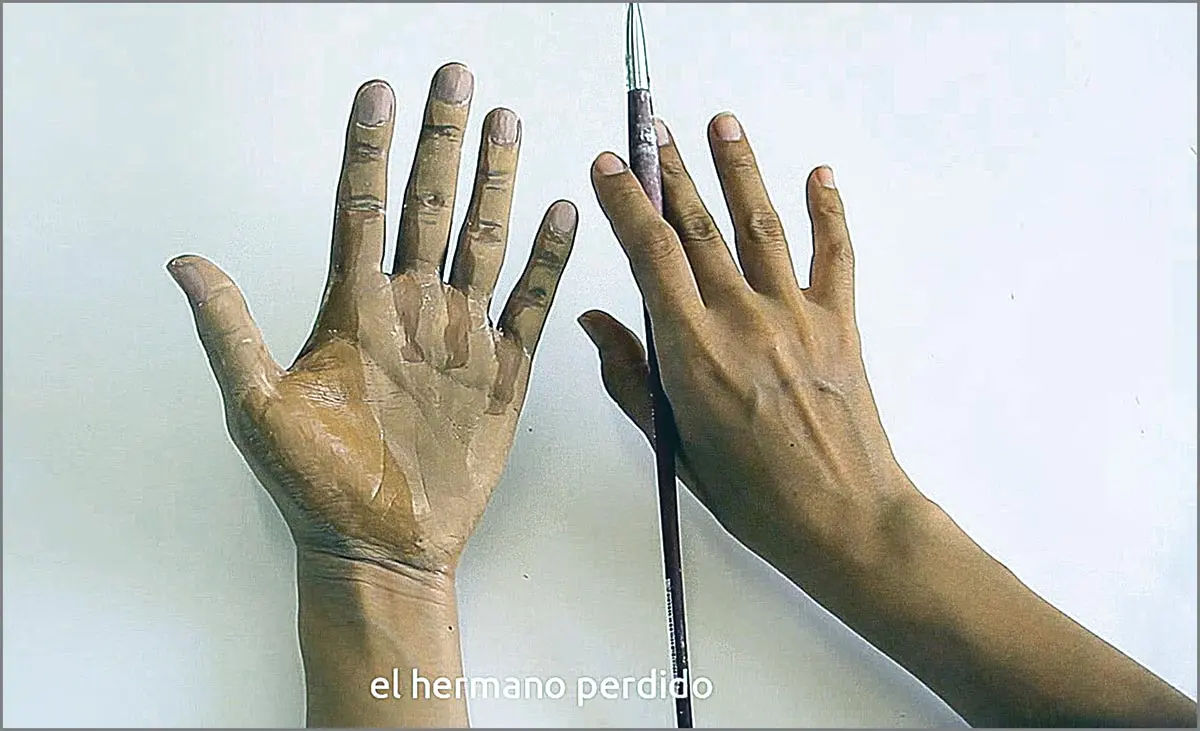
This kind of game with similarities and differences is also present in the video Que no sepa tu mano izquierda lo que hace tu derecha (Don’t Let Your Left Hand Know What Your Right Does, 2011). In the projection, we see two female hands. The right hand paints on the left-hand palm, using its own back for a model. The video features, running as subtitles, a story by Ximena Briceño that explores the figures of the soul mate, the doppelganger, and the mimic. It ends when both hands look identical (two backs of the right hand).
In her most recent show in Lima, Paisaje entre comillas (Landscape in Quotes, Galería Lucía de la Puente, 2015), Gamarra engages the art-historical genre of the landscape in order to reflect on the construction of the concept of Nature and the role played by representations in our relationship with the territory.
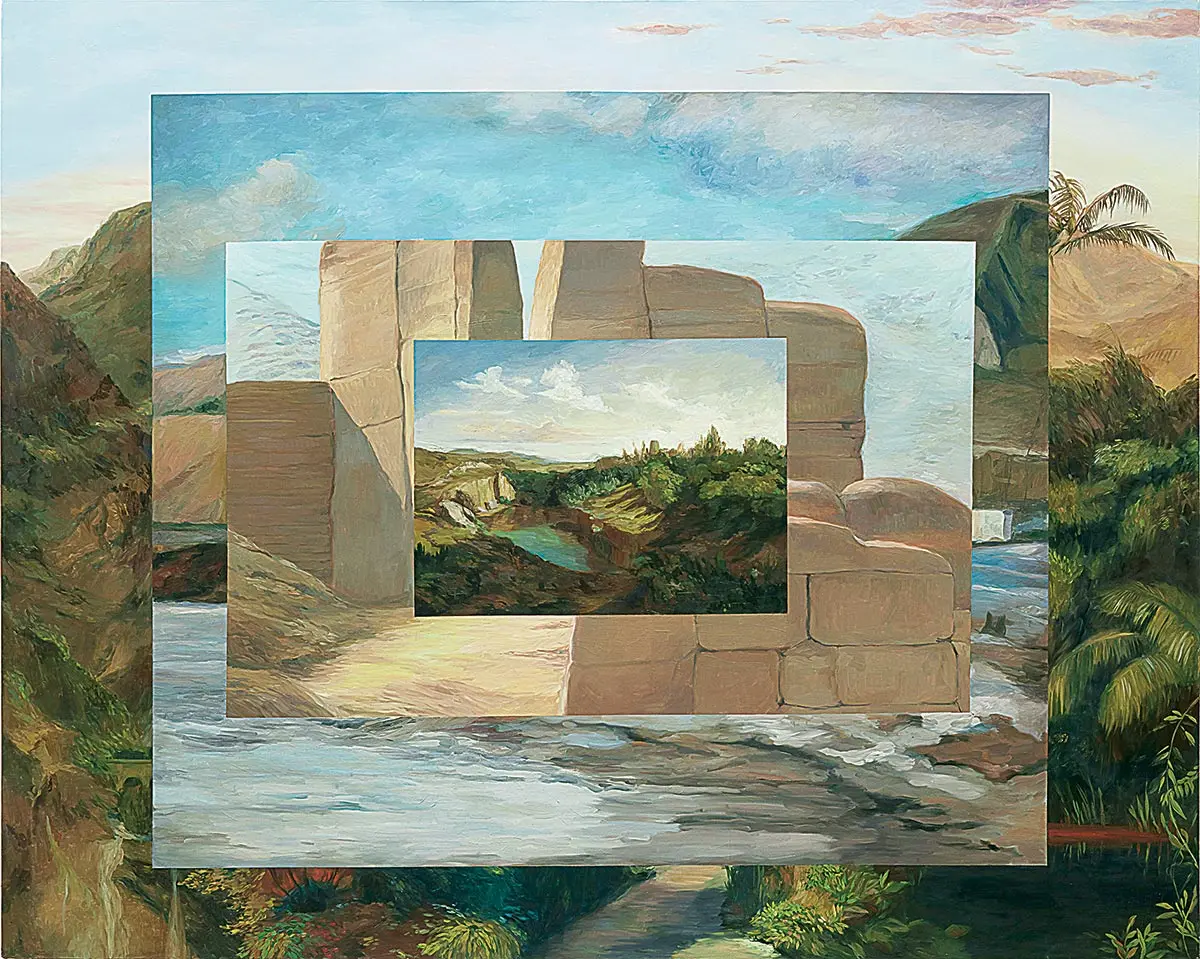
El marco del paisaje II (The Frame of the Landscape II, 2015) presents a succession of images arranged like concentric windows. These are different kinds of landscapes, inscribed one on the other: a mountain landscape with a somewhat tropical feel (announced by the palm trees it features) contains a marine scene that, in turn, contains an archeological landscape (identified by its ruins) that, for its part, contains the panoramic view of a green field. The sequence covers different geographies and times: from the pre-Columbian era in South America to the emergence of the landscape genre in early Fifteenth-Century Europe, to the boom of exotic landscapes in the Seventeenth and Eighteenth Centuries, the product of European colonial imperialism, which once again refers us back to the pre-Columbian world and its ruins. Through this construction, Gamarra confronts different ways of narrating the territory, connected to different ways of interpreting and relating to it.
In her installation Yacimiento III (Deposit III, 2015), old landscape paintings, mirrors, and gold leaf-covered panels lean against the walls in a corner. The mirror introduces the viewer and the gallery’s architecture into the scene, dislocating them in the same way Gamarra’s landscape paintings dislocated their distant referents. Next to the gold leaf panel is a small painting of a river in the Amazon basin, its surface golden in allusion to the contamination caused by mining. The suggestion is that the ways in which we relate to the territory are guided —and legitimized— by the representations we make of it.
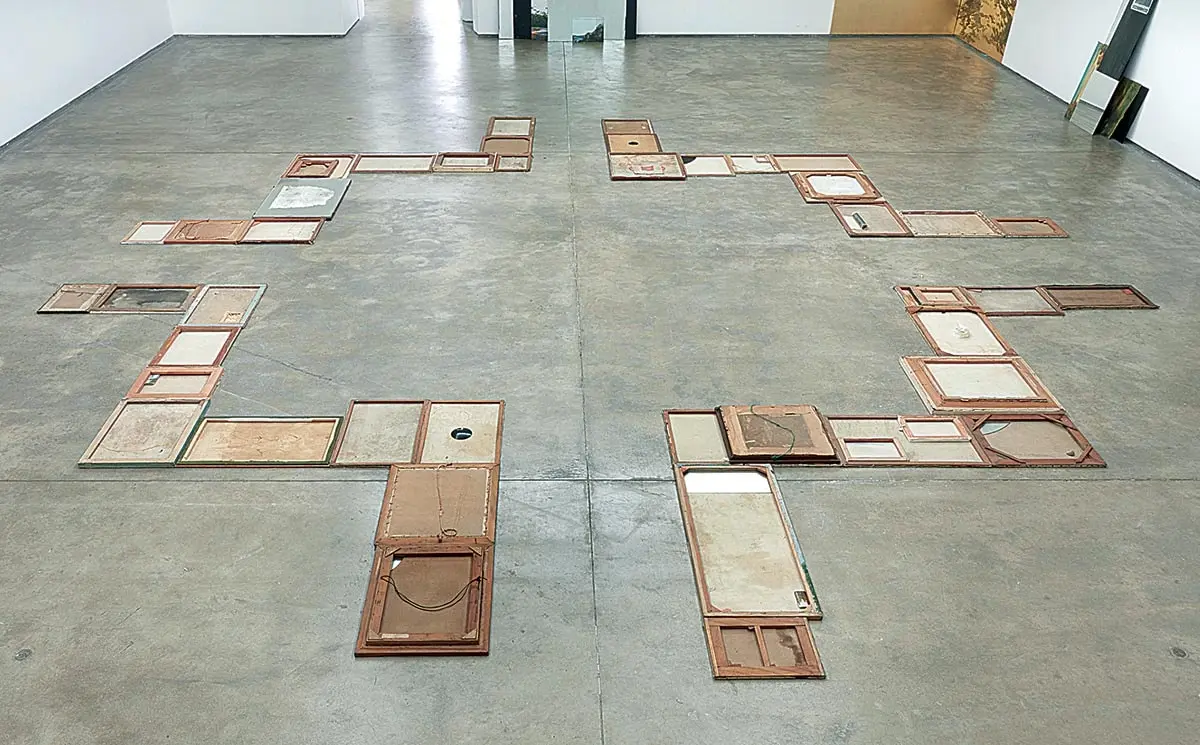
In her installation Chakana/Huaca (2015), Gamarra places second-hand landscape paintings facing the floor, forming a chacana, or Andean cross. The pre-Columbian formal referent is built by turning the landscape over: the real space of the gallery is demarcated through an operation that negates the painting’s optical illusionism but connects a European souvenir with an Andean one.
Throughout her career, Sandra Gamarra has extracted a philosophy of classification and order from her sets and collections of objects and has applied it to many areas, including the art field. Along the way, Gamarra has tracked the implications, the reach, and the ramifications of her themes, turning the painting into both an instrument for analysis and a construct to be analyzed.
The critical look at our world-organizing systems, apparatuses, instruments, and discourses that Sandra Gamarra proposes is, at the bottom, part of an effort to understand her own possibilities for intervention in that world.
* Courtesy: Sandra Gamarra.
MAX HERNÁNDEZ CALVO