
Haiti’s tumultuous history is filled with violent passages. On occasion, their protagonists become iconic in popular culture, be it in a positive or a negative way; such is the case with Chaloska, who became a prominent character in Haiti’s carnival. Etymologically, Chaloska is a contraction of Charles Oscar (Etienne), the name of the general who inspired the character. Etienne was Chief of Police during the brief Vilbrun Guillame Sam presidency (February 25-July 28, 1915). Feared throughout the country for his brutal methods, he was responsible for one of the most resonant massacres in the country’s history. The carnival character evolved years later, a cartoonish representation featuring an exaggerated mouth and disproportionate teeth. The Chaloska character is not intended in praise; on the contrary, it embodies popular dissatisfaction with the country’s corrupt leadership. In this context, Viktor El-Saieh uses it as a symbol in his most recent solo exhibition, titled Tet Chat (Cat’s Head), to express his own disappointment with Haiti’s unstable social and political situation. The title makes reference to a popular Haitian expression, meaning something that remains unfinished or has been shoddily put together; in the specific case of this show, it is a comment on Haiti’s social realities.
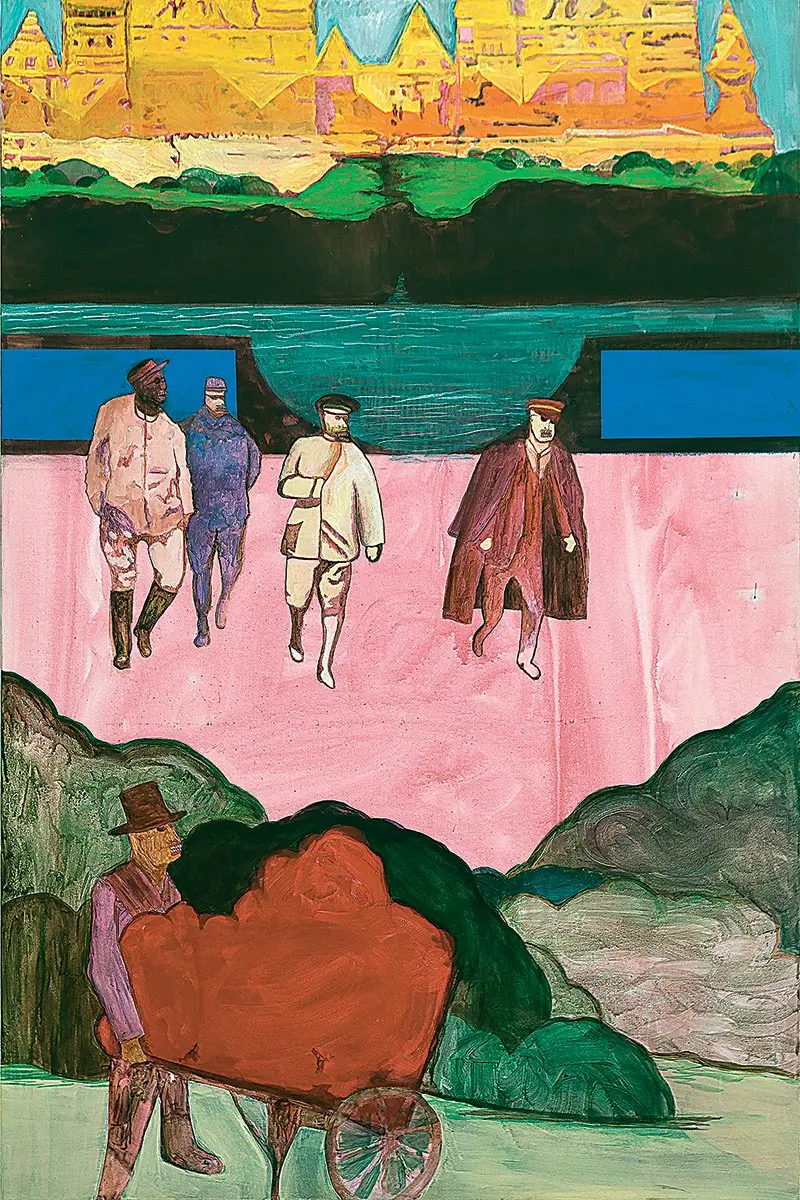
Chaloska is not El-Saieh’s central concern in this exhibition—the focus is on the unstable, chaotic conditions created by the country’s successive governments—but he does become its main character, inserted in the narrative that the artist creates in each one of his works. All the human figures depicted in the compositions feature a Chaloska-like mouth. Emphasizing the character’s histrionic component, on opening night El-Saieh recreated his Chaloska Manifesto, a performance previously presented at the Ghetto Biennale in Port-Au-Prince.
Born in Port-Au-Prince, Haiti, in 1988, Viktor El-Saieh moved to Miami as a child and studied Political Science at Florida International University (FIU). He currently lives and works between the two cities. El-Saieh is a self-taught painter; in an interview, he explained that his education in the arts took place in the gallery of his famous grandfather, Issa El-Saieh, active in Port-Au-Prince since the 1950s. There he became acquainted with the work of many of the principal artists of the Haitian School, such as, among others, Philomé Obin, André Pierre, and Seymour Bottex. From them, he took formal elements and themes like the representation of historical figures, richly developed in his previous solo exhibition, Historical Precedence. The works on display there illustrated his view of the country’s situation as the result of its history. In his new exhibition, however, El-Saieh opted for a different, perhaps more explicit mode of political commentary, deploying symbols and resources used by the common folk and thus making his message more accessible.
At the conceptual level, El-Saieh purposely takes elements from Haiti’s history and popular culture such as those mentioned above. At the formal level, he applies to his compositions recognizable elements of the Haitian School, such as the naïf pictorial language noticeable in works like Yon Fet Chaloska/A Chaloska Party, which depicts a picturesque carnival scene. In other works, such as Chaloska pou Prezidan/Chaloska for President, these elements are combined with more academic principles of composition and proportion.
Other contemporary Haitian artists, like Edouard Duval-Carrié, have proposed similar solutions, albeit with different results. With their highly distinctive, very personal iconographies, both artists have been able to convey their ideas and opinions about the country in works that are rooted in Haiti’s artistic tradition yet use a contemporary language.
El-Saieh’s work is a visceral act of rebellion. His paintings are distinguished by the complexity of their scenes, which register several events simultaneously in different planes. The images reflect a dream-like world where no clear boundaries are established between reality and imagination. The concept of the marvelous-real, articulated by Alejo Carpentier in his literature, may very well apply—in Haiti, it seems part of everyday life. Among other things, this painter also explores the relationship between Man and Nature, in that mythical state explored by Carpentier. For example, in works like Kouleu-Cheval/Snake-Horse, where two men converse in a solitary landscape; they are both hybrids, half-snake one, and half-horse the other, an allusion to their shared apocryphal transformative power.
IRINA LEYVA