
More was lost in Cuba, said Williams Carmona in the title of his recent exhibition in New York City. It is clear that his native country (1967), which he left in 1990, drove Carmona away. Leaving Cuba was a decision in favor of creative freedom, as has been the case with many of his colleagues. Carmona passed through Mexico, Spain, and the United States, and in 1991 he settled in Puerto Rico, which he considers his place of residence. He had a presence in New York in the 1990s, in a gallery that has been closed for over a decade. His painting has moved in the direction of expressionism and surrealism. On occasion, in very large formats, fantasy and an intense colorfulness inhabited his works. Back then, the painting was more common than sculpture, unlike more recent times, when he frequently works in three dimensions. The subject matter is varied; there is a focus on Cuban migration, and the work encompasses political, social, and religious situations as well as a reflection about today’s powerful, harrowing global civilization.
The exhibition More Was Lost in Cuba is not too large or overwhelming. While Williams Carmona does use bronze for his sculpture, most of the works exhibited in New York share the characteristic of glossiness, as in Lolaaaa de mi Vidaaaa (Lolaaaa of my Liiiiife), from 2016, a work in ink and shine in which drawing is dominant and paint is watered down, with many transparencies. Religion and sacrifice are present in Carmona’s work. Among the small elements, there is a large number of ears, some figures, and so forth.
Religion and art have been in connection since ancient times. Academic monotony had to make room for the natural and the local, that which few saw until it was discovered and used to blaze the trail of the marvelous-real, of magical realism, and of Tropical Surrealism—the term Carmona uses to describe himself. In Cuba, the avant-garde was present between 1927 and 1959; Williams Carmona was born sometime later, in a country where the Revolution was already firmly installed.
Walking around the exhibition one encounters Jungle Woman / Mujer Salvaje, a resin and acrylic sculpture, 212.5 cm x 70 cm. In it, the saturation of elements is complete, its baroquism is evident, and the finishes at leg level are articulations with brushes. Meanwhile, the images on the torso—it is populated with faces—shift and the face of the jungle woman itself is that of a doll with a peculiar hairdo. Another unique work is Mikaela en mis pensamientos (Mikaela in my Thoughts), also in resin and acrylic. This is a two- and three-dimensional work in a range of blues, with the figure of Mikaela at its center. The nucleus, the mass, the vegetation, the pachyderm-like presence in 62.5 x 55 cm, resulting in a dream-like work of art, a version of the Thousand and One Nights.
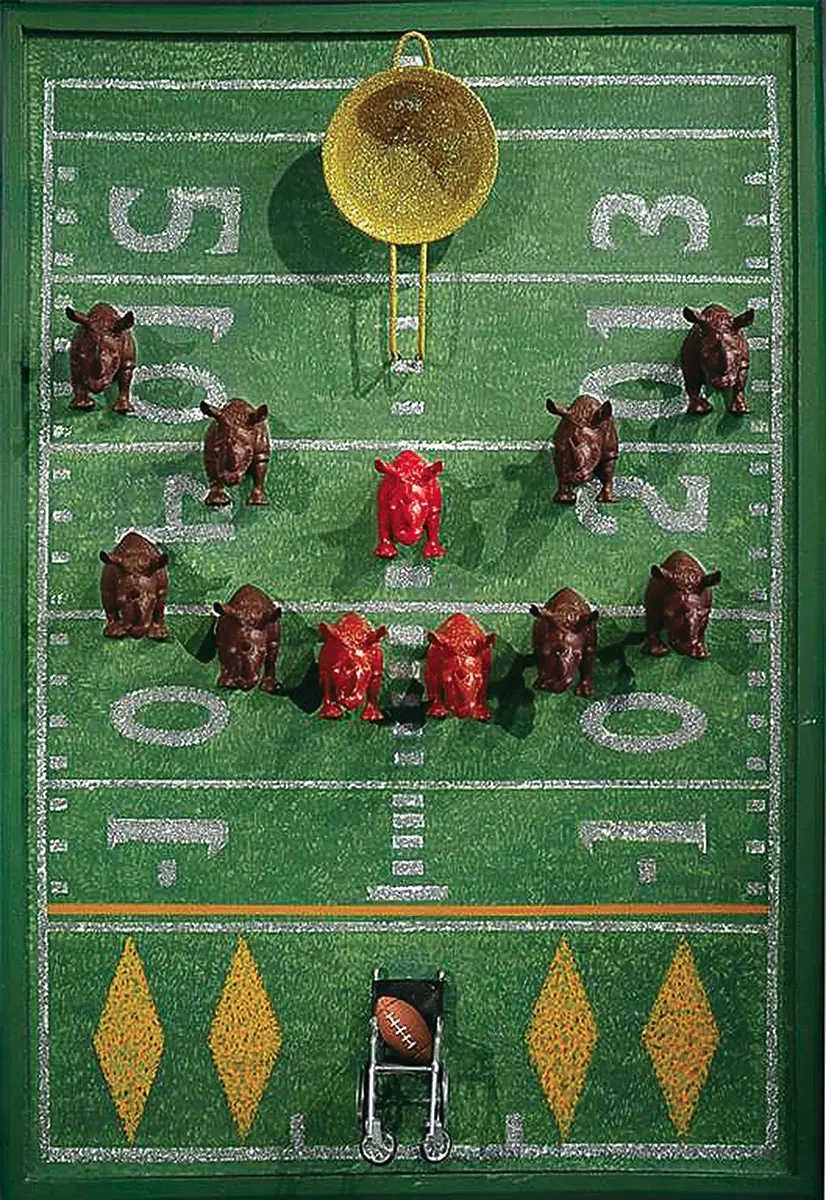
In this relationship between the plane and the small volumes, No More Touch Downs / No más anotaciones, from 2016, can be interpreted as depicting various games, competitions among animals on fields for humans—specifically, a football field. The artist pays special attention to the damage suffered by the players, such as the concussion ratified by Carmona with a ball on a wheelchair. Resin, metal, and a light shine characterize the mat on which the scene is set, imprinted with yardage lines. The complementariness of green and red hues holds the scene together. The small animals in menacing formation stand out volumetrically against the green cloth representing grass. In this work, the baseball-bowl award occupies a signal and also critical place, and is remarked upon by gloss adhered to the yellow paint. Shine and gloss are present throughout the exhibition, but not the gilded shine of gold leaf that differs from the metal’s religious use. In this way, Williams Carmona modifies the valences of current religious representations: gilding in its everyday, pop, and folk-urban uses are equated with the plastic shine we find in the most diverse places and elements of his work. Today, Williams Carmona, born in Cuba, is a character in Central America, in Latin America. He is an artist who has been working for thirty years in the search for new expressions for our gaze. He understands the character of the struggle and suffering that occupy this world and focuses on them with hopeful irony.
GRACIELA KARTOFEL