
A title like RetroPerspective—notice the altered prefix aimed at subverting—should already inform us about the manner in which the works in an exhibition will be displayed and organized to encourage a thematic openness while problematizing the most common guidelines used in traditional exhibitions. Such is the commemorative exhibition under the curatorship of Katia Canton that marks forty years of artistic production by Alex Flemming at the Museu de Arte Contemporânea da Universidade de São Paulo, a museum conceived to house inclusive strategies from the postmodern period like those followed by the São Paulo-born artist.
Flemming began his artistic career in Brazil alongside figures like Julio Plaza and Regina Silveira. But his work became more solid while attending the Pratt Institute in New York City under the Fulbright Scholarship in the early 1980s, a defining time for the evolution of art that, after much exploration of its various modalities (excluded arts, technical reproducibility, popular culture), led to the consolidation of new semiotic laboratories in the visual field.
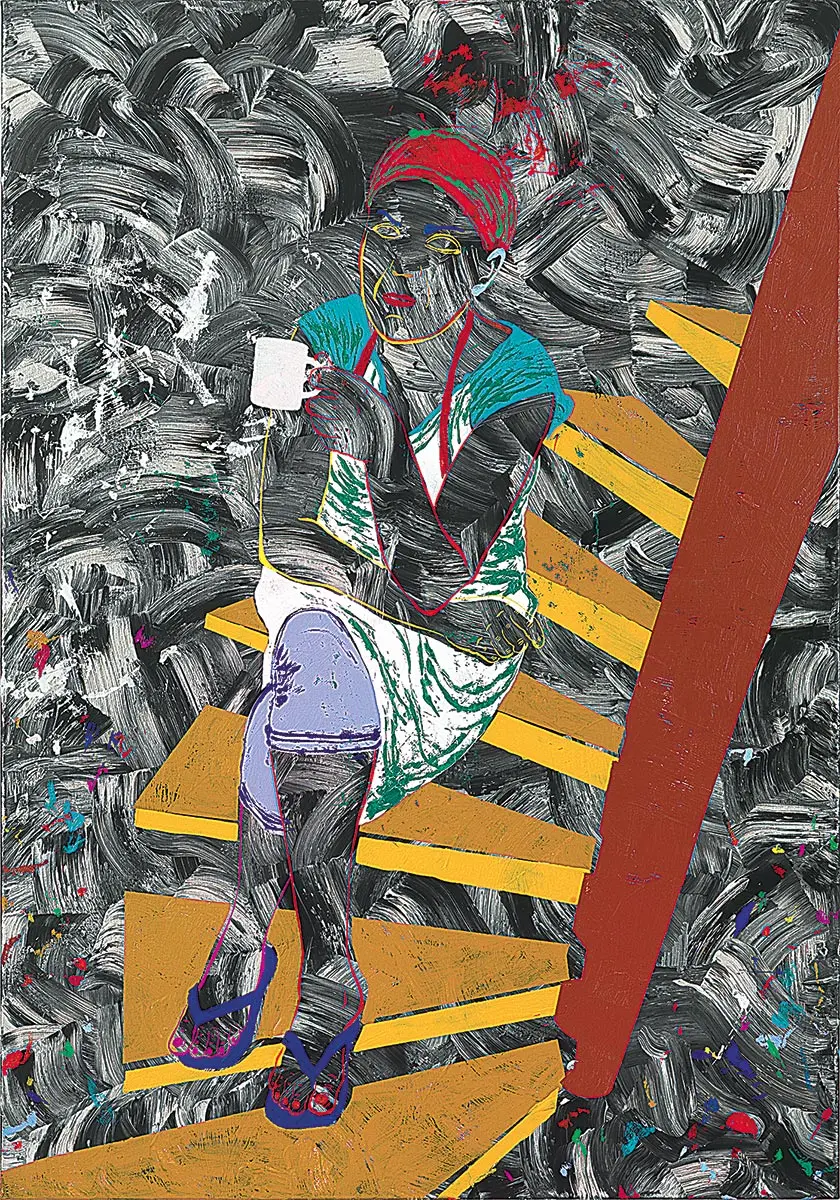
When with his earlier paintings Flemming decided to parody the 17th-century natural history engravings of Ulysses Aldrovandi—namely, representations of a basilisk, a sort of mythical lizard or serpent from America—he was simply pointing to a codified image found in old encyclopedias as something to be explored. And, thus, Flemming embarked on a journey of no return where art is understood as an indexing factor, that is to say, as an indicator of what art represents and how it is represented. And while it is palpable that his works from the early decades are primarily paintings, the process that he used is closer to a graphic approach. When he time after time recycles with matrices the standard and paradigmatic figure, repeated over backgrounds already polluted by the intervention of other matrices in strident colors and fuchsias, Flemming leaves no doubt that his preoccupation is to generate visual grammatical combinations in which simulation and play take precedent over any other experimental objective.
Since then, another characteristic in Flemming’s trajectory becomes tangible through the assumed nomadism between São Paulo and Berlin, with their respective languages and cultural trappings. Themes begin to incorporate mummies, monsters, and popular Latin saints, or rely on the postcolonial aura of parodying Greek statues as symbols of a grandiloquent history then believed to be in its final throes. At that time, he completely identified with Baroque or Neo-Baroque; with concepts that had permeated the literature of the time as tools for artifice and renewed apotheosis, or as Cuban writer Severo Sarduy defined it: with a “furious baroque, challenged and new, which can only emerge in critical margins […] within the lateral, open superimposed, eccentric and dialectal space of America.”1
In addition to the influence of Baroque, Flemming also based his work on the human figure as an icon: close-ups of vaginas and torsos that become part of classic elements of art as landscape; or vertebral columns integrated into the background in works like Heights (1991), his famous series of portraits of prominent individuals who have been reduced to numeric data. That period also included his first incursion into sculpture, where tinted objects with metallic colors begin to be explored as pictorial surfaces. In the exhibition, we find his sculpture-sofas, computers, or items of clothing in rhetorical attitudes, covered in luminous inks and banal banners like those with names and diseases of the time, which are part of that which Flemming calls “absent body.” Completing this idea is the series Chaos, portraits from 2010 in which prominent individuals offer everyday attitudes that are chokingly beautiful.
Continuing the discourse on the human figure, another fundamental part of the exhibited selection of works is the 2001 series Body Builders, in which maps of regions with war conflicts are stamped on male figures. The seduction of well-exercised solar plexuses on the digital plotter is completed with biblical texts in foreign languages like ironic approaches to propaganda or advertisements. This endeavor of ideologies superimposed to the metaphor of the body is still present in Still Life, a series created early in his trajectory that consists of records of torture found in local newspaper clippings, treated like images of torture that references catholic iconography.
An entire symptom becomes essential in the work of this postmodern artist: the footprint. Such mark expands from prehistoric art to the digital period and is evident in his most paradigmatic work titled Vidas en Efigie (Lives in Effigy). The twenty-two portraits printed on the glass are displayed in a subway station in São Paulo, one of the Brazilian city’s landmarks that appear in some of the prints shown in the exhibition. Whether because of the anonymous human heads or because of the poem fragments left to the public to decipher, the effigies pay homage to the footprint, almost like a gesture of unlikely encounters, of subtle interactivity with the also anonymous receptor that may or may not identify with the effigies.
NOTE
1. Severo Sarduy, La Simulación (Simulation), Ed. Monte Ávila, Caracas, 1981. p. 77.
XENIA BERGMAN