
Visiting the town of Cali in the Cauca Valley of Colombia, I stumbled upon an exhibition that aroused my interest. Titled Objects of Study for a Popular Republic Cut Short by young artist Alex Rodríguez, it consisted of a series of academic documents and graphics rescued by the artist from the ruins of oblivion. The documents showed illustrations and charts pertaining to the natural sciences, geography, mathematics, and other subjects that constituted the curriculum of secondary level education in schools like the one from which Rodríguez retrieved that material. A ceramic human torso shows the interior of the human body, books narrate a story of social transformation, and other educational objects form a world where teaching was the pillar of society.
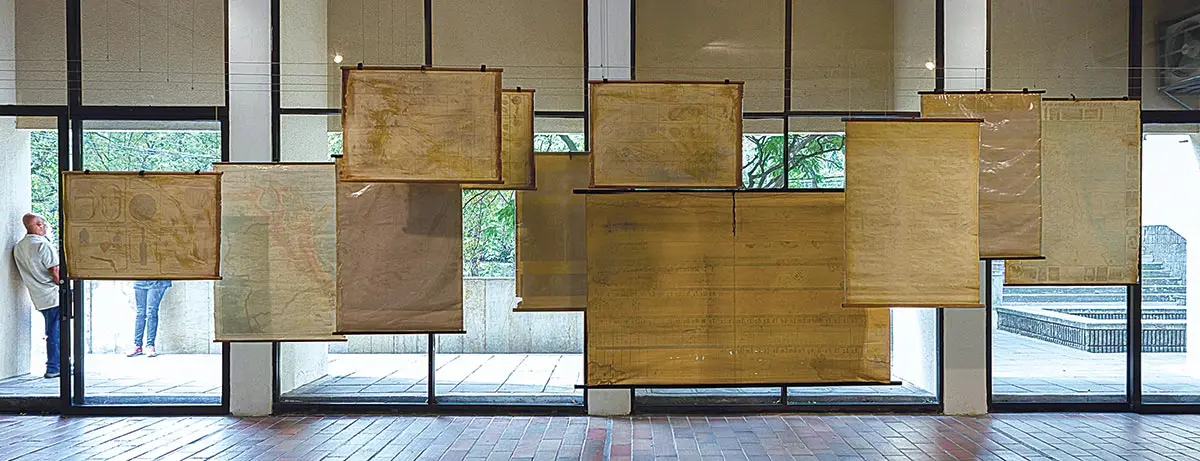
The exhibition reveals a certain educational aesthetic, for there is indeed a poetic dimension after On the Aesthetic Education of Man (1794) by Friedrich Schiller became central to the teaching proposals of modern individuals. Knowledge is above all aesthetic knowledge; therefore, the perception of the sensitive will be stressed in class. All didactic materials become actual cultural remnants Rodríguez successfully articulates in the exhibition space in an unusual manner and with the passion of an archeologist. Museum and school resume their modern and educational role.
According to the curator of the exhibition, Jaime Cerón: “Alex Rodríguez’s interest in finding remnants of life within the conventions that organize society has led him to rely on fieldwork as a recurrent method in his creative practice. Through the gathering of images and objects, the revision of a variety of documents, and conversations with different social actors, he finds points of view to structure the vital experience. Rodríguez creative work involves artistic processes based on given situations such as assemblages, photography, and ready-made objects. By being structured as do-it-yourself projects, they contain traces of events that, while latent on the surface of things, could not otherwise be perceived at first glance.”1.
Of course, we cannot forget to mention Emile, or On Education (1762) by Jean-Jacques Rousseau, a major work that influenced modern utopists, including Schiller, who believed in the possibility of educating individuals with the idea that being citizens was an important investment on the future. That sort of citizenship that seems so rare and weird today in educational precepts was the pillar of the educational project. The work by Alex Rodríguez showcases this strange tension of a past that, supported by somewhat orthodox pedagogic methods, proposed a future in which the general knowledge of each individual would be marked by the visual experience.
While it was possible to prove—thankfully—that successful teaching methods can be all about the carrot without a need for the stick, the idea that everything, absolutely everything, enters through the eyes could not be denied.2
This visuality in teaching methods is underscored in an exhibition that becomes a sort of symbolic reconstruction of a dilapidated monument of modern education, in which utopia and citizenship go hand in hand. And Rodríguez underscores the role of sight in the teaching methods in an exhibition that becomes a sort of symbolic reconstruction of a dilapidated monument of modern education, in which utopia and citizenship go hand in hand. Jacques Rancière successfully demonstrated in his book titled The Ignorant Teacher: Five Lessons in Intellectual Emancipation (2009) that there is no better way to escape ineffective teaching than to recognize that teachers are as ignorant as those learning and initially regarded as ignorant. In other words, to recognize students as equals. Thus, the Socratic formula “I know that I know nothing” resonates strongly again. And it is there where the nostalgia would begin for that modern utopia that continues to keep some of us awake at night.
Lastly, it is important to note that this type of exhibition organized by the C program is the result of an Alliance between the Museo La Tertulia and the Museo de Arte Moderno de Medellín and involves a curator choosing work by an emerging artist to showcase it in the demanding contemporary art scene. It is a program that has included the participation of artists like Laura Huertas-Millán, Angélica Teuta, Víctor Garcés, Tatyana Zambrano, Román Navas, Gabriel Botero, and Henry Palacio.
This exhibition will share the stage with works by prominent artists like Beatriz González and José Horacio Martínez. It is nice to see that the Museo La Tertullia is gradually reclaiming its leading role in the cultural stage and that MAMBO continues to be, without a doubt, on the right track. It was time for institutions of such stature to recover from the crises that they have experienced.
NOTES
1. Jaime Cerón. Alex Rodríguez: “Objects of Study for a Popular Republic Cut Short,” http://museolatertulia.org/exposicion/alex-rodriguez/
2. This is, of course, an exaggeration and is by no means an attempt to ignore the experience of the blind population.
RICARDO ARCOS-PALMA