
As Barack Obama said on his visit to Cuba, “it is not easy” to establish communication with a certain sector of contemporary art. Cryptic turns of meaning, scarce sensorial stimuli, and an excess of “art world” in the arts are but a few causes of this realm often being impenetrable for non-experts. Painting and sculpture, the supports that, historically, best interacted with the widest audiences, have obliterated their borders from within, and today, freighted with “concept”, have become the new opaque tropes of unending reflections. Seen that way, matter, color, form, and space could seem terms in an outdated lexicon that are nevertheless reincorporated often into artistic practice and force us to theorize. We slide back, and it is not too much of a surprise, since many “unresolveds” remain, some of them inexhaustible.
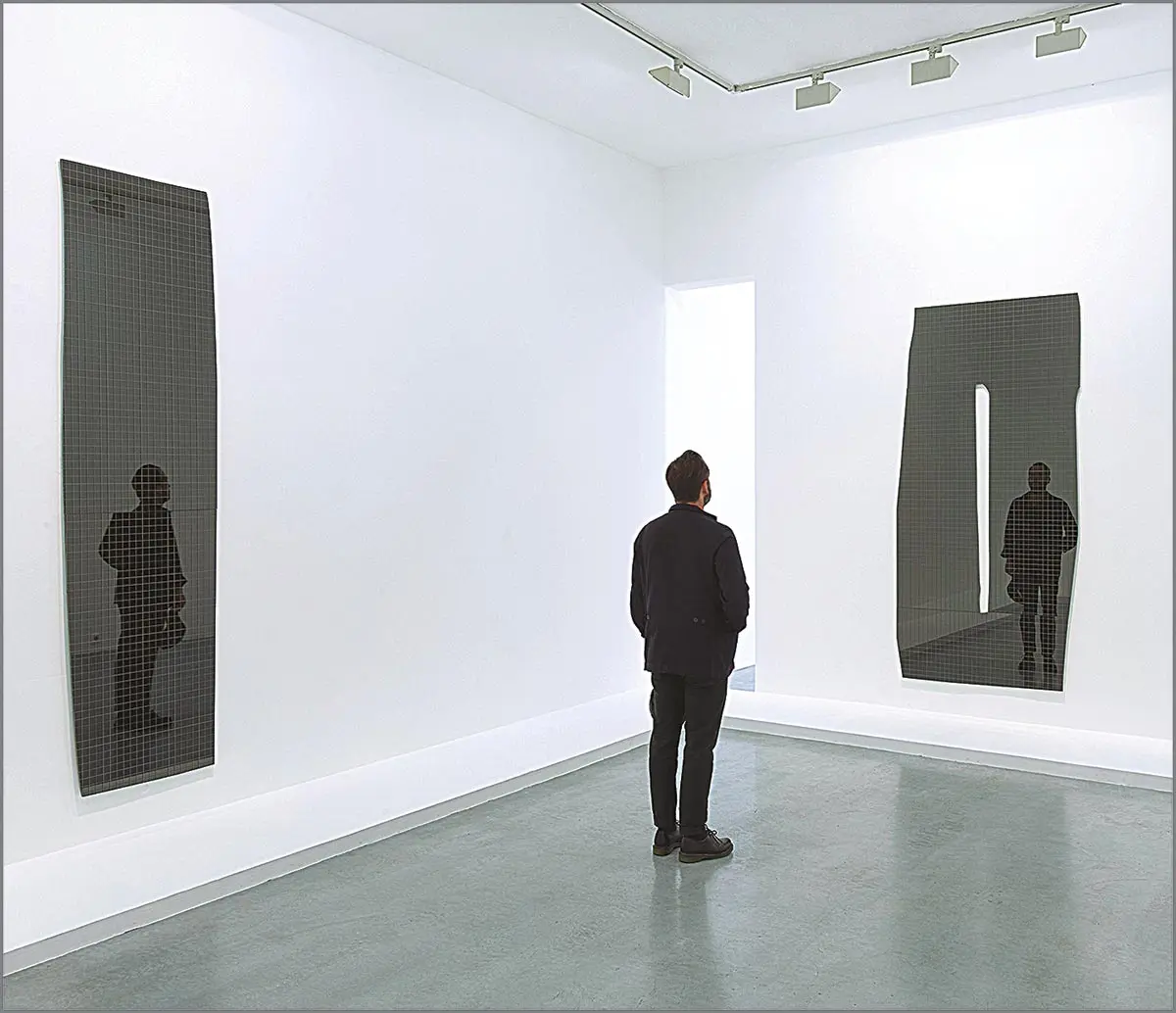
Speaking of sculpture, the eponymous exhibition of works by Armando Andrade Tudela (Lima, 1975) focuses with absolute intensity on objects. Andrade manipulates, melts, and reassembles materials in order to explore the autonomy of form and strengthen its meanings. The exhibition features three new series: an untitled triptych comprised of large-format black mirrors; Vuscohh Vohhlver, comprised of plaster assemblages arranged on iron rods; and, finally, Canon, where some utilitarian articles have been transformed into sculptural shapes.
The mirrors’ irregular outlines contrast with the industrial imprint of their surfaces so that the seemingly minimalist aesthetic clashes with the specter of figuration (the almost imperceptible reflection on the glass.) The disturbance caused by these anti-mirrors or subverted mirrors is due in good part to their unusual aspect (they are asymmetrical, semi-opaque, gigantic, and have a hole at their center), but also to the projection that, perhaps because of the impossibility of mirror-image reflection, we impose on them: what is disturbed is our naturalized perception mirrors, as we are confronted with these objects that, despite being precisely that, do not work in that way. The deeper issue is not, then, the mirror as a concrete object, but reflection as a poetic principle. This is one of the formal and philosophical lines along which Andrade Tudela has been working for years. In 2010, for example, as part of the ahir, demà exhibition at the Museo de Arte Contemporáneo in Barcelona, another untitled work featured a fiberboard plank covered by five large pieces of transparent glass that covered almost the entirety of the surface. As Chus Martínez, the project’s curator, put it, this work served as a border between two images of a single space: on the one hand, the old Renaissance chapel and its ceremonial function; on the other, the current gallery—and its similarly ceremonial function, I dare add. This operation, however, was only made possible by the fact that the image was duplicated by its reflection on the glass. Along Martínez’s lines, the glass was limited to speak of the space—formerly a religious building and an arms depot during the Spanish Civil War—only on the basis of its materiality: “all that is left of all that [space’s past] are the materials and the shapes that signify it.”1
Seen in that light, the formalist reduction functions as a stimulus for reflections of all kinds, prompted by the shapes and the materials. Vuscohh Vohhlver, another series in this show, seems to indeed move in that direction. Featuring small- and medium-format works, it explores textures and volumes in suggestive ways. These works are plaster assemblages on metal-rod bases, and some molten-aluminum objects displayed on metal shelves. Andrade Tudela explores shifts in scale, material, format, and use in order to enhance shifts in meaning, but also to disrupt the processes of aesthetic perception and reception. Finally, in Canon 1, the exhibition presents prefabricated objects that the artist intervenes and transforms into sculptural entities. What is interesting in this case is to ask: What is it that transforms an object into sculpture, and who can or cannot operate that shift?
Form, matter, texture, and autonomy operate in this exhibition not only as starting ideas and communicative possibilities but as a complex conceptual field we use to reactivate debates and stories, including those of the arts. In an enlightening essay about mirrors and self-portraits, James Hall narrated the mirror fever experienced in Fifteenth-Century Europe after the introduction of those magical reflecting glasses. It was, he asserts, “as though artists were suddenly able to see themselves.”2
Such an optical feat allowed people (not only artists) to for the first time look inwardly and not outwardly. Perhaps in today’s art world what we need is fewer mirrors.
NOTE
1. “El tiempo aprieta”, in ahir, demà, Barcelona: MACBA, 2010, p. 13.
2. James Hall, The Self-Portrait: A Cultural History, London: Thames & Hudson, 2014, p. 31.
DIANA CUÉLLAR LEDESMA