
Variations on the basis of a rigid constructivist matrix: that is the essence of the work of São Paulo artist Cassio Michalany, as revealed in his first solo exhibition in Rio de Janeiro, held at Mul.ti.plo Espaço Arte. The exhibition O Lugar do Outro (The Place of the Other) brought together a series of Michalany’s painting-objects (as the artist calls them), which presents a sequence of his paintings inside wooden boxes, expanding our perception of depth on the basis of three-dimensionality.
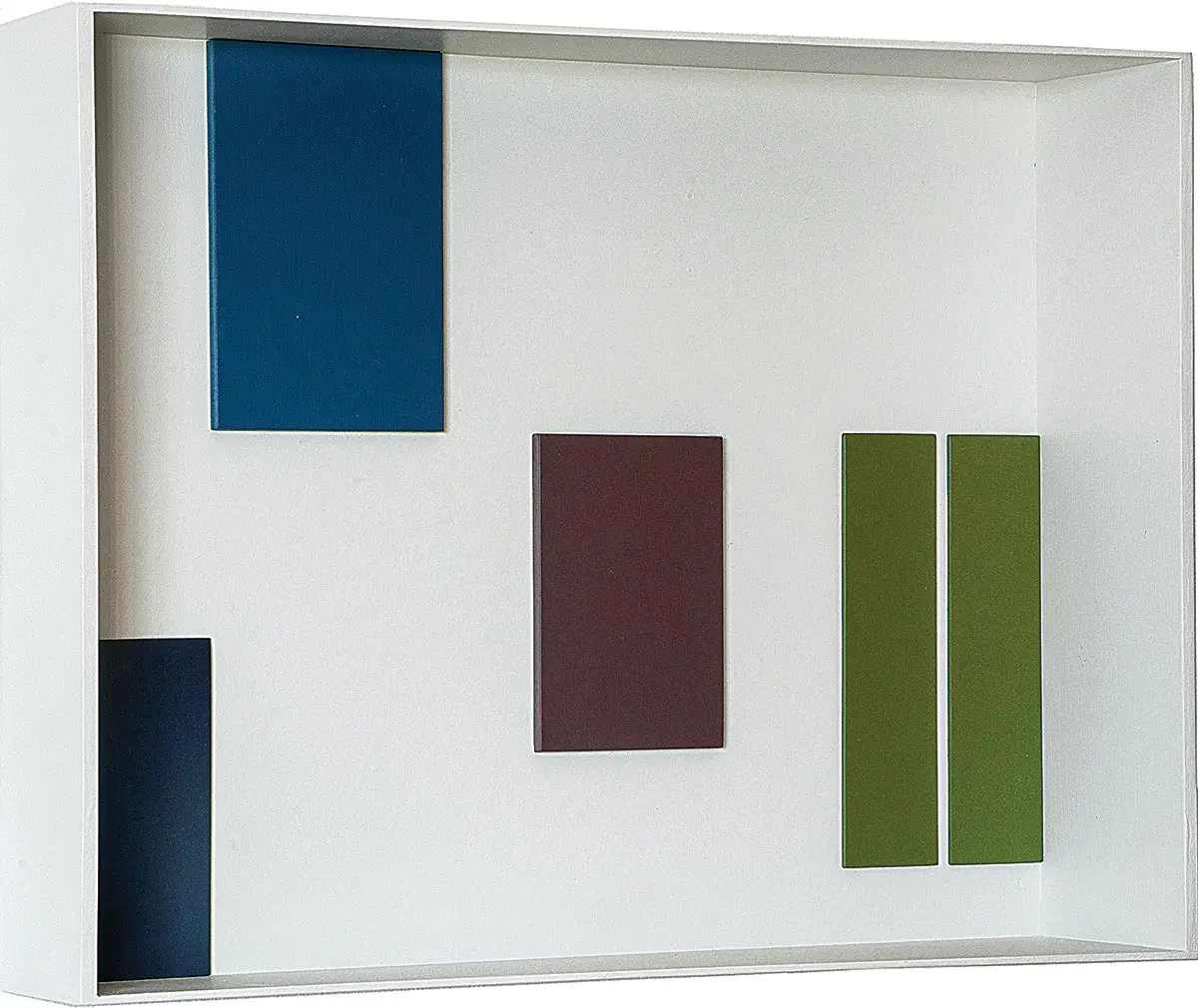
The show featured nine recent painting-objects and some never exhibited before, where Michalany reorganizes the space of the work via the internal distribution of fine pieces of painted wood. In his process, Michalany prepares an initial, well-thought-out, and greatly constructive schematic plan for that interior relieves. There are up to four possibilities for visualizing the inside of a single box, according to the exhibition’s set up; this makes it possible for the viewer to circle the work, producing a new composition. Michalany also presented four paintings on wood from different periods in his career, all—like the painting-objects—untitled.
The boxes are organized following remarkable criteria: the point of origin is always a painting aligned to one of the sides. The composition unfolds starting from there, along with a set of complementary imaginary coordinates. “The direct confrontation with the matter, wood, and ink-free the work from the general categories and prior concepts that constrained it. The result is a series of three-dimensional paintings that build indeterminate spaces but are not in any way random and never cease to move and shift,” says curator Cauê Alves in a text about Cassio Michalany’s painting-objects.
A masterful colorist, Michalany always worked with sober hues: always very dark blues, greens, and reds; earthen tones; ochres. “Never a simple, easy color, though,” says the artist. “Mainly because I do not want to promote their interchangeability. Each color must interact with another.” In the case of the painting-objects, these closed hues also produce a different dynamic. These are not colors that jump up to our gaze; they are deeper than that. Their systematization reveals Michalany’s work to be in consonance with issues of the contemporary era, especially the impersonality and the seriality that mark social relations.
ALESSANDRA SIMÕES