
Colombia’s 2016 National Artists Salon was held in Pereira, a city right in the center of the country’s Coffee Axis and mountain region. The site’s geography was evidently present, particularly in the first work I visited, by Grupo Otún. This work set the pace for my exploration of the Salon. The Otún group was formed because Rosa Ángel, the Salon’s Artistic Director, wanted to invite Martín Abad, an Antioquia artist whose 1970s happenings were intended to “dislodge” Pereira society from its traditional position, and who later went to live in the mountains for a long time. Grupo Otún, which includes Martín Abad, Mauricio Rivera, and Álvaro Hoyos, decided to carve a window in a Community Action hut in the Zea neighborhood in order for people to simply watch the Otún River, which borders the city but—as often happens with rivers in Colombia—is mostly ignored by its denizens.
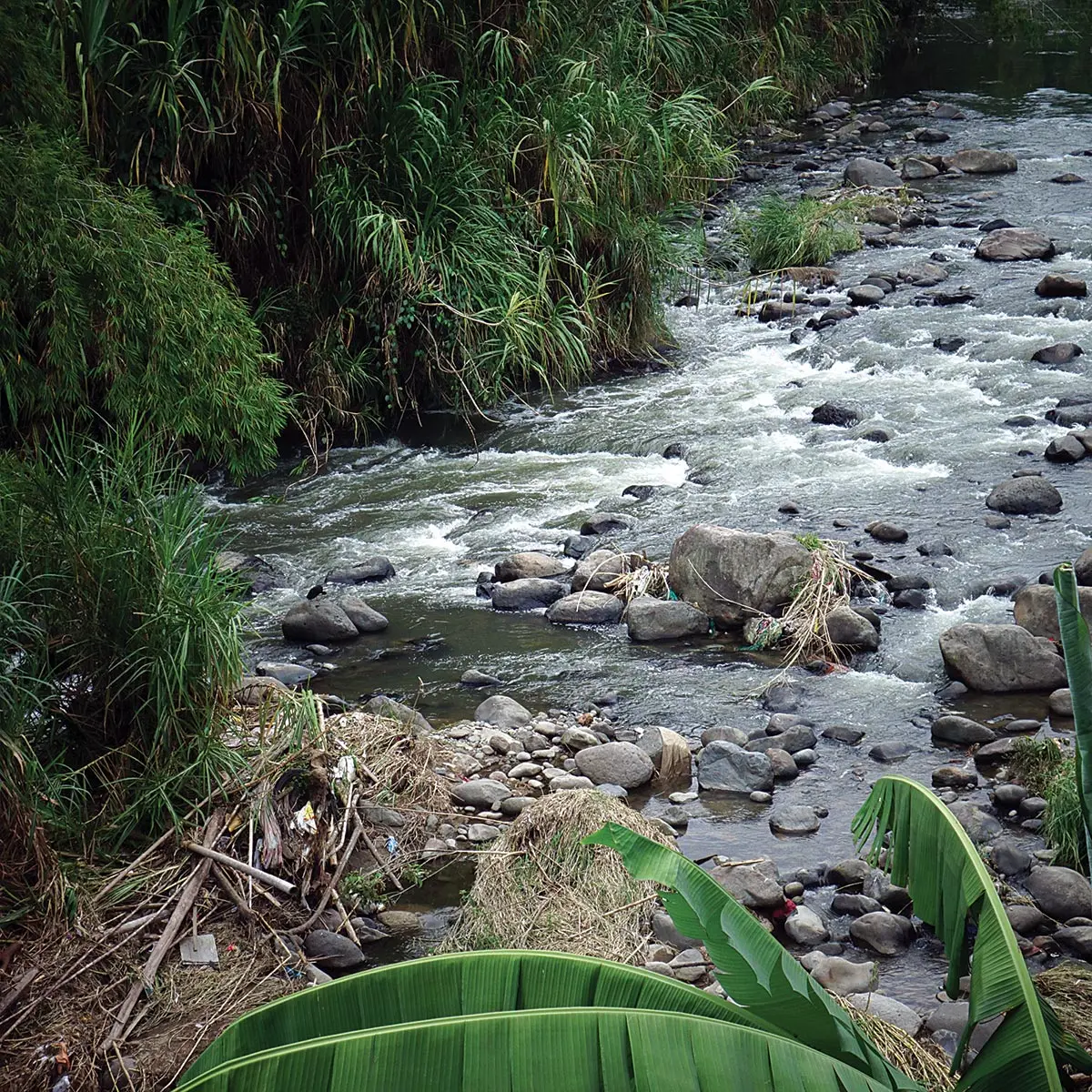
I found myself in front of a typical Coffee-region river, filled with rocks and perhaps quartz and emeralds; the biodiversity on its banks was striking, as was the abundance of trash and the ramshackle huts people have built for habitation. Abad decided to name the work El río escultor de piedras (The River, Sculptor of Stones), quoting a bambuco (a traditional song from Colombia’s emerald region) titled Pereira, by Luis Carlos González. This landscape already defined my perception of the Salon, which I will attempt to summarize in two words: tectonics and fluxus. By this, I mean a Salon featuring the presence of mountain ranges and seemingly immutable geology, and the almost always hidden flows that shape it: rivers, music, conversations between artists, the unstable life of a society that is both agrarian and urban, the invisible movements of money, and an awareness both of the transience of life and of history as a flow that continues to shape the present.
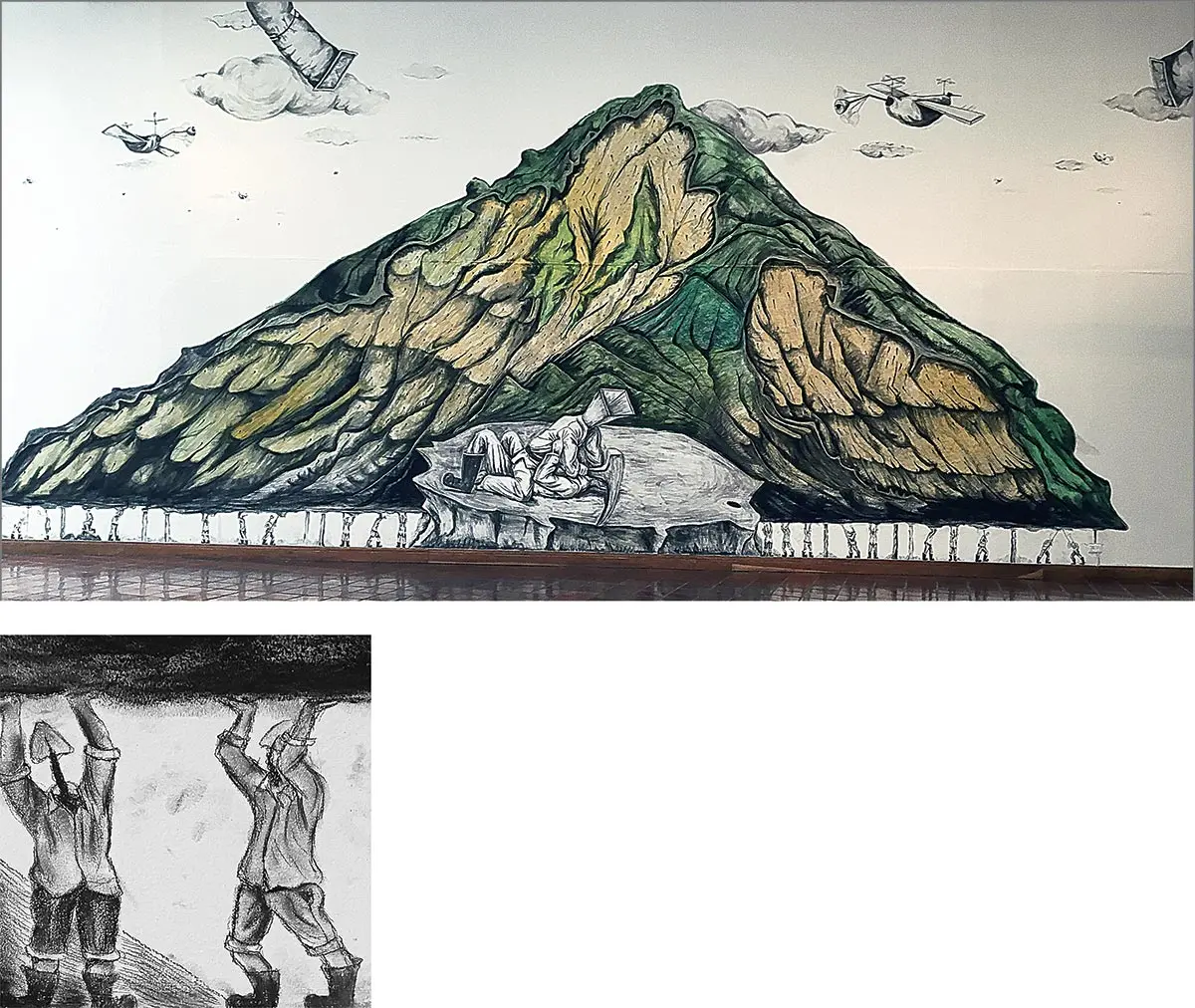
Later I visited one of the galleries of the Pereira Art Museum, preceded by a mural by Indian artist Prabhakar Pachpute. It was a large green-colored mountain, made in a way I haven’t seen for years in an art exhibition: an experimental painting in acrylic, charcoal, and pastels that worked very well and evinced the intention to bringing into the gallery a series of many-gorged mountains, paradoxically supported by the thousands of miners who have remained invisible to Colombian society since the Eighteenth Century. This mural originated from a visit by the artist to the gold mines of Marmato, a municipality in Caldas where the exploitation of the mineral is the dominant activity. Pachpute’s work already began to propose porous tectonics, presenting us with the image of dark tunnels where the miners are hard at work.
This gallery provided a visual complement to the proposal of looking at the local geography, again emphasizing the region’s rocks via Dibujos móviles (Mobile Drawings), a work by Luis Roldán: the wall was occupied by small gestures in a wire; the floor, by muñeca stones that can be broken almost perfectly in half by a single strike, and also the gestures of life in the Coffee Region. Interestingly, looking up online the description of the Marmato municipality, one learns that it is so mountainous that houses grab onto the slopes in order not to fall—a description that applies to thousands of towns in Colombia. Matilde Guerrero’s Tierras prometidas (Promised Lands) was made with the aesthetics of a nativity scene: gilded and shiny façades of homes, buried with a gesture that wavered between decisiveness and instability. All of these works were preceded by Héroes mil (Heroes by the Thousand), by Juan Fernando Herrán, a monument that appears to have been built out of wooden crates and results, in consequence, transitory like a precarious concept of nation. But this gallery also offered a point of historical inflection: in this case, two landscapes in a romantic vein due to their theme and their interest in the contemplation of nature, both by Gonzalo Ariza, a mid-Twentieth Century Colombian painter. The entire selection of works proposed a reflection about ways of representing the landscape, an idea not particularly enveloped in urgency. In truth, even today the landscape of Colombia invites contemplation and imitation, but the social situation undermines those moves and demands other ways of representing it.
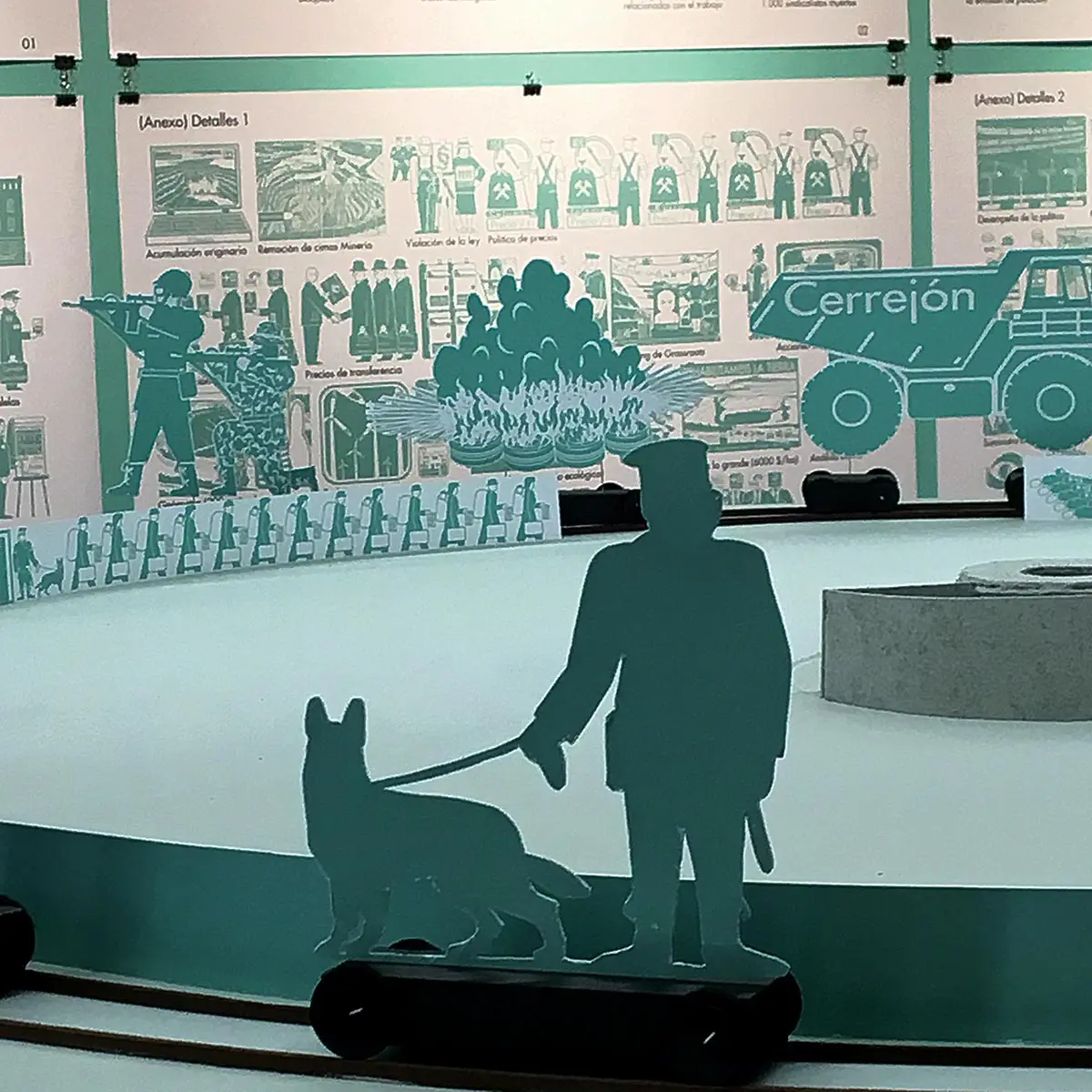
Such some fragile tectonics already found itself battered by injustice and invisibilization in other areas of the Salon. The Rialto, an emblematically modern building, was turned into a series of exhibition spaces where a critical consideration of inhabiting unfolded. Andreas Siekman presented the paradoxes of the mining economy in countries like Colombia, which extracts carbon with all kinds of ecological consequences and exports it to a place like Germany, which in turn prides itself in no longer being dependent on mineral exploitation and having become, rather, a flag-bearer in environmental policies. Siekman’s work deployed many resources to transform the document into a kind of mural or “pedagogical” billboard with a sense of humor, a whole theater of two-dimensional cutouts—bringing to mind Egyptian mural art and the stage games of children’s theater—where the contours of things, of depredation, and of armies are paraded in public.
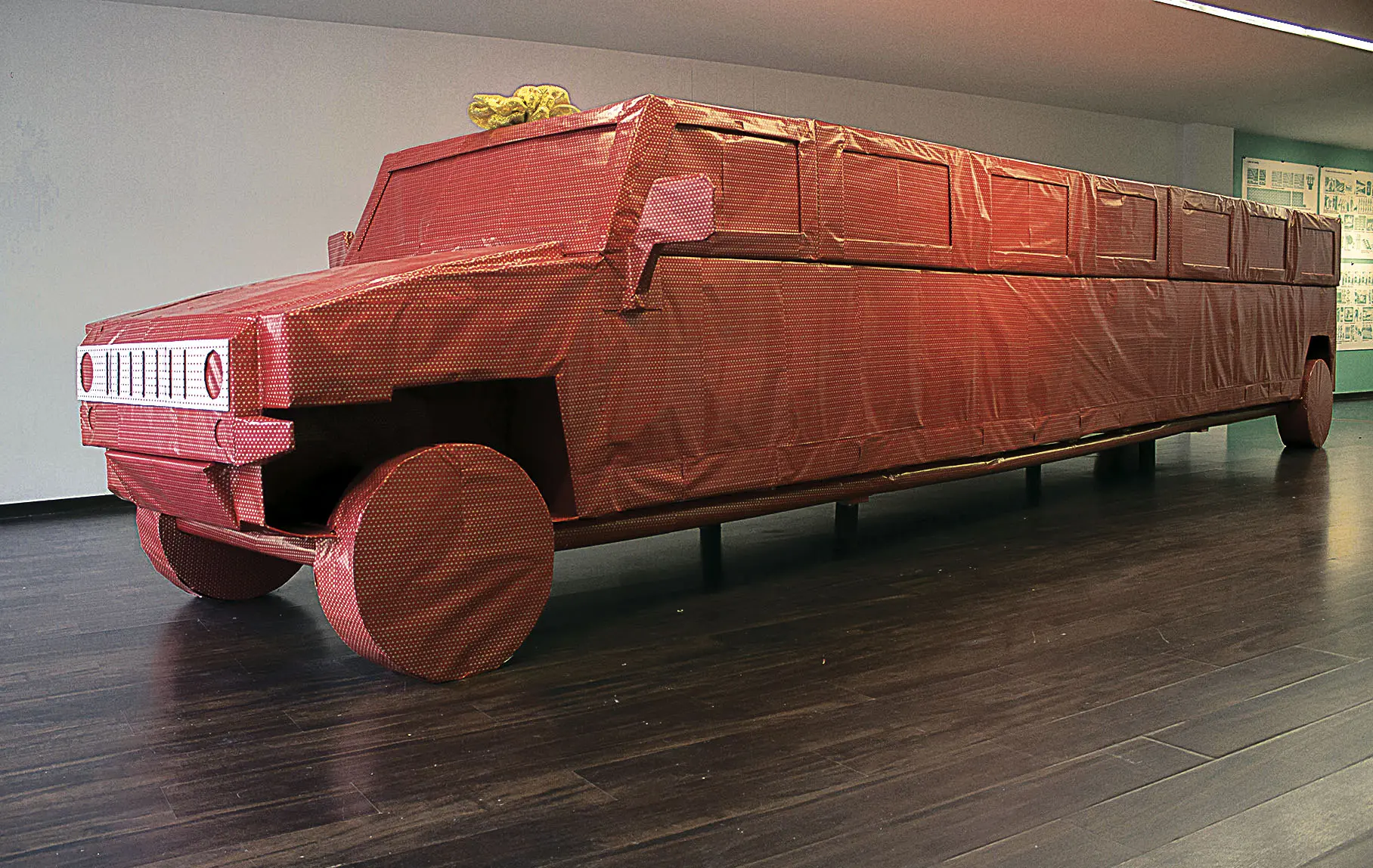
In these galleries, we perceived an urgent highlighting of the invisibility of, for example, money flows. Carlos Bonil exhibited a huge truck made from cardboard and wrapped in gift paper. The title, Ya muy desagerado, uses an untranslatable colloquialism to emphasize the presence of drug money, at times so ostentatious that it cannot be denied, yet often unmentioned. The gift-wrap paper brought to mind Anexo 273 (Annex 273), a 1996 work by Juan Fernando Herrán that visually presented a newspaper item about the cash money sent by a Colombian cartel, inside gift-wrapped boxes, to a presidential campaign.
Equally invisible are the massacres, between feast and horror, perpetrated by paramilitary forces in Colombia. A large piñata in Paulo Licona’s H.H: Hermoso Horror (BH: Beautiful Horror), left our perception irreconcilably crisscrossed by the issue of the feast and the cruelty experienced, in hidden ways and for many years, by war-torn countries.
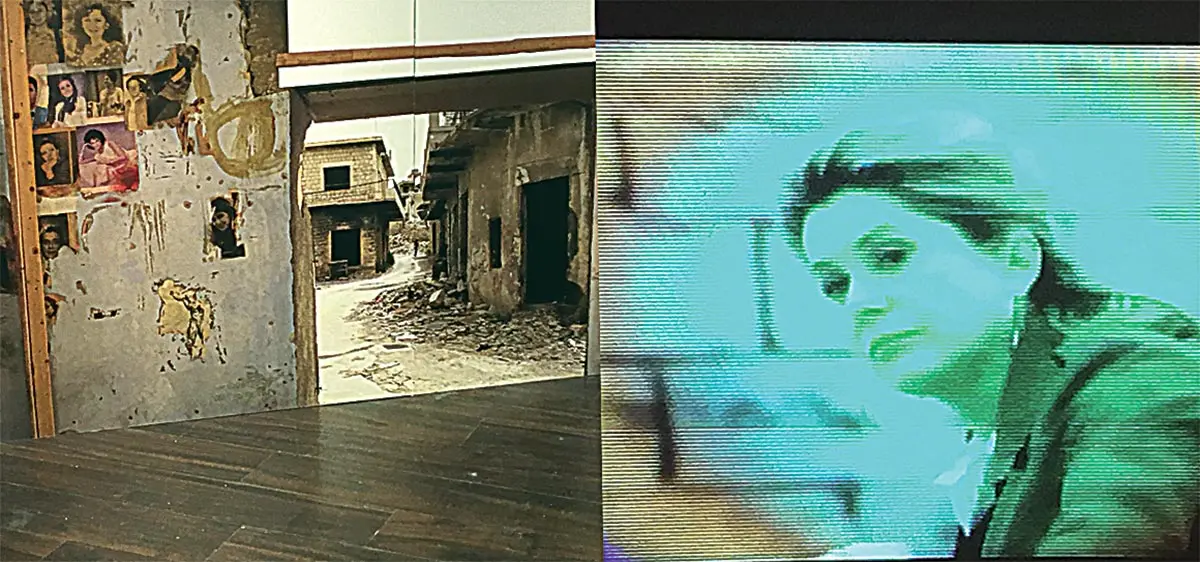
In the work presented by Lebanese artist Rabih Mroué, a barricade detached from the gallery wall and supported in the back by a war-like architecture was used to display photographs of spaces left in ruins by sustained shelling. The barricade was accompanied by a film of the face of Catherine Deneuve as the actress walked around war-ravaged areas of Lebanon. Je veux voir underscored the urgency of looking at the devastation caused by war all around the world, and in Colombia, and was perhaps intended as a prod for viewers to look, through the gaze of a well-known film actress, and to counteract the psychological mechanism of foreclosure, which banishes acts of suffering and cruelty from the individual and the collective imaginary, allowing us to not see or think about them.
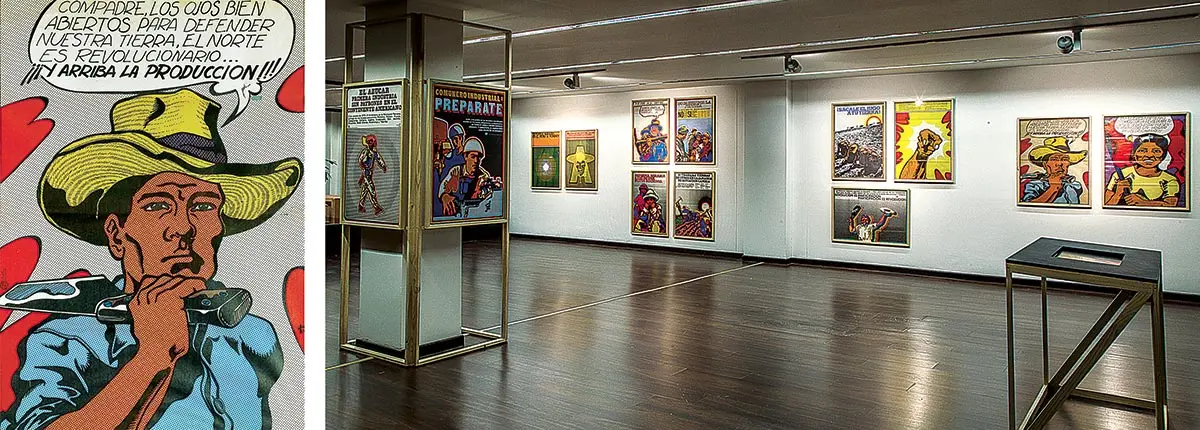
Agrarian issues erode these tectonics. The graphic resources, color, and photography of a series of posters about the struggles of Peruvian peasants stood out in these galleries at the Rialto. Inti Guerrero tells us that these posters were published between 1968 and 1973 by the Communications Office of the Land Reform launched in Peru by the military junta known as Revolutionary Government of the Armed Forces. The posters were created by La Oficina (The Office), a group of designers, photographers, writers, and journalists dedicated to the production of copy and audiovisual materials to publicize the reach of the economic, social, and cultural revolution led by General Velasco, head of a regime seen as leftist and anti-imperialist in the context of the ideological divisions that characterized the Cold War. The basis for the production of these images was a series of photographs by Jesús Ruiz Durand. The inclusion of these photographs in the exhibition is important because the Salon included historical enclaves intended to express Latin America’s still unsolved issues. Inti Guerrero notes that “as in Colombia, in Peru, the failure of the land reform resulted in the survival and entrenchment of the latifundism system, the disproportionate concentration of land property and wealth, which anchored social injustice and drove the people to insurrection and to a war ultimately contaminated by drug trafficking.”
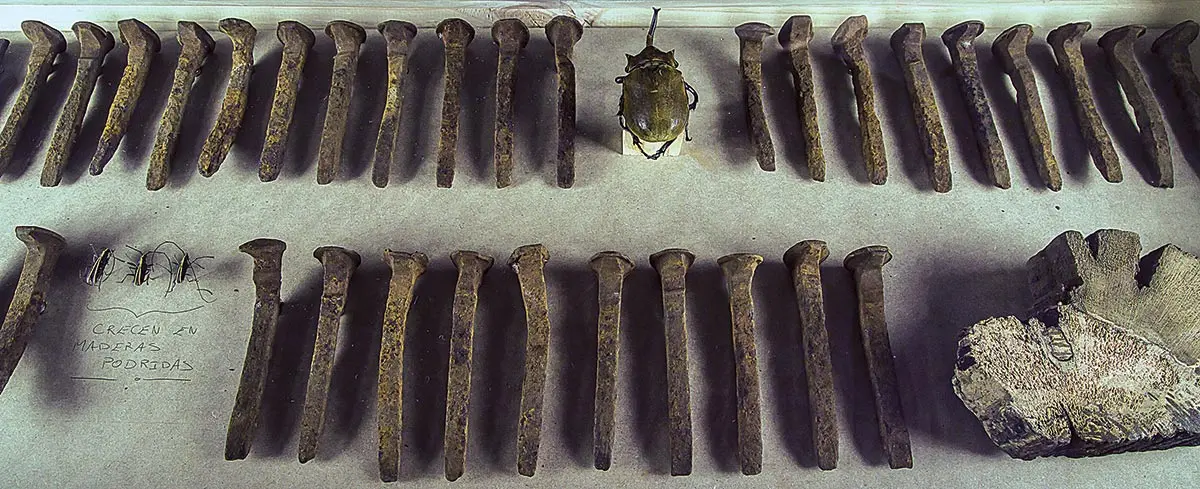
Indeed, history expanded our gaze throughout the Salon, opening up spaces of time as duration. Durmientes (Sleepers), by Costa Rican artist Oscar Figueroa, was based on an expedition in which Figueroa followed the railroad tracks used in the 1920s for the transport of United Fruit bananas across Guatemala, Honduras, Costa Rica, Colombia, and Panama. Figueroa’s expedition was intended to salvage the traces of the railroad sleepers, both literally—through frottage of the wood bricks—and metaphorically. I was reminded of Colonel Aureliano Buendía in One Hundred Years of Solitude, who, after the massacre of protesting United Fruit workers in Ciénaga, wakes up on a train and takes some time to realize whether he is surrounded by corpses or by sleepers. The exhibition dialogued with Débora Arango’s El tren de la muerte (The Train of Death), a painting from the 1940s-depicting piled-up bodies surrounded by a halo.
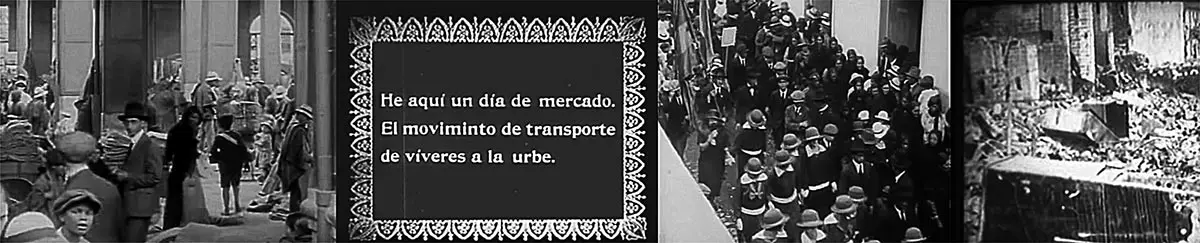
Manizales City, a 1925 documentary by Félix Restrepo, also surprised me. Made with silent-film aesthetics, it presents life in that mountainous, coffee-producing city, showing us its social classes, occupations, festivities, and architecture, and also the remains of the 1924 fire that almost destroyed it. Such time enclaves make me realize that this National Salon did not deflect the debates that have raged in Colombia since 2005, about whether to organize regional salons or a single independent National Salon with a more international vision. Instead, I think that this 44th Salon sought to engage those debates, expanding the concept of “the regional” beyond the mere use of the word and presenting proposals that speak from specific sites and specific bodies, in order to discuss “the regional” in terms of temporalities, artistic proposals, discourses, and issues that are common to many places around the world.
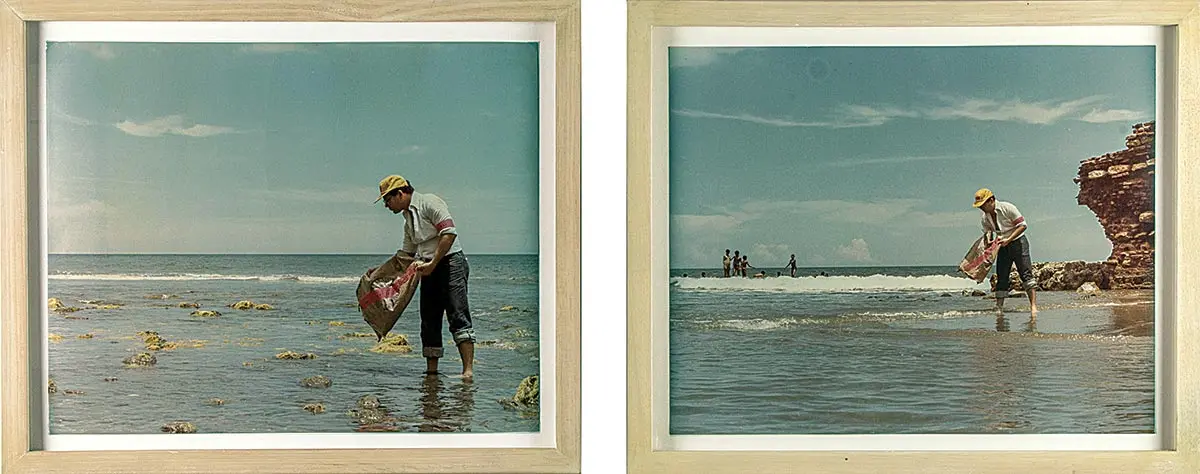
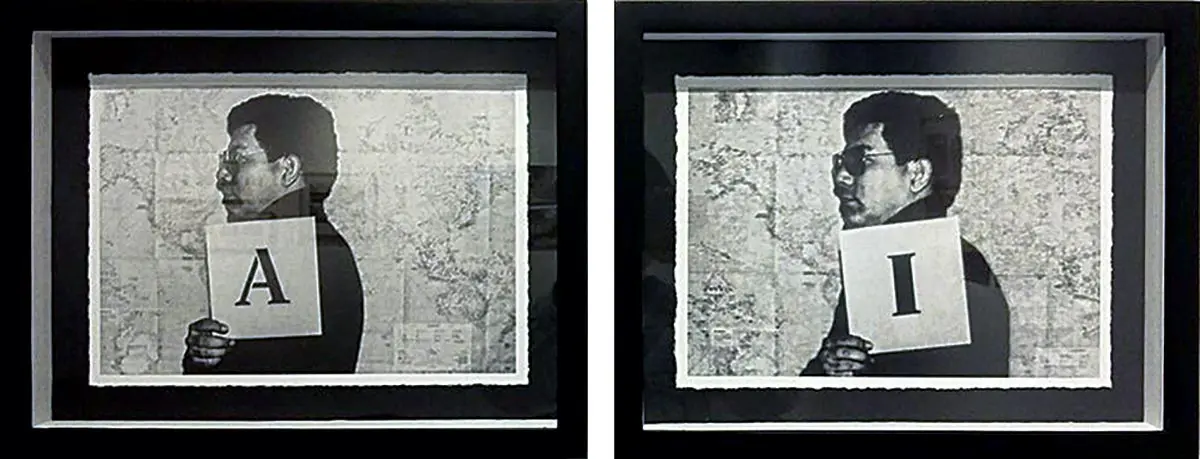
The curators of the 44th National Salon were: Rosa Ángel, Artistic Director; Inti Guerrero, International Curator; Guillermo Vanegas, Regional Curator; Víctor Albarracín, Editorial Curator; Liliana Andrade, Museographer; Carolina Ponce de León, Visual Arts Director, Ministry of Culture. This team launched open calls and invited other groups to curate as well. One result was Todo lo que tengo lo llevo conmigo (All I Have I Carry With Me), an exhibition curated by Ximena Gama and Pamela Desjardins, where artists, including the memory of María Teresa Hincapié, signaled towards forgotten private histories. Another was La Usurpadora (The Usurper), a group formed by María Isabel Rueda and Mario Llanos. This group is based in Puerto Colombia, Atlántico, and from there they proposed a look at two artists from the Colombian coastal region: Álvaro Herazo (Cartagena, 1942-Barranquilla, 1988) and Alfonso Suárez (Mompox, 1952). It was important for me to see their works again, with their fluid swing between humor and precision in dealing with such topics as the uprootedness and the constant journeying of the contemporary subject, or the transformation of our rivers into garbage dumps, or the ocean that challenges us—in one of Herazo’s works—to see it as a space for concrete and cement. The curators say something that is very interesting: these artists present their concerns from the platform of their own bodies. They build a private space on the basis of objects and offer up their bodies modified by all manner of concerns that deserve to be included in our discussions of “the political” and “politics” today.
This is a partial review of a Salon filled with many proposals. Its title was: Aún (traduces “still”, but also “yet”). It reminds me of Duchamp’s The Bride Stripped Bare by Her Bachelors. Aún, a word that is open to the temporality that presents history as an impossible idea of progress, but not as an inevitable ruin.
NATALIA GUTIÉRREZ