
Bridge was the first solo show by Costanza De Rogatis and organizing it meant many things: One involved the review of images whose lecture could be coherent through a specific discourse; secondly, such discourse had to be as close and authentic as possible to this photographer’s perception of reality; and, another, required the alignment of certain personal situations that inspired the photographic shot. Thus, the need for a “bridge” that connects the environment to De Rogatis’s intimate and sensitive perception.
Erik del Bufalo, the author of the exhibition’s introductory text, points that Bridge is not “merely a collection” of images, but that it is actually about a passage, a journey, as the photographed objects are transient, stopping just for a while before moving into another dimension. To photograph in these works means to go through rather than to capture.” Indeed, the sequence of images that De Rogatis presents are visual lectures on certain introspective “journeys” that she expresses through images. More than capturing the motive, she establishes—through the motive—a correspondence between it and her way of visibly externalizing her affections or sensations. This is the reason why photography as a technique or as a “means of communication” is not really the most important thing for her. What De Rogatis cares about above all is the expression of the very personal content, the presentation of specific natural places or body images that lead to affective situations involving her or her family—all under the veil of sensations and framed by her singular way of relating to the outside world.
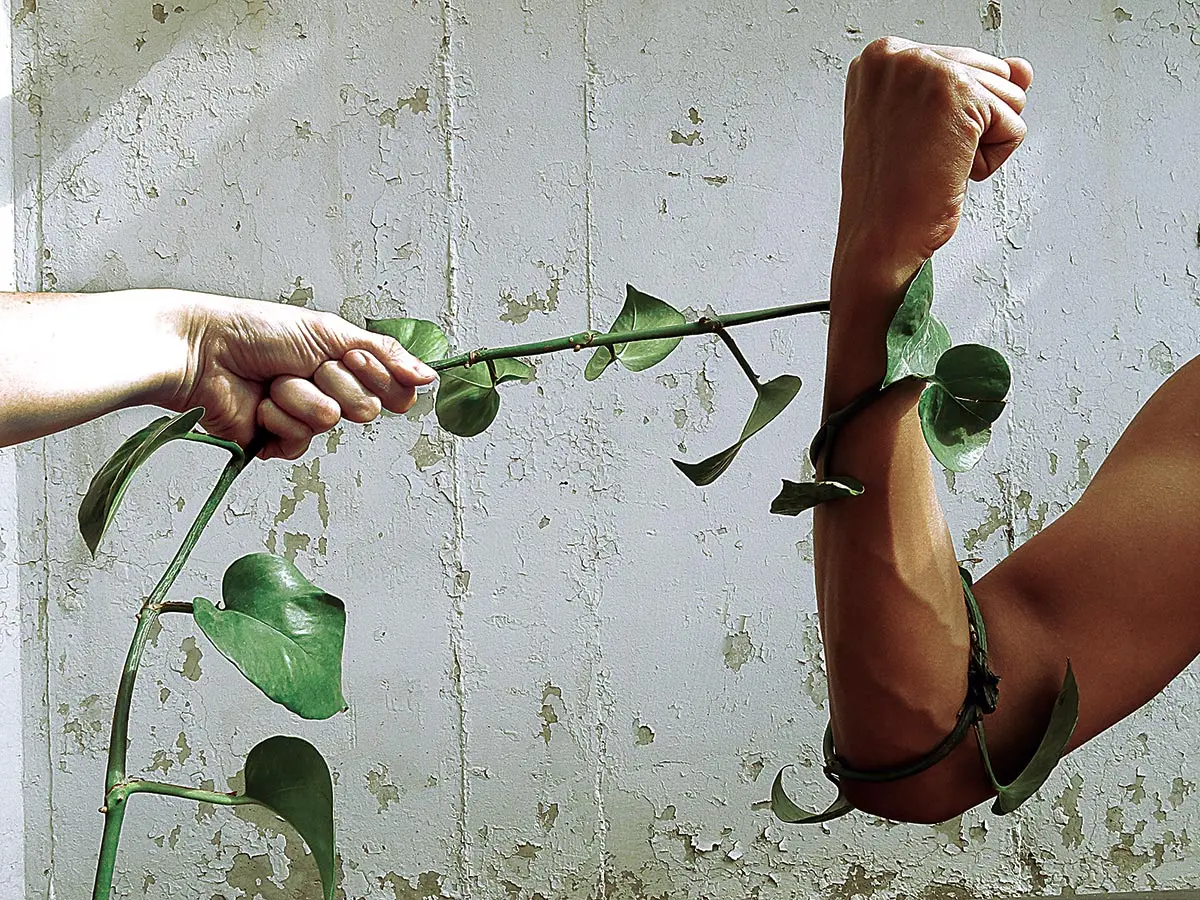
In this manner, the term “bridge” is used as the name of this exhibition to convey this passage from perception to meaning. One directly implies the other and vice versa. Under this binary premise between seeing (perceiving) and feeling, several conceptual associations are contained in the images and in the manner in which they influenced the mounting of the exhibition. The images do indeed appear to be grouped in “series” or “thematic cores,” within a montage of various superimposed formats displayed at different heights, taking the form of something that feels like syntax. There is in these sequences a visual narrative in which Costanza De Rogatis successfully sublimates that which remains hidden in her internal world; in that other side. And she is able to bring it to the surface through photography. And the result is highly tactile images that make us feel as if any natural or organic element (water, vegetation, rocks, fire) was touching skin (her skin, our skin). We also sense the beating of a non-human heart; an animal’s heart posing voluminous and grotesque on a plate. We observe, and feel, the skin is lacerated, hurt, burned by the sun, or by the pressure exerted by a couple of clothespins. We observe the body as mass, but also see the way it contours in all of its beautiful femininity.
The images are revealed as if someone were speaking to us from the depths of a soul, a feminine soul. It is a whisper that comes through eloquently but vulnerable, expressed amid an emotionally complex context. Here, the body appears to serve as a container of sensations that include affections like touching another person, a sister, her pair.
Nonetheless, the persons are not identifiable. Their faces and figures are hidden or only shown in sections, possibly as a result of formal decisions of a compositional nature or to emphasize or showcase some meaningful—and personal—aspect of the image. The composition is established ahead of time for each shot by the photographer’s gaze. But the composition also plays a defining role in each syntactic construction established by De Rogatis among images. This discursive condition also builds a bridge between images and sensations that is up to us to connect. Light, on the other hand, conditions the predominating temperature in all of them. Light allows us to perceive “temperate scenes” as contrasting environments of light and shadows. Thus, light covers but also reveals.
It could be said that this exhibition is the result of a profoundly introspective exercise through images. It gives rise to a series of sensations that are interconnected—that have crossed the bridge—and that involve several senses: the sound of water, the humidity of the forest, the friction by the texture of rocks, the burning of the sun or fire, the softness of bed sheets, and so on. All expressed through various “mood temperatures” perceived in the light contrast, in the intimacy of mundane situations and, of course, in the body, in the positioning of a diversity of places and sensorial situations. Thus, photography as a bridge represents to Costanza De Rogatis the means through which she is able to sublimate all these contents, in order to “give a visible body to the things that have been imagined or experience.”
SUSANA BENKO