
On August 10, the Satélite curatorial project founded by Violeta Horcasitas published an invitation to an action by Eduardo Abaroa scheduled for August 20, 2016, at the Museo Nacional de Arte, in the exhibition space that contains works by José María Velasco. Satélite (self-described as a “reflection and problematization of the museum institution”) caused great controversy in social networks after presenting the mexiconceptual exercises by Heriberto Yépez, published online between the months of April and May as an ephemeral virtual museum. Yépez, who after his participation at the International Symposium on Contemporary Art Theory (SITAC) metamorphosed from a writer into a conceptual artist, later on, participated in a conversation with Abaroa organized by Satélite and published on August 15 by La Ciudad de Frente, an online tabloid, as part of a strategy to generate anticipation about the upcoming event that same evening at the Museum.
Among the names, references, critiques, and complaints that abounded in that conversation, Abaroa pointed, for instance, to something that broadly described what would come to be his action: “If we judge ideas and cultural practices by the results that they yield and not by the intentions behind them, then contemporary art would be poorly regarded, politically and culturally speaking. Today art is accessible in museums, but its coverage is elitist, insufficient, and centralized. Indeed, it does not know how to avoid being racist, just like the majority of Mexican society. Museums rarely succeed in appealing to the general public, and they know it; this is the reason they follow the logic of international entertainment.”
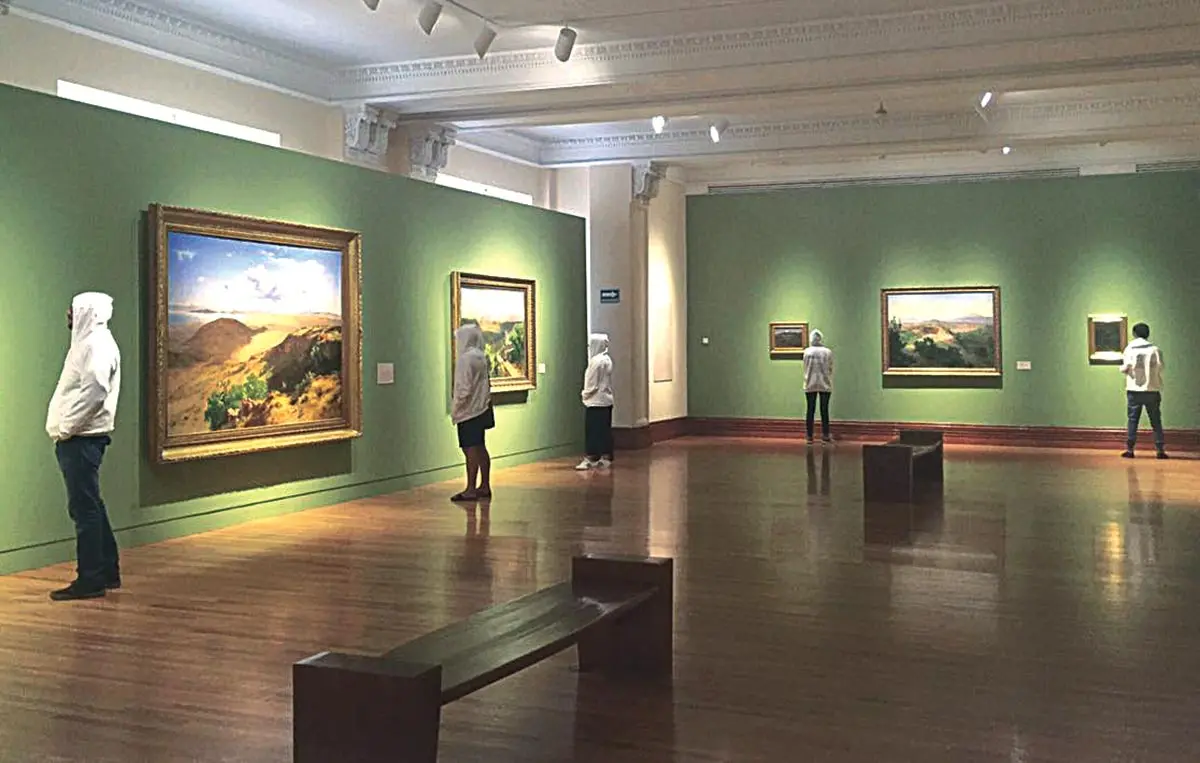
Known for turning materials and familiar, but uncomfortable, referents into monumental works, Abaroa understands that for a subversive exercise to be effective, it must be a momentary distortion. An absence of outside noise, an act of resistance that does not require legends on banners raised like weapons (to avoid any confusion with other political manifestations that it nonetheless reflects); but that it may inscribe such legends on something just as portable like, for instance, the back of t-shirts. Several volunteers could then wear them and stand in front of the information labels of José María Velasco’s paintings—images that portray the Oaxaca’s landscape in a highly conventional, but also highly paradigmatic, manner—long enough for the legends to become a rupture from the organic and official continuum by transgressing and transcending the content on the information labels; by superimposing these new labels on in the t-shirts as hypertexts—which are actually quoted from articles and news about conflicts, violence, and calls for sovereignty in several places in Oaxaca.
This is an action that Abaroa describes as “A hacker’s exercise; the producer of pirated material or any novice, all have the objective of subverting the flow of information, materials, and persons. A new range of possibilities of meaning is generated by interrupting or diverting such flow. This exercise consists of an experiment of tergiversation or détournement applied to the work of one of the most important Mexican artists of the 19th century (José María Velasco), whose work incorporated political, aesthetic, and scientific aspects that can be explored in an informal and transdisciplinary manner. The work attempts to reflect on the flow of both information and persons in the museum.”
This action by Abaroa is the actualization of a situationist sit-in. Abaroa himself cannot stop regarding as a virtual intervention, a materialization or three-dimensionalization of gestures and behaviors that define and are superimposed to the Web. It is a moment of agreed reality, a face-to-face challenge, the slogan of an intervention in a political place to explore the reach, content, and possible lectures of an artist, his work, and the exhibition space that houses it.
The photographs that document the action will eventually be uploaded by Satélite (and other sites) in order to authenticate it, to turn it into a civic act, news, into a gesture sold like a brand of bottled water; a place and a moment when, without conflict or confrontation, the stratification of cultural institutions was broken—even if just for a brief moment.
It is heroic and indecent, arrogant and means. As an act and as a virtual document it is experienced with too much solemnity not to become its own parody, which is also the parody of all the civic acts (from ceremonies to marches and sit-ins) that have defined the national landscape. This landscape that Abaroa transgresses and transcends reflects back, like a mirror, a harrowing wasteland in which the phenomenology of the Mexican survives despite us; a footnote in our folklore. By superimposing the narrated landscape of his legends on Velasco’s landscapes, Abaroa not only becomes a provocateur but also an ironist.
RICARDO POHLENZ