
The notion of a boundary—real and interior, physical and figured—and its calling into question reappear once again in Éter (Ether), a challenging exhibition of works by Eduardo Basualdo (Buenos Aires, 1977), at Ruth Benzacar Gallery. This evanescent exhibition—six installations—explores the boundaries of space, of perception, and of the body. Basualdo’s works demand attention with their intriguing simplicity, their evident fragility, and their enigmatic meaning. On this occasion, the wide range of materials used—plastic, glass, paint, drywall, metal beams, glue, paper, steel wire, iron, and copper wire—provokes an equal number of experiences in the viewer.
The lyrical text visitors find as they enter the gallery’s ample barn-like space is by Pablo Maturette—the author of El sentido olvidado, (The Forgotten Sense), an essay about the sense of touch—and talks about the feeling of being trapped inside one’s own body. “My body is not me, it is an oppressed continent, a terra incognita, a region of wretchedness…” In tune with this, Basualdo doesn’t lose sight of the drama implicit in the coexistence of body and mind. In that intersection, the artist is able to establish a dialog with the audience and insert a sense of reality in the fictional context that is a gallery or a museum.
Then, through the installation Puente levadizo (Drawbridge)—a wall with an opening, divided in the middle, with one of its sides fall forward and the other backward, with a steel cable across both to maintain their balance—which draws on the floor a line that grows upwardly to become space, we arrive at the exhibition’s unforgettable centerpiece: Indivisible. It is a large traversable wall and a white plastic sheet of the same size, which covers it like skin. Basualdo grants great power to the observer, who draws new outlines with his or her action, and creates spaces with his or her own figure. As the visitor’s body passes through and detaches the plastic from the wall, the installation becomes space, generating a new dimension. The sensation is hallucinatory; those who enter through one of its sides do not know what they will find at the end of the path that opens, as space exists because of their thrust and enthusiasm.
Is there some influence of Lucio Fontana? In a conversation with ArtNexus, Basualdo agrees. “The gesture is similar, almost identical, but the concept is different. What Fontana does is he punctures the canvas in order to denounce fiction… he shines a light on the fact that a painting is two-dimensional and that there is nothing on the other side (there is darkness or there is blankness.) At any rate, the cut I apply is a tangent, it never goes through to the other side. The cut goes inside the structure. The point is rather to know the nature of structures, of boundaries. My work in recent times has focused on the fiction of rules and boundaries.”
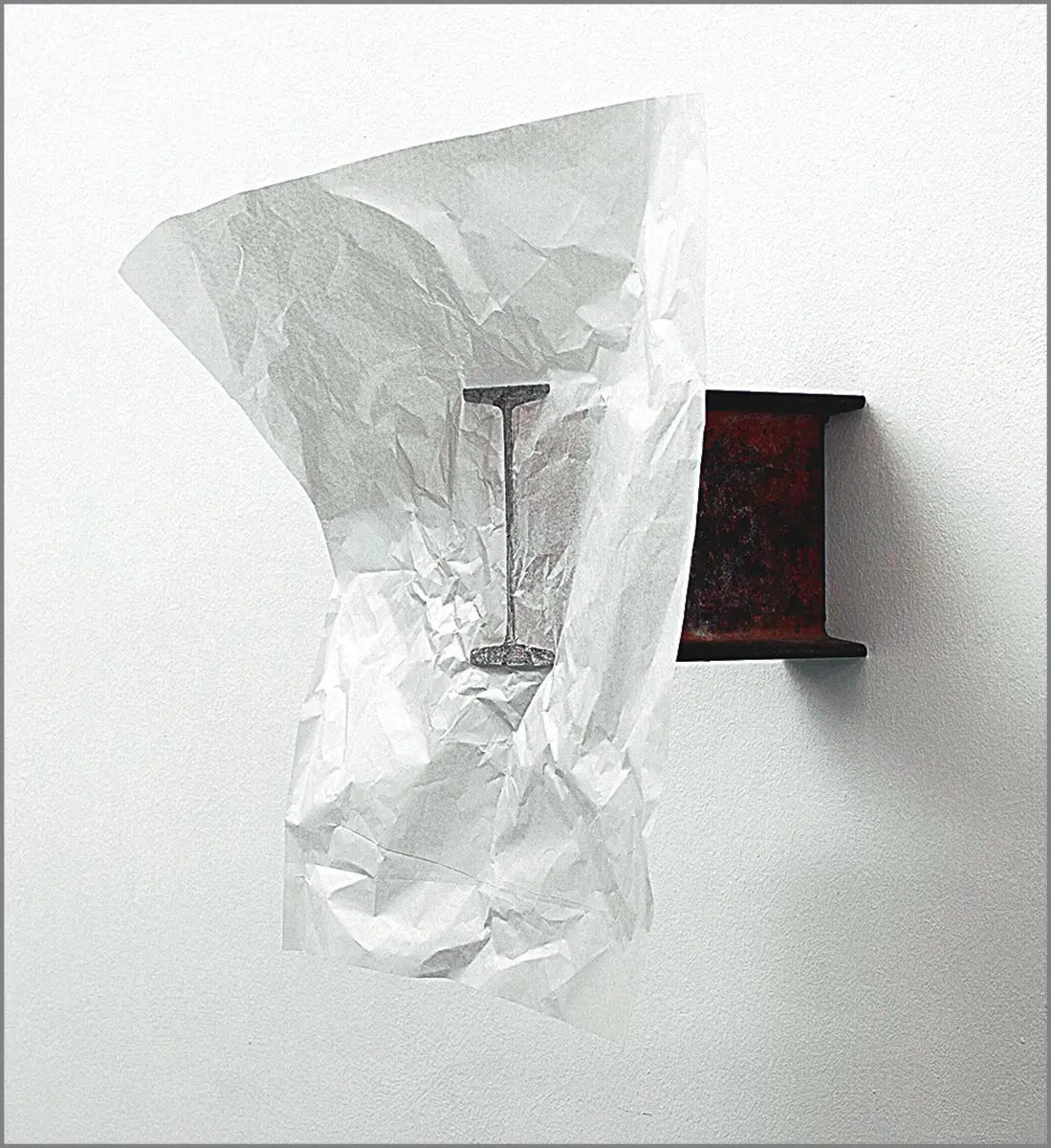
Space, again: El salto del león (The Lion’s Jump, 2016) is composed of a simple copper-wire ring (irregular in shape, 300 x 120 cm) suspended from the ceiling by a black thread; it is a portal that invites us to think about the possibility of openings rather than of closures. Almost in counterpoint, in Doble negación (Double Negative) our passage is doubly blocked: a window grill painted in white is installed on a wall of the same color. The closing of this challenging show, a show that presents us with unexpected situations and fills us with the vertigo of discovery, comes with Primera nieve (First Snow), where the exterior side of a beam that protrudes from the wall is covered by a thin sheet of paper, and Continente (Continent), which plays with the sign of “on air” that is turned on inside a radio studio during a broadcast, “as though the air was the material on which one can print.”
Basualdo is also a member of the Provisorio-Permanente group of artistic experimentation, formed by five young artists trained in different disciplines. Virtuosic and sensible, the group often juxtaposes in its works real events and metaphysical fantasies. Provisorio-Permanente (the name translates as Provisional-Permanent) builds devices influenced by Sci-Fi, based on optics and locksmithing. They incorporate elements from literature, film, and the theater. Deeply memorable is Nocturnidad (Nocturnality), their beautiful and heart-rending installation in tribute to Héctor G. Oesterheld (kidnapped and disappeared by the dictatorship in 1977, along with his four daughters), the author of the mythical graphic novel El Eternauta.
In his still young but intense career, Basualdo has previously exhibited solo at the Universidad de Antioquia Museum (Colombia, 2006) and Ruth Benzacar Gallery (Buenos Aires, 2009). His participation in such international events as the Venice Biennale (2015), Gwangju, (Korea, 2014), Montevideo (Uruguay, 2012), Lyon (France, 2011), Mercosur (Brazil, 2009), and Pontevedra (Spain, 2006), attest to his ascendancy, as does his presence in institutions, fairs, and galleries both local and international, where he dazzles us time and again with his proven talent.
VICTORIA VERLICHAK