
Thanks to his consequent, lucid, and sustained efforts at visual investigation, Hayfer Brea (Caracas, 1975) is today one of Venezuela’s most relevant contemporary artists. Brea’s career has been characterized by the solidity of its proposals, based on an inquiry into the landscape as an artistic subject, and by his interest in subverting and positing new ways to engage it.
Brea’s first approach to the subject first came through his long study of the mountains. Some years ago, however, he turned his attention to bodies of water, especially the Caribbean Sea and the lakes of Valencia and Maracaibo. This approach has already resulted in many artworks and exhibitions, the most among the latter being Una línea imaginaria (An Imaginary Line) and Registro de territorio (Register of Territory).
Although they ran almost simultaneously, these two shows differed notably from each other both in the way the artist came at the study and representation of bodies of water and in the aesthetic resolutions of the work as such.
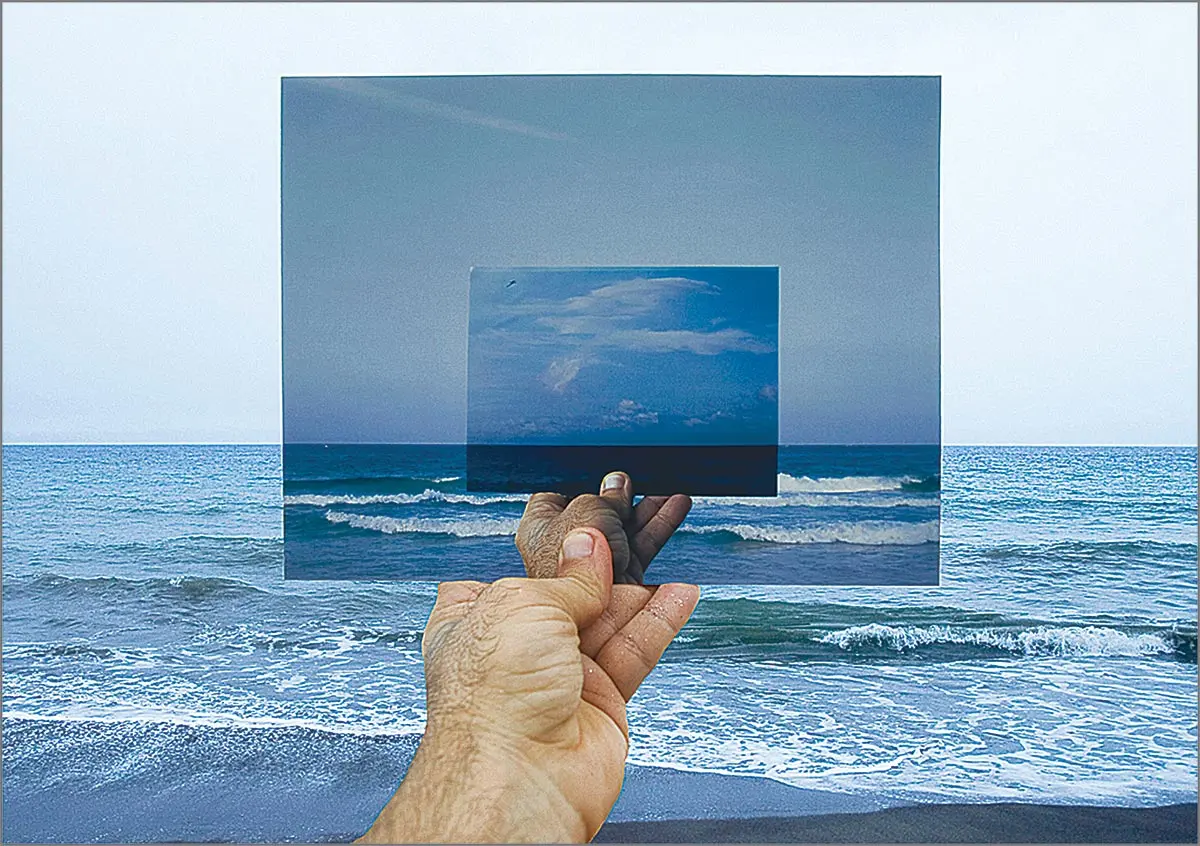
In Una línea imaginaria, Brea reflected on the horizon, an element that is inseparable from the notion of landscape, using the resources of contemporary art in its more conceptual tilt.
The exhibition featured eight impeccably presented works. In Línea pétrea (Rock Line), Línea quemada (Burnt Line), and Horizonte contenido (Constrained Horizon), Brea established a visual interplay between the subject of the sea horizon, posited as a line, and the materials used in the elaboration of the work (rocks and seawater, characteristic of the coastal region, or charcoal, a tool of his trade). In Línea pétrea, for example, Brea put together gray rocks that had a linear incision of white matter. Placing them next to one another on the wall, he was able to form an extremely subtle horizontal line. In Línea quemada he used pieces of charcoal to create a black line on the wall, accessing, in that kind of visual tautology, a minimal representation of the landscape.
A different set of works, like Tres momentos, tres lugares, un horizonte (Three Moments, Three Placer, One Horizon) and Línea fragmentada (Fragmented Line), use photography as a medium to reconstruct the horizon on the basis of several vistas of a single landscape, or of different ones. These fragmentations and distancings place the viewer halfway between the traditional contemplation of the horizon and its apprehension as a concept and recreation.
Finally, Horizontes impresos (Printed Horizons) and the videos Una línea imaginaria (An Imaginary Line) and En lontananza (Faraway) seek to establish semantic games by the introduction of the written word as a tautological resource.
The exhibition Registro de territorio is part of a long-range project. As its title has it, it brought together the photographic registers of the artist’s performance actions at lakes Valencia and Maracaibo. In them, Brea introduced a sheet of paper into different spots around the lakes, allowing for water to leave its horizontal mark on the support, like a watercolor. The photos show the moment when the artist submerges the paper in the lake, so he is also in the image. In these works, Brea subverts the usual modes of representation, allowing the landscape itself to leave its aesthetic imprint on the support while underscoring the artist’s mediating intervention in the process of representation. To my mind, this work is Brea’s riskiest approach to his inquiry into new ways of studying and representing the landscape, inasmuch as it considers the mechanisms that this representation conceals, unveiling its most basic strategies.
Registro de territorio includes, as actions, not only the registers, but the plot of different physical explorations of the site, the repeated visits, and the logistical actions that are required to achieve the end product.
KATHERINE CHACÓN