
The São Paulo Cultural Center (CCSP in its Portuguese initials) presents Hudnilson Junior: Zona de Tensão (Hudnilson Junior: Zone of Tension), curated by Marcio Harum, María Adelaide Pontes, and María Olímpia Vassão, a large-scale retrospective of the work of the São Paulo artist (1957-2013). Hudnilson Jr., a pioneering figure in the use of Xerox art in Brazil, was a multimedia artist; his work is the result of a meticulous and challenging process, and he turned the exercise of his creativity into a metaphor for his own life.
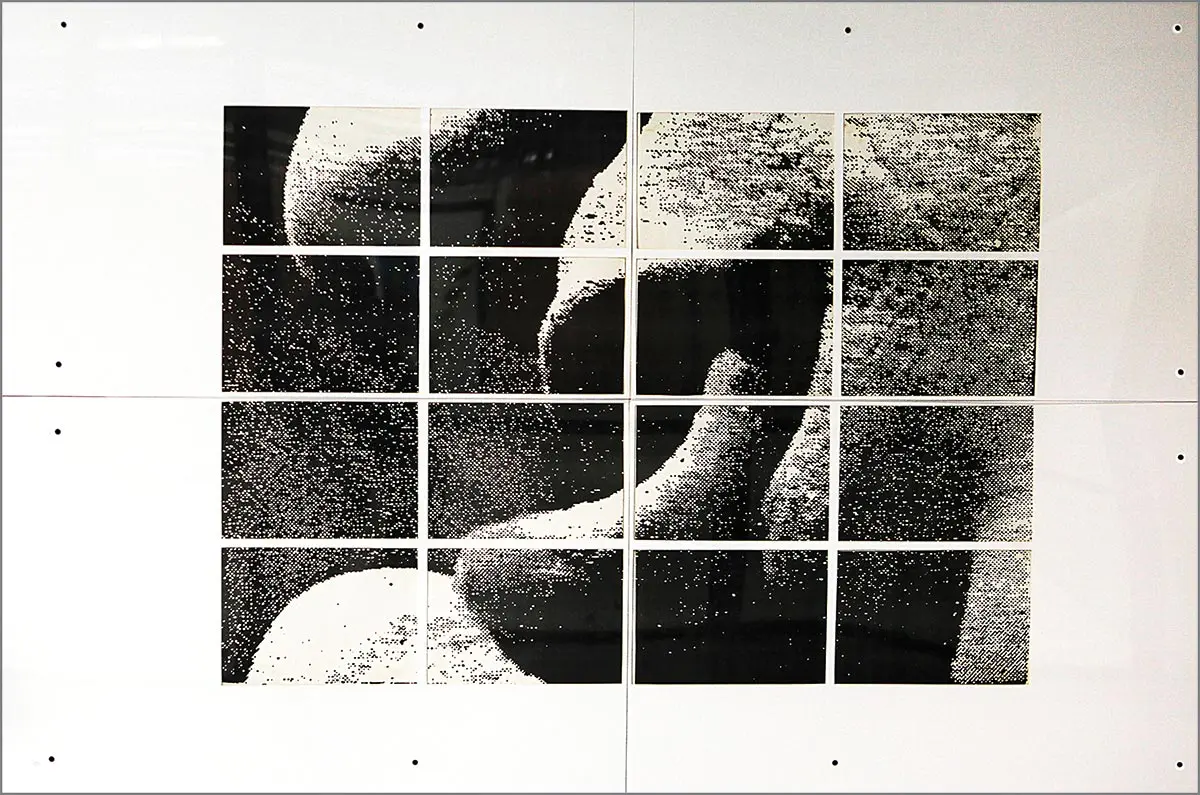
Set in the Tarsila do Amaral gallery, the exhibition features a selection of fifty artworks by Hudnilson Jr. and is organized around four thematic segments: Posição Amorosa (Love Position); Narciso (Narcissus); Zona de Tensão (Zone of Tension); and Referências e intervenção urbana (References and Urban Interventions). The works selected for this exhibition come from the São Paulo Cultural Center’s own collection, from the artist’s family’s holdings, and from Mário Ramiro’s collection. The potent selection provides an immersive journey into Hudnilson’s art, his creative power, and his pioneering attitude with regards both to Xerox Art and graffiti.
The curators took great pains to present not only Hudnilson’s works but also the process that resulted in them, using to that end his Cadernos de Referências (Reference Notebooks), sort of albums where the artist collected images, erotic journals, visual maps, assemblages that supported his creation; his personal process notes and reflections; and a collection of articles and news clips: Arquivo de Arte na Rua (Archive of Art in the Street), a selection organized by Hudnilson as an extended newsreel of urban art over the course of approximately thirty years. Hudnilson’s writings show great concern with the method and an obstinate quest for perfection.
Hudnilson’s oeuvre is marked by eroticism, self-referentiality, and a cult of his personality, all with the body as its founding principle. Inflammatory, alternative, it explores an obsession with organization and painstaking care not only of his work but also of his referents, which end up constituting an immense visual map. Hudnilson’s meticulously recorded, cataloged and commented on his own process. He even made notes and wrote directions for the set up of future exhibitions according to the original idea, as well as self-critiques and comparative charts of the results of different shows.
This exhibition makes it possible for us to follow Hudnilson’s career through works developed at the CCSP, the Pinacoteca de São Paulo, the biennials in which he participated, his explorations of Mail Art, Xerox Art, performance, installations, collages, and urban interventions with the 3Nós3 Group.
The four exhibition segments make explicit the close connection between the artist’s practice and his own life, his desires, passions, vitality, and aspirations: Posição Amorosa presents his investment in Mail Art, which originated the series and its investigation of sexual-emotional relationships, as well as Hudnilson’s dialog with the many artists who, prompted by his postcards, replied in the same manner; Narciso puts on display the intimacy between the artist and the mirror/device that in the Narcissus myth appropriates the image of Hudnilson himself: the installation is an enviroment composed using large-format fax printouts of the artist’s image, reflected on a large mirror on the floor; Zona de Tensão is an exercise in voyeurism and repetition, or automation, elements used by Hudnilson to explore the vast potential of resources such as enlargement and gigantism, zoom-ins into intimate details, and the investigation of human scales in the urban space, an exercise through which figurative images were rendered abstract; Referências e intervenção presents the work of the 3Nós3 collective, formed by Hudnilson Jr., Mário Ramiro, and Rafael França, in the late 1970s. Added to this are the Arte na Rua archives, the collection focused on urban art that he kept for many years, and his Cadernos de Referências, which collected visual images appropriated by Hudnilson and edited into notebooks/journals by means of assemblage.
Hudnilson studied visual arts at the Armando Álvares Penteado Foundation (FAAP) between 1975 and 1977 and experimented with many modes of artistic expression. In 1979, alongside Rafael França (1957-1991) and Mário Ramiro (1957), he founded the 3Nós3 group, which developed interventions and urban art in the São Paulo landscape until 1982.
Hudnilson began his series Exercício de Me Ver (Exercise in Looking at Myself) in 1982. It consisted of the xerographic reproduction of parts of the artist’s own body and was exhibited at Galleria Chaves in Porto Alegre and at the University of São Paulo’s Museu de Arte Contemporânea (MAC-USP) in 1983. Hudnilson’s stencil-based graffiti works date from the mid-1980s. In those years he met Alex Vallauri (1949-1987), who guided and collaborated with Hudnilson on a number of projects. In 1984 Hudnilson participated in the 1st Havana Biennial and in Arte Xerox Brasil, an exhibition at the Pinacoteca do Estado de São Paulo that he curated. He exhibited at the 18th São Palo Biennial in 1985 and at the 3rd Mercosur Visual Arts Biennial in 2001.
In 2002 Hudnilson participated with Narciso Revisita Seus Espelhos 2 (Narcissus Revisits his Mirrors 2) in Rendam-se Terráqueos (Surrender, Earthlings), a group exhibition of graffiti art at Casa das Rosas, in São Paulo (his work was installed in the bathroom.) In 2012, the CCSP presented the exhibition Obra e Documento – Arte/Ação e 3nós3 (Works and Documents – Arte/Ação and 3nós3), with works by the triad of M. Ramiro, R. França, and Hudnilson Jr. (3nós3), as well as the team formed by Genilson Soares by Francisco Iñarra (Arte/Ação).
Also in 2012, Hudnilson Jr. participated in the exhibition Colagens (Collages, with Nino Cais) and in the group show Poética relacional (Relational Poetics), both in the São Paulo gallery of Jacqueline Martins.
HÉLCIO MAGALHÃES