
The description of Irene Kopelman simply as someone “who combines art with science” seems superficial when one comes to understand the depth of this artist’s commitment to the two fields of knowledge that are the focus of her work. In fact, she shows such interest in nature and the scientific method that she would qualify as a contemporary participant in the age-old search to define the physical and spiritual relationship of human beings with the natural world. Although the ultimate result of her exploration of nature is the creation of works of art, the process Kopelman follows is notably close to that of scientists who observe, classify, order and document what they discover in the biosphere.
Kopelman’s fascination with aesthetic creation linked to the scientific process has led her to take part in expeditions to lava fields in Hawaii and aboard a sailboat to Antarctica, as well as exploration trips to Mount Kinabalu in Malaysia and, in recent years, to the coasts and tropical jungles of Panama. For each of her projects, she has made drawings working outdoors, over long hours during which she is exposed—like an obsessive researcher—to sometimes extreme temperatures and inclement weather conditions. The works she produces en plein air, or in labs or studios while she observes specimens brought in from her fieldwork, have provided the base for the many solo exhibitions Kopelman has held over the years in Argentina (where she was born) and Holland (where she currently resides) as well as other countries in Europe and Latin America. In addition, starting in 2006, she has published a series of artist’s books titled Notes on Representation, which at this point include seven volumes.
In 2012, Kopelman was chosen as the first artist-in-residence at the Smithsonian Tropical Research Institute, an organization dedicated to studying biodiversity on the Isthmus of Panama. Since that first trip, she has come back on multiple occasions to Panama, where she has created uncountable drawings and watercolors of fallen leaves, lianas, mangroves, parasites, and the traces of crabs, among other things. She never takes the easy path: the representation on paper of the shapes she discovers in rainforests or the patterns of pellets of sands that crustaceans leave behind on the beach are intricate. It’s as if the very complexity of the subject captivates this artist, with her perfectionist outlook and untiring zeal.
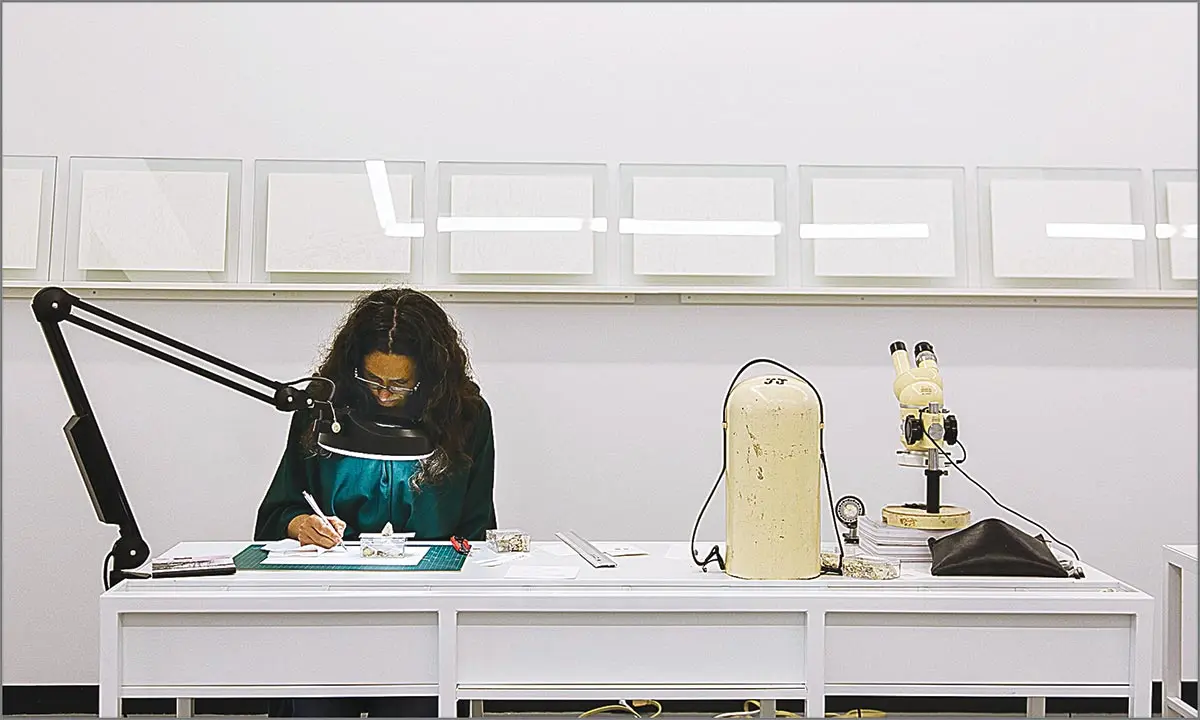
The opening of the exhibition at the Diablo Rosso Gallery in Panama City offered the public an unusual experience because the exhibition space had been transformed into a sort of laboratory, all in white. There were several metal tables, one of them set up as a working area with a magnifying glass and a microscope, and others with modular display areas that were still empty. Towards the back, on another small white table, were two rectangular, vertical aquariums with interesting live specimens of underwater mangrove roots. On the walls, on one side, there was a series of pencil drawings of mangroves displayed on a long thin shelf and, on the other, a group of detailed watercolors of those subaquatic roots with the colorful shapes that grow on them.
Kopelman had created the lab where she would be in residence during the five weeks of the exhibition, in such a way that the public could watch her carrying out her work. The material she would be drawing came from two research projects at the Smithsonian, the O’Dea Lab, and the Altieri Lab, which the artist explains in detail on her website. They consisted of fossil specimens she had brought into the gallery, as well as a series of experiments she would have to draw on-site on the Pacific coast, recreating the patterns that barnacles and mollusks leave on rocks. By the end of the exhibition period, the available display cases had been filled with the new works the artist had created during her residence-art action at the gallery-laboratory.
Even without knowing the complicated creative process involved in Kopelman’s work, her drawings impress and seduce the viewer with their simple beauty and subtle strokes. Her images are exquisite but also quite muted so that one has to come into intimate proximity with them in order to discover the nervous pencil marks or the delicate hues of the watercolors. Somewhat counterintuitively, her close-ups of tangled mangroves or microscopic interpretations of the intricate patterns of fossils seem to offer a grandiose view of nature. Kopelman’s images awaken a sense of almost reverential wonder towards the natural world. The artist shares a small part of her long conversation with nature, an experience that feels almost spiritual.
MÓNICA E. KUPFER