
Ivens Machado, a Brazilian artist born in the city of Florianopolis in 1942, died in May of 2015. He had moved to Rio de Janeiro in 1964 and exhibited regularly there since that time, gaining critical attention in the 1960s. He didn’t exhibit his work solo after 2011 when he developed the large-scale project of the France-Brazil House in Rio. Machado died without ever receiving the same degree of recognition that other artists of his generation, for example, Cildo Meireles, did. As gallerist Marcia Fortes insightfully noted in a text in 20151, Machado and American artist Chris Burden died in the same week and carried out investigations that were clearly connected. It saddens us to contrast the different fates of their respective oeuvres, clearly the result of the structural differences in the visual arts systems in the United States and Brazil. Fortunately, however, different curators are gradually revisiting the work of Ivens Machado, in spaces that invite the audience to forcefully experience its magnetic pull.
A first opportunity to see Machado’s work again came in the city where he lived for decades and in a space bearing some responsibility for the institutional recognition he has achieved, the Museu de Arte Moderna in Rio de Janeiro. Open in April of that year and curated by Machado’s friend Fernando Cocchiarale, the exhibition Ivens Machado featured works from the museum’s collection and from the recently established Ivens Machado Collection, currently in the process of being cataloged and researched. Recently, audiences in São Paulo had a chance to visit a portion of the artist’s oeuvre in O cru do mundo (The Raw of the World), curated by Kiki Mazzucchelli at the Pivô, an important independent space for the visual arts in the city. As the curator’s text reminded us, Machado’s last large-scale exhibition in the city was held in 2002 (at the Pinacoteca do Estado de São Paulo), and the new show helped him dialog with younger generations who may not be aware of his oeuvre.
One fact that quickly grabbed one’s attention was the dialog between the materials used by Machado and the architecture of the Pivô, a space integrated into the Copan building, projected by Niemeyer between 1952 and 1961. There is a clear connection between the construction materials manipulated by the artist and the concrete that dominates the space. The iconic character of Machado’s works was highlighted even more by the curatorial decision to leave large breathing spaces between them. Often, our gaze moved towards those images, which seemed to have been born from a site-specific intention rather than being objects transported to the exhibit location and organized there. It was inevitable to wonder how the artist would have reacted to the exhibition and, also, what works he would have been able to create especially for an encounter with the building’s solemn architecture.
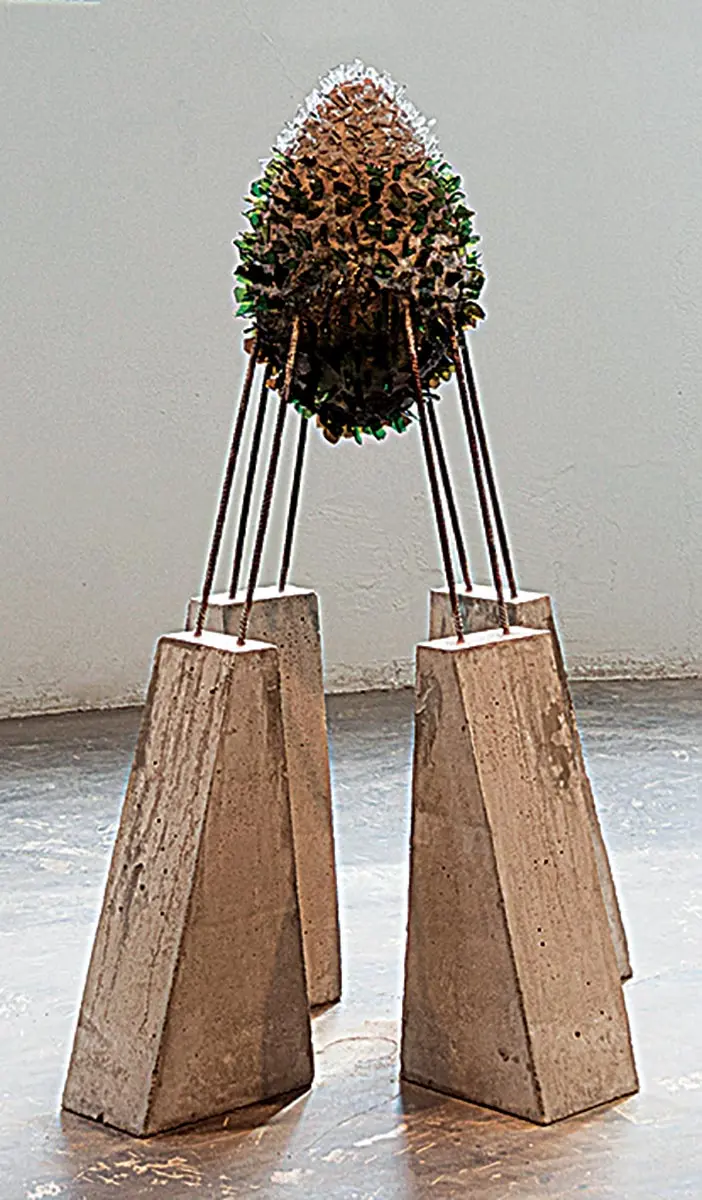
The selection of works covered a vast period, 1973-2010, and came mostly from private collections and the Ivens Machado Collection. The physicality of these works came to the encounter of visitors’ bodies from the start. After ascending the stairs leading to the exhibition space, we encountered a 1982 work that was rebuilt specifically for this site. Untitled like a good portion of Machado’s production, it was a kind of concrete egg erected on four iron structures anchored in turn to concrete. The surface of the suspended, almost religious shape offered an interesting piece of information: covered by green and transparent broken glass pieces, it revealed the artist’s interest in the chromatic contrast derived from the use of different materials.
Even for those of us who had seen Machado’s work before, encountering several of his works in the same space amplified that datum, presented here as a new discovery. Further into the exhibition was a 2007 work that exemplified Machado’s interest in the relationship between material and color: the artist collected several kinds of calcareous rocks and grouped them into samplers that extended along a single line. The sculpture jutted out from the wall and from a frontal relationship with the body of the observer in the direction of the ground, extending like a sinuous line. We were, in consequence, unable to encircle the work as we did with most of the sculptures on exhibit, and our gaze explored the object’s graphic aspect.
Machado’s ability to create strange bodies using essential materials as the support for buildings was also striking. There is, however, a tension between elegance and the brutalism inherent to Machado’s images, just as there is one in a manner of display chosen for the objects. While on the one hand the materials are heavy and possess the appeal of a house in the process of being reformed, there is on the other an undeniable beauty in the color contrasts between kinds of concrete, in their articulation with iron, and in their formal outlines, which have something of the animalesque and the instinctive.
This singular balance is in evidence both in Machado’s three-dimensional investigations and in less common works in his oeuvres, such as his experiments with notebooks and video. While concrete is the basis of modernist architecture, paper sheets are the surface on which projects are set, and, according to what can be seen in Machado’s videos, the human body is the cell for verbs in action (as was also demonstrated by Richard Serra.) There is no possibility of harmony in any of the three instances. Concrete was poured into the shape of bristly creatures, the notebooks have irregular lines, and the videos demonstrate the impossibility for two to become one. At the same time, in none of these spheres is there room for a generalized disorder, expressionist features, or a full liberation of the demons that inhabit the human mind.
There is much of the carnal in this exhibition, but there is also great intelligence and a deep study of anatomy. We leave this gathering of images with an awareness of the latency of human fallibility, yet we continue to try to attribute it some kind of meaning. The hope also remains that Ivens Machado’s work will be better known and more deeply studied so that future intersections with other anatomies in the history of art become possible.
NOTE
1. Marcia Fortes, “Chris Burden e Ivens Machado se foram na mesma nuvem”, Folha de São Paulo, June 14, 2015.
RAPHAEL FONSECA