
At first glance, the exhibition Asset Forfeiture by Jonathan Hernández stands out for its neatness and clarity. The diaphanous gallery space is occupied by pieces arranged with the meticulousness of a minimalist architect or the exquisiteness of a Euclidean geometer. Nonetheless, the works displayed attempt to convey something diametrically opposed to harmony and equilibrium: namely, the confused, sordid and disturbing nature of a Mexican reality trapped for years in a “war on drug trafficking” that has been as merciless and contradictory as the “war on terrorism” that so many countries suffer today.
Jonathan Hernández has been trying for some time now to make sense of the chaos that nobody has so far been able to clearly explain. And he does so by clinging to the one thing that he and so many others like him are able to hold on to like a castaway holds on to a lifesaver for dear life: his own personal and non-transferable experience. It is the experience of someone who is irremediably immersed in chaos and who can only try to think and act from within. “In this narrative—the press release rightly stresses—the artist is part of the current and complex puzzle, he is not outside of the problem. On the contrary, he is regarded as another link in the extensive chain of social decomposition.” Thus, it is not surprising that during the last two years, Hernández has been acquiring in public auctions the assets seized from drug dealers and turn them into “raw material for the production of the works shown in the exhibition.” Nor it is surprising that such deliberate insertion in the vertiginous circuits of formation and dissolution of capital that results from drug trafficking allows him to pose questions about the relationship “between that which is legal and that which is illegal in the global economy: How does the daily assimilation of the illicit occur? How do money laundering mechanisms work? What is a tax haven? And, what is the role of art in this environment?” as stated in the aforementioned press release.
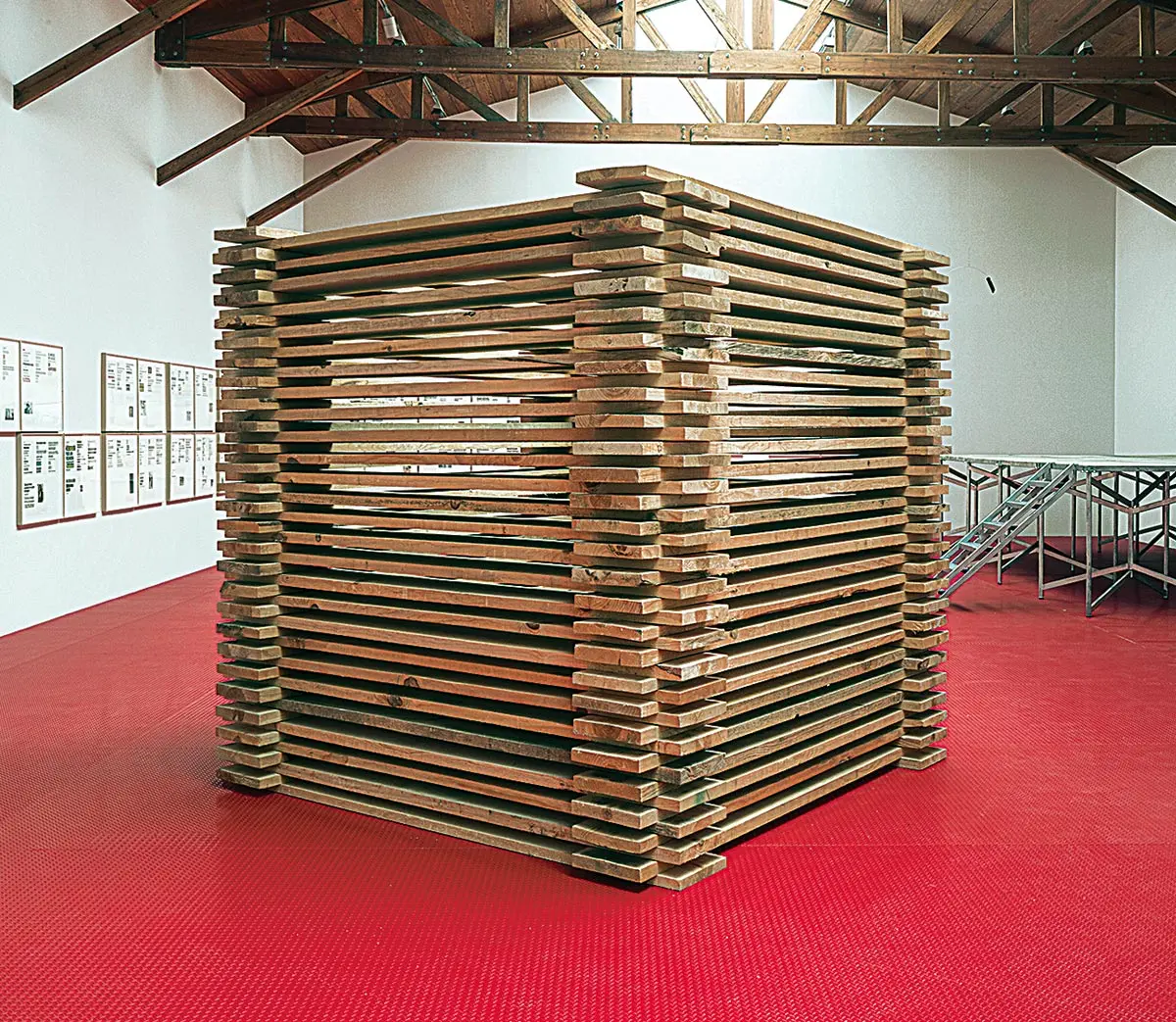
But, I insist, by evoking in this exhibition this muddled and often bloodstained reality in such diaphanous and impeccable manner, it would appear as if Hernández was trying to create a distance between him and such reality. It is either a desperate gesture to survive or simply an opportunity to reflect on the situation. In this manner, the blood spilled with such cruel generosity in the Mexico of today is evoked in the installation titled Diamantes de Sangre (Blood Diamonds), which actually consists of the red color covering the floor of the exhibition. It is so beautiful that, if it were not for its stinging title, it would offer viewers a purely aesthetic, retinal, experience, as Marcel Duchamp put it. And the “absence of the State,” frequently mentioned as one of the reasons for the power consolidated by the “drug cartels,” is represented by Hernández in the installation Vacíos de Estado (State Vacuums), an impeccable stage supported by a light metal structure and framed by a clearly surgical cut that exposes the understructure of the panels of the exhibition room. The weapons used in this incomprehensible conflict have also been subjected to an operation of displacement and consolidation. Instead of assault rifles and machine guns, Hernández resorts to knives and blades to reference the essential crime tools. But, rather than exhibiting them in all of their ominous bareness, he opted to embed them to the point where only their handles protrude. They outline an attractive and colorful diagonal on one of the exhibition walls. The same “cooling” treatment is given to the theme of the increasing complicity of art galleries when it comes to money laundering, which Hernández compellingly represents in the piece titled White Cube. It consists of a cube built with carefully crisscrossed and superimposed untreated wooden planks. The cube continues to be a cube but it has also become a “stained” filter as a result of the dirt from the money that it has laundered.
There is another component to the “war on drugs” that is equally or even more unsettling than the dismemberments and massacres. I am referring to the daily exhibition of that war by a media that is not transparent or naïve, and that follows a hidden discourse that is nonetheless pretty effective. And Hernández has decided to expose in Descabezados (Beheaded), a group of 52 collages created with newspaper headings and images taken from them. Here, Hernández’s idea is to unsettle the dominating media discourse and open the possibility for other gazes to exist about the drug war and the reality that makes it possible. The collages have been grouped in a book and only a part of these are part of this exhibition.
CARLOS JIMÉNEZ