
This exhibition, Told and Untold: The Photo Stories of Kati Horna in the Illustrated Press, establishes a clear divide between the “told” and “untold” portions of Horna’s work. Her Masks photographs, her Dolls, her photos of the Paris Flea Market and of La Castañeda are all well known and widely admired, but we must also be aware of her “untold” work, such as her photographs of the Spanish Civil War, her portraits of Mexican intellectuals, her architecture shots, and, above all, her vast contribution to periodical publications.
Featuring photographs, contact sheets, and numerous publications, Told and Untold give us an ample selection of Horna’s abundant published oeuvre. What she did was not direct, first-hand photojournalism; she sought to depict not blood-splattered tragic scenes but inner suffering, as well as the resilience of people in the face of highly perilous situations. This is how her Spanish Civil War portfolio and her images of militants are to be understood. The personality of her shots was by her own commitments as a militant, first forged at a very young age during her Berlin years.
Katalin Deutsch Blau was born in Budapest (Hungary) to a well-off Jewish family. Before the age of 20, she had settled in Berlin, where she came into contact with the ideas of theorist Karl Korsch and playwright Bertolt Brecht and joined a group of activists, intellectuals, and artists. This education in commitment and militancy had a profound influence on her future as a person and as a photographer.
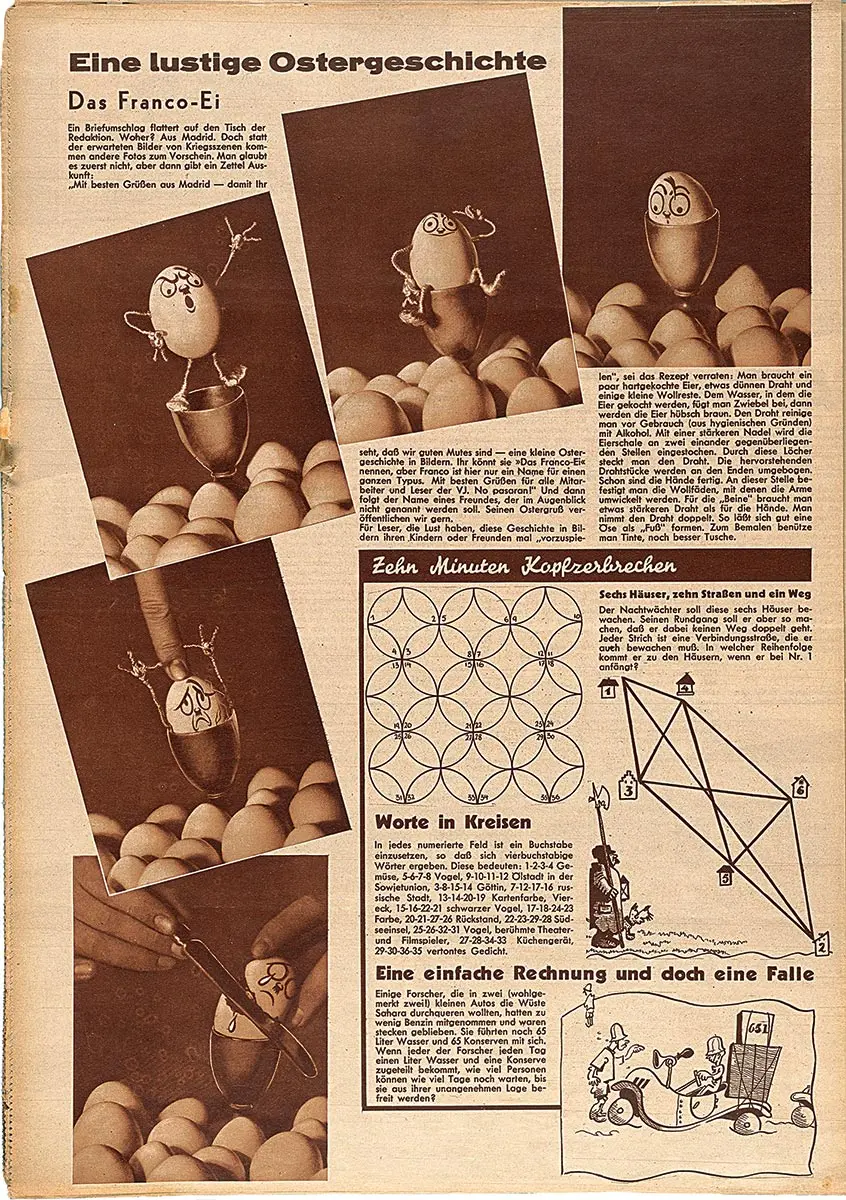
Horna was shaped by her engagement with László Moholy-Nagy’s concepts and by her brief studies under József Pécsi in Budapest, in 1932; she adapted these guidelines to her own purposes, as can be seen in the cuts and trims she applied in several of her series. Her first exile began in 1933, where she was forced to leave Berlin due to the climate imposed by the rise of National Socialism. She arrived in Paris, where she shot some of the portfolios mentioned above as well as a caricaturesque, a somewhat surrealistic one based on kitchen subjects, and a critique of Hitler using eggs as the basis for her images. While in Paris, she received a commission to photograph the Spanish Civil War and traveled to Barcelona. Both her journalistic skill and her anarchist political commitments were on display there, at the young age of 24. Battlefield conditions were not a common experience among women in that period. Horna published in several journals, among them Umbral, an anarchist weekly where she worked as art director and photographer. There she met José Horna, who would become her husband and the father of her only daughter. In 1939, at the end of the war, they decided to seek refuge in Mexico. It was not Kati’s first exile, but it was to be her final resettlement.
Mexico has a significant tradition of welcoming foreign refugees who are then able to fulfill their potential in the country. This was certainly the case for this couple: they integrated into local intellectual circles and also frequented a group of European émigrés, especially those connected to Surrealism: Leonora Carrington, Remedios Varo, Gunther Gerzso. Outside the Surrealist group, another European immigrant to Mexico with whom Kati Horna established a good work relationship was the forward-looking sculptor, thinker, promoter, and writer Mathías Goeritz. During this period Kati devoted herself to teaching and continued to publish on different issues of architecture.1 At the time, photojournalism in Mexico was ebullient and growing. Kati Horna had arrived at the right moment: the city’s expansion and modernization required precisely her kind of respectful, perceptive, narrative, and committed gaze. The photos and publications on exhibit here provide good proof of that.
This is Kati Horna’s first solo exhibition in the United States,2 and it focuses on the wealth of events she captured and reflected, on her formative experiences and the human and professional risks she took, and on her vast presence in publications of the period. Curated by Michel Otayek and Christina de León, coordinated by Gabriela Rangel, Told and Untold contributes significantly to the Americas Society’s roster of important historical exhibitions. The museography, by Theodora Doulamis, is intended to properly display these photographic jewels and publications and to teach us about the care that is required in the maintenance of these works. None of this would have been possible without the collaboration of Dr. Ana María Norah Horna, the photographer’s daughter and the director of the Kati and José Horna Foundation.
NOTES
1. Entre Cúpulas. 1990. Kati Horna, coordinator. José de Santiago, Víctor Monroy, and Sergio Carlos Rey. Division of Postgraduate Studies/National School of Fine Arts/UNAM, Mexico.
2. The most significant precedent of Kati Horna’s works on exhibit in Ney York is Women Pioneers of Mexican Photography I, September 2015, Throckmorton Fine Arts. Catalog essay by Graciela Kartofel.
GRACIELA KARTOFEL