
Cuban artist Lidzie Alvisa (Havana, 1969) presented 35 works in her most recent solo show, which is also her first ever in the city of Miami. Curated by Marilyn Sampere, the exhibition is formed by three different bodies of works created between 2001 and today. The show welcomes viewers by the gallery entrance with a mirror with the words “ego” and, right next to it, “ism” written with small piles of pins neatly arranged. Recognizing themselves in the reflection prepares them to initiate the walk through the two exhibition rooms containing the show.
The central connecting thread of the exhibition is the female body. It would appear that Alvisa takes into account the political nature of the female while she also questions themes that are central to life and to artifice, establishing connections between objects and concepts like time, strength, impossibility, and the game of opposites, among others. She does so by relying on the body as silent support and on several artifices that she uses as constants: pins, watch hands, ballet slippers, globes, shoes, mirrors, and words.
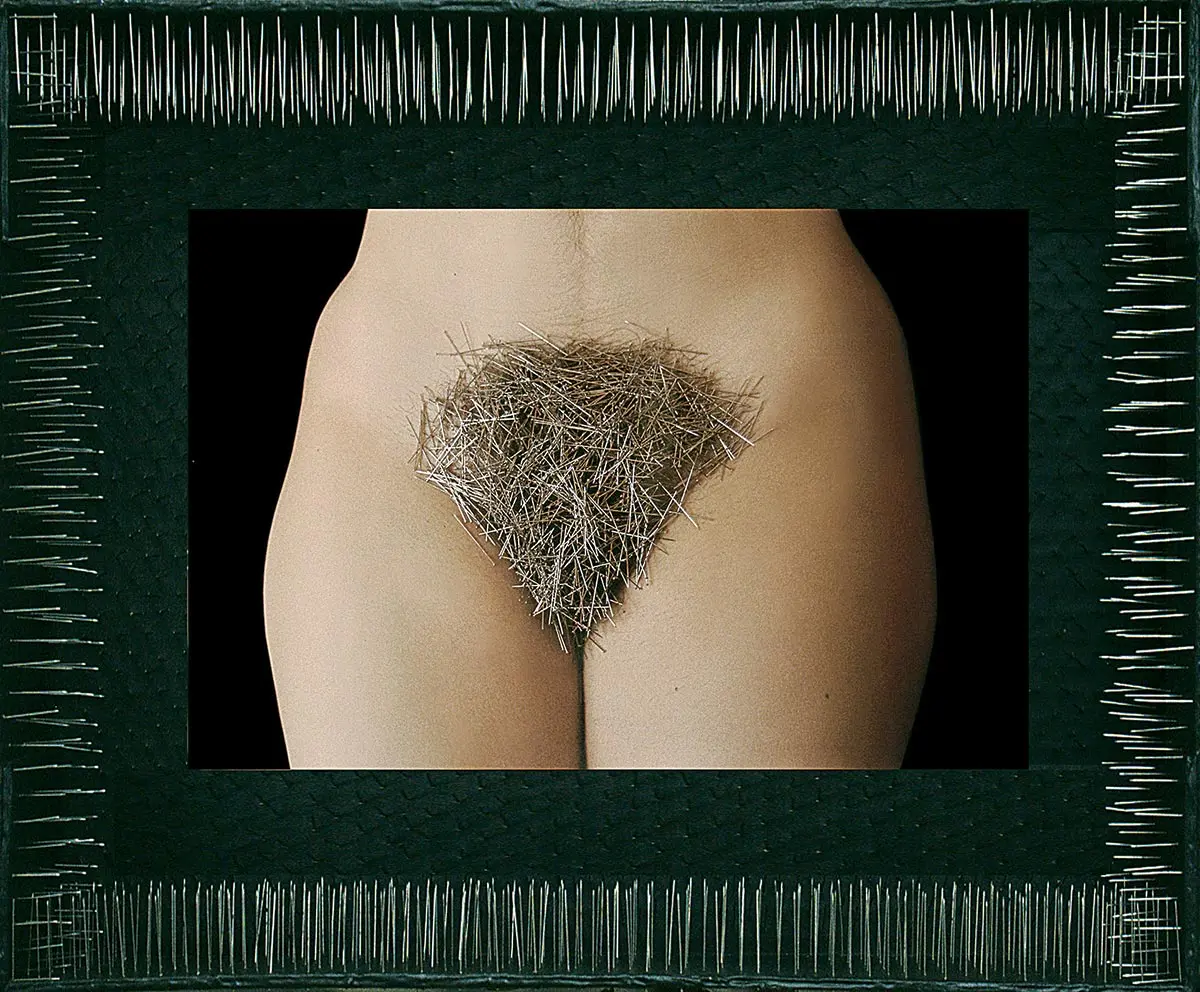
Most of the works shown to consist of compositions with body parts, eyes, ears, pubes, rears, and legs that have been photographed and intervened with a common element that leads to multiple readings: the accumulation of pins. Already a material that implies matteric tension and a complex gesture, the pins block these powerful communicational areas of the body, seal its orifices, metaphorically speaking. By giving each of the images a black paper frame—also intervened with pins forming lines—Alvisa creates thorny tunnels that, like impassable barriers, protect the works in the series, reaffirming the idea of distance and impossibility.
At first glance, the recurrent relationship that Alvisa establishes with the pins in her series of works becomes evident, both in the photographs and in the papers. She uses them as artifice in connection to the body, as sharp, puncturing objects which, while aggressive and masochistic, are also employed for mending, for unifying two parts of something. Thus, one wonders: Who is the enemy? From whom must one be protected/defended? Is it from the body itself, from women? One of the possible readings would be a sexist reductionism of gender where, because of social constructs (represented by the pins), the female potential is hindered. On the other hand, femininity in the history of art has been associated with the arts and crafts traditions, also the creative qualities of the female gender have also been showcased through the thread and pin—which in turn leads to another lecture that connects the use of pins to the trajectory of women throughout history. The pin as a literary device in works like the Grimm Brothers’ Sleeping Beauty, or as an artistic one, like in the rivers of pins by artist Maya Lin or the traditional Chinese landscapes created with mosquito nails by artist Chen Chun-Hao, has been used as a visual element that suggests a certain political reading based on the obvious. The same occurs in Alvisa’s work, but the reiterated use of the intervened black frame becomes a resource that is more formal than conceptual. Alvisa questions social conventions in works like Imán (Magnet, 2000), Las Trampas del Interior (Interior Traps, 2008), and Ojos Que No Quieren Ver (Eyes That Do Not Want to See, 2004). The work stems from a performance idea: the silent pose of the model with the artifice. Nonetheless, the potential violence implied by the pins is frozen in the photographic instant. On the other hand, the series titled Rodapiés (Baseboards, 2010) proposes a combined visual strategy: installation and photography. A pair of perfect legs dressed for dancing cannot move because the ballet shoe laces embrace both legs impeding their movement. Conversely, the installation shows the baseboard of a group of photographs—images of several feet wearing a diversity of shoes—taken from different angles and rendered in a manner that contrasts the earlier images.
Alvisa also uses the connection between the elements to propose a reflection of opposites or contrasts: a hand with an iron glove shakes a hand with a lace glove, a large blotch of inkstands in contrast to the pristine white shirt that it has stained; various pearl head pins serve as earrings, and a pair of watch hands superimposed on a wrist tell the time in the piece titled Mi Tiempo (My Time, 2003). There is also the series Fragile (2006) and Unreality (2014) that overtly propose the problem with the connections among objects. In addition to suggesting impossibility, these works also suggest the contrary; communication and understanding among opposite, as is the case of the gloves, pieces that address planner encounters that exposed obvious contradictions between soft and hard, strong and vulnerable, possible and impossible.
Alvisa appears to be expanding her approach in recent years, going from symbolic photographs to installations, as she has also invested in new alternative supports, like the mirror in Ego-ísmo (Ego-ism, 2004), words in Se Pierde la Idea (The Idea is Lost, 2015), as well as works on paper like Sin Título (Untitled, 2016), which represent perforations and inserted pins, create geometric spaces, and allow for the central role of the pure simplicity of both materials in works that, beyond their thematic, suggest a new direction outlined with the complex relationship between object, word, and body.
AMALIA CAPUTO