
Lourdes Peñaranda belongs to the generation of Venezuelan artists who in the 1990s gave a new impulse to conceptualism, with proposals that integrated aesthetic elements and contemporary traditions. She stood out in young artists' salons with works marked by studiousness, attention to essential structures, and a point of inflection for historical and social processes. In recent years she has focused on the study of the formal legacy of modernity and the work of minimalist artist Donald Judd—whom she explored in-depth for her doctoral thesis, and later incorporated into her own production—accompanied by an investigation of not only color from an expressive or formalist standpoint but a conceptual one as well. This is to say, as a spatial event or as a metaphor for the transformation of perceptual reality in historical, political, cultural, and social fields. This intention is reflected in her project Breve historia del color en Venezuela (A Brief History of Color in Venezuela), where a reworking of geometric abstraction, minimalism, and the use of color move towards critiquing the Venezuelan population’s inability to react against the unconstitutional impediments placed by the government to the electoral process. In this case, the color becomes a symbol and event. Peñaranda uses the concept of the horizon in its different definitions (as terminus, border, or frontier) and constructs a critical, aesthetic and experimental horizon on the basis of color.
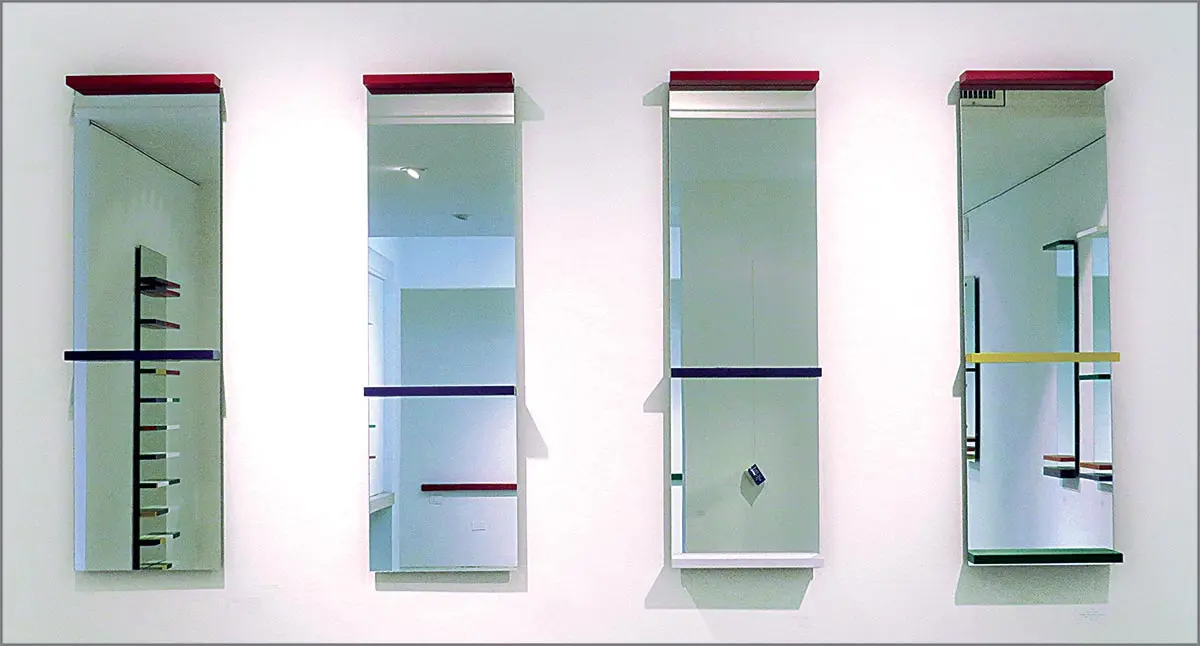
Once the terrain of her interests was delineated, Peñaranda carried out a study of the numbers, statistics, and colors corresponding to different political parties in the fourteen electoral years between 1947 (when the universal secret ballot was introduced) and 2013. Each date is given a title. With this, the proposal entered the domain of mathematics and of progressions, without abandoning its care for the artistic values it was interested in reinforcing. This allowed Peñaranda to activate linear and chromatic traces of the exercise of the vote and its contradictions. Fourteen stations comprised of small shelves against the ground of a reflecting mirror gave physical structure to the exhibition. Each station corresponded to an electoral year. The planks, or horizons, were measured according to the width of the book of the Venezuelan Constitution, alluding to the impossibility of using the shelves for any other publication. The distance between these horizons corresponded to the percentages of the vote obtained by each political party and displayed the colors that dominated the scene over almost six decades as well as the empty space represented by the dictatorship years. Grouped on a separate shelf were all the years, with all the colors and distances in play. The exhibition ended with a fragile tri-color horizon (yellow, blue, and red) on a downward slope, supporting the national Constitution. In this procedure, Peñaranda defines an essential vocabulary of accumulations, juxtapositions, and algorithms that give structure and shape to the installation inside the exhibition gallery: illusory space and represented space fuse into a space of chromatic continuities. The mirrored background reflected several works into a single unit, making it impossible to cross-read them.
What is important in the dual operation conceived by Peñaranda is the way it formulates color as a source of critical reflection about history and politics, and at the same time as a structural anchor for the construction of discourse. She posits it as a space of connections in social, intellectual, emotional, everyday human experience, or as a personal experience that renews its meaning and its sense in the course of history and culture. The Maracaibo exhibition allows us to see chromatism as a process traversing some of our most basic everyday decisions. Color ceases to be a formal element and becomes the vessel for meanings that refer to emotions and sensations, according to its placement in the reduction and measurement scales of Venezuela’s electoral history. This work implies a profound commitment to democracy and seems to free geometric abstraction from its customary aversion to the emotional. Color emphasizes formal structures, but also emotions. Peñaranda’s geometric modules are not neutral, and they are not devoid of meaning. In his introductory text, curator Gerardo Zavarce points out that “this Breve historia del color becomes also a political history and, without warning, a Brief History of Democracy in Venezuela.” And we could also add that it becomes a Brief History of Modernity Through Contemporary Eyes, or a Brief History of Totalitarianism Besieging the Country, where democratic minimalism is confronted with chromatic totalitarianism under a gaze that combines poetics, politics, and aesthetics.
MARÍA LUZ CÁRDENAS