
The work of Luiz Sacilotto (1924-2003) represents the alliance between postwar modernism and Brazilian modernization. A central player in Brazilian Concrete Art, Sacilotto left behind the legacy of essentially visual art, with formal compositions that bespeak of a coherent, sustained effort. Sacilotto’s work questions, above all, the reality of perception and subjectivity. It questions the nature of the objective in painting and the veracity of the real.
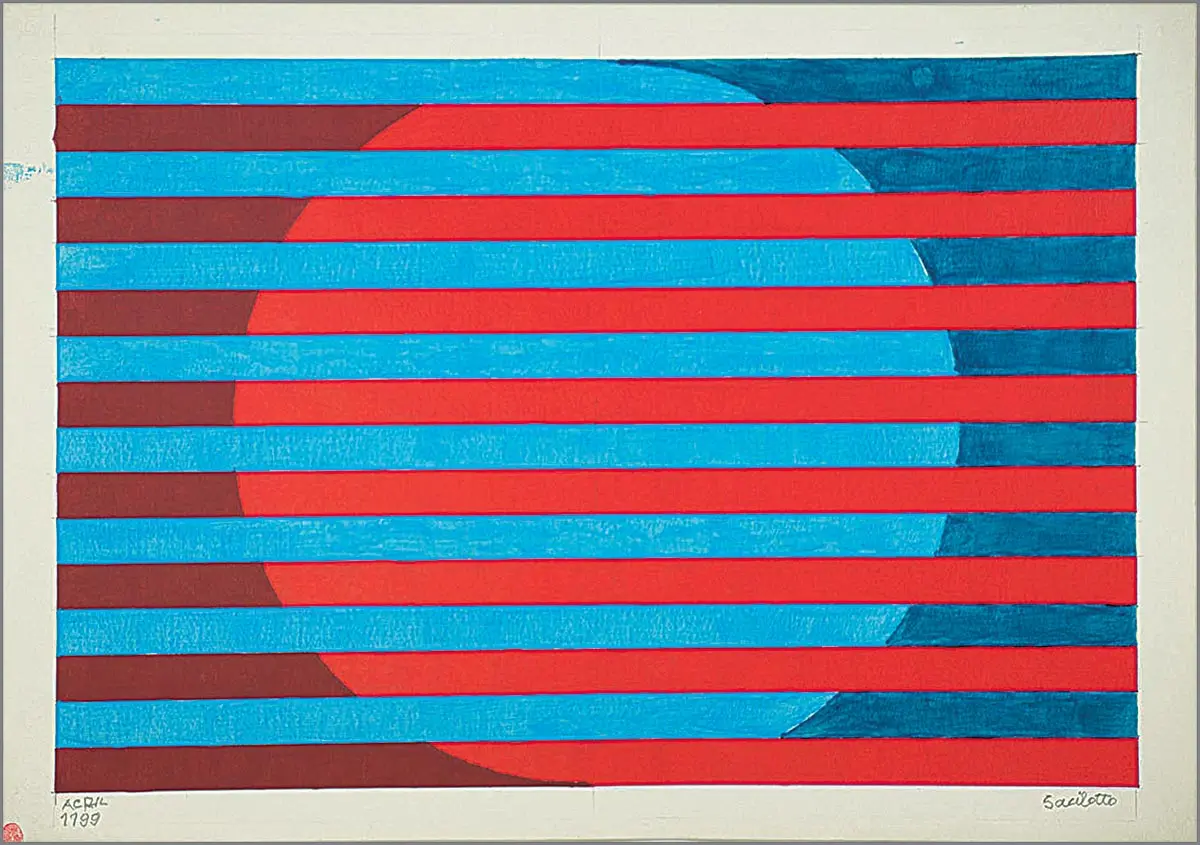
All of this can be seen in the exhibition Sacilotto – em ressonância (Sacilotto – In Resonance), conceived as a way of showcasing the artistic value of the drawings, color studies, projects, and sketches on paper made by the artist throughout his career. Exhibited at the Instituto de Arte Contemporânea (IAC), the exhibition was based on a series of works recently incorporated into the institution’s collections.
The scion of Italian immigrants, Sacilotto was born in Santo André, in the region of the São Paulo ABC, the cradle of a well-rooted proletarian ideology forged in a long history of union struggles. Sacilotto studied at the Instituto Profissional Masculino do Brás and began his career in the 1940s as an impressionist painter. Around that time he earned the label of “proletarian artist,” given him by critic Sérgio Milliet, who because of his ideology connected Sacilotto with the Santa Helena Group, which included Volpi, Zanini, and Rebolo.
Despite the impressionist affiliation that marked his early years, Sacilotto established himself in the art world after gaining experience as a designer, the field that would give him the elements for the development of Concrete Artworks. In 1944, Sacilotto began to work for Hollerith as a designer of high-precision lettering, which brought him into contact with the debates then raging around the legacy of the Bauhaus, as both the Ulm School in Germany and the Swiss typography revolution were being articulated at the time. Sacilotto also projected aluminum windows, in a serialized way, which prodded his interest in industrial materials—wood, aluminum, enamels, iron, brassware, etc.—as supports and raw input into future artistic productions.
The principal stamp of Sacilotto’s work was the simple numerical rhythms, in progressive or recessive order, which generated remarkable optical-kinetic structures, serializations, and programmed repetitions. The creation of environments of a strong spatial ambiguity and great internal coherence permeates all of his works, punctuated by counterpoints of completeness and void, background and support, concavity and convexity, presence and absence, positivity and negativity.
Sacilotto was part of the Ruptura group, whose 1952 manifesto launched geometric art in Brazil almost half a century after the movement began in Europe. Other members of the group included Gerardo de Barros, Lothar Charroux, Leopoldo Haar, Kazimir Fejer, Anatol Wladyslaw, and Waldemar Cordeiro, their intellectual leader, who returned from Italy with up-to-date information about the latest European modern art. Together they signed a defense of art as a “medium of knowledge that can be deduced from concepts, which places it above opinion.”
The constructivist movement in Brazil was characterized by debates that expressed the dazzling intellectual ebullience in the country during the 1950s and 1960s, a period especially marked by the divide separating Concrete and Neo-Concrete artists. The Neo-Concrete schism in Brazilian art dates from March 1959, with the publication of the Neo-Concrete Manifesto by the group of the same name, and must be understood in conjunction with the Concrete movement, harking back to the early 1950s and to the artists of the Frente group in Rio de Janeiro and of the Ruptura group in São Paulo.
At any rate, Concretism continued to exercise influence on Brazilian art for a long time. Even artists who were not part of the movement absorbed into their own work some of its characteristics, such as its objectivity, its clarity of ideas, and its reduction and simplification of resources in search of the essential. Once the movement’s dogmatic and rationalist period was over, the Concrete artists slowly renewed their formal vocabulary. From the graphic arts to advertising, from design to architecture, from landscape art to urban design, from popular music to dance, all of these fields gained from the actions of the Concrete artists.
Cordeiro once described Sacilotto’s work as the ”main beam” of Concretism, because he worked with binary, Gestalt-holistic geometric sequences that were calculated with precision and left no room for improvisation or uncertainty. Always using squares, rectangles, triangles, vertical and horizontal stripes in different widths and colors, isolated or in groups, Sacilotto created structures that amaze us with their visual dynamism. A good Concretist, he probed the boundaries of the objectivity of perception and the illusions of the gaze. He was decisively important in the process of modernization and the international turn in Brazilian art.
ALESSANDRA SIMÕES