
“Improvising. Might be what you like, till you hear the words. Want to listen sharp. Hard. Begin all right: then hear chords a bit off: feel lost a bit. In and out of sacks, over barrels, through wire fences, obstacle race. Time makes the tune.” James Joyce, Ulysses
When confronting a solo show at a gallery one hopes to find a coherent curatorial discourse that offers a vision of an artist’s current lines of inquiry and conveys the moment in which his/her trajectory is at. Ghost Town, the most recent exhibition by Mateo López at Casas Riegner, undoubtedly exceeds the aforementioned expectations. Not only is the narrative effectively woven—opening critical paths, weaving new proposals based on earlier works, generating a local social and political poetry within a greater scope—but also the exhibition’s information sheet and its nods demonstrates thorough research work in the manner of rethinking how to present the work of one of the most interesting Colombian artists of the moment.
As its name indicates, Ghost Town explores the conditions, times, and symbolic elements of a city that could very well be Bogota. The exhibition combines works in which we can identify mechas or targets of the traditional Colombian Tejo game suspended in the middle of the gallery (Fucsia, 2016), the old track of a trolley car that used to run along Calle 10 in Bogota—which leads us to question in works like Perspectiva Rota (Broken Perspective, 2016) the modernity of the country and the pressure exerted by lobbyists—and a calabash tree intervened with car paint that once again addresses the tiresome theme of public transportation in Colombia.
Beyond the local approximations to the city made by López, the exhibition is truly captivating for the perceived superimposition of temporalities and movements. The piece titled Despacho (Office, 2016) combines these two concepts: city and time. It consists of a wooden desk packed with letter-size sandstone sheets. They are arranged on, under and on the sides of the desk. Sandstone is a very common material in the quarries of Bogota and several old buildings and monuments were built with it. Its extraction is known to be extremely harmful to the environment. For this reason, attempts have been made to regulate its consumption without successfully impeding its illegal trade. The piece becomes a simile of that chaotic period in the city and of the bureaucratic government of the time: heavy, slow, and disorganized.
In his first exhibition at Casas Riegner titled Inside and in the Middle in 2006, Mateo López recreated his studio in the gallery. There, in a sort of performance, he worked on his projects during the hours in which the gallery was open. Just as he did ten years ago, in this current exhibition he continues to envision an interest for the present, temporal suspension, and movement. Ghost Town reveals the origins of an artist hungry to work with drawing and to explore its three-dimensional possibilities. In the same manner that his early work conveyed the perfection of the finished objects, here his interest focuses on the process and its uncertain nature. In the work titled Old Ideas Stuck in Corners, for instance, we observe how some very tall stretchers made with triplex contain several drawings-sketches that reveal projects that López has wanted to develop or that plans to work on at some point in the future. All of them will gradually change during the time of the exhibition, showing the potential of drawing to become an object, movement, and temporality. In its most poetic form, the show offers possible, almost speculative, futures that could eventually occur or not. We could even think of this piece as a metaphor for memory itself, understood as a basic phenomenological effect of the passing of time.
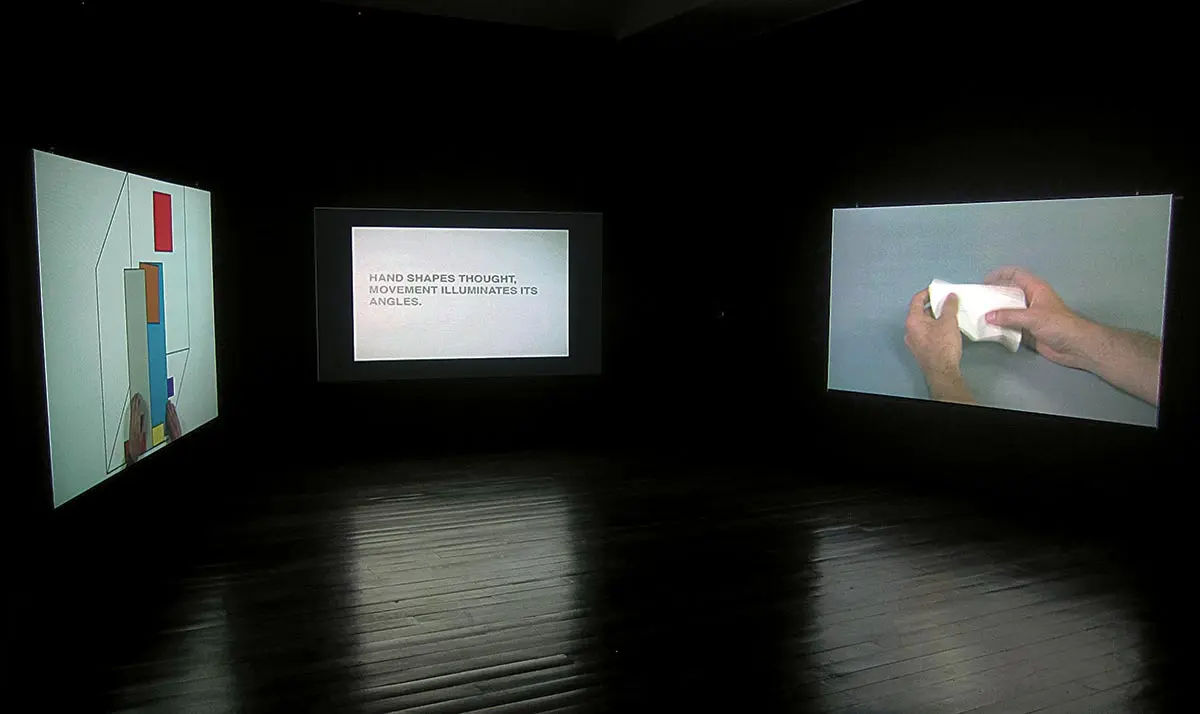
The movement in the studio of López, which we believed to have already seen in a previous exhibition, continues in the video installation titled Time as Activity. Three screens in a dark room, each reminiscent of the work done inside the studio, show those private choreographies performed by the artist with his hands and bodies, as well as the repetitive, at times absurd, actions that are part of working: endlessly folding paper, manipulating paper, undoing it, or playing with his hands. It is a portrayal of the fragmented movement through time that is staged as a video installation which also incorporates the noises generated by the movement in the studio.
Ghost Town becomes a philosophical essay on things that, from an aesthetic perspective, speak about the social and political construction of memory in the city, about the temporality of work, and the mobile potential of drawing as a porous category open to endless forms.
CLAUDIA SEGURA