
Although the convention has it that the birth of conceptual art occurred during the mid-1960s, five hundred years ago Leonardo da Vinci was already saying that “art is a thing that pertains to the mind,” and Marcel Duchamp—perhaps for other reasons—paved the way in the early 20th century for a large roster of artists for whom art equals ideas and the finished work is barely the result (not always tangible, circumscribed or well defined in time and space) of an extremely peculiar process. The fact is that, no matter how visionary, Leonardo had no way of anticipating the doubts that would drive the creative impulses of artists from the beginning of the tumultuous 20th century and on. Even those early pioneering artists could not have foreseen the longevity of the conceptual path. After all, it was not a tendency or trend but an element that was permanently cast through artistic thought. Today is impossible to conceive a work of art, no matter how formalist it appears, that is not conceptually charged.
At the same time that art incorporated conceptual content at the very core (and often as the only possibility) of the artist’s gesture, Paulo Bruscky emerged in Brazil as one of the most important masters of that landscape. Not only semantically speaking—that is, what art wanted to say—but also in the context of the system itself and the materials employed. Bruscky mastered the art of overcoming the censorship of the military government in Brazil by finding alternative ways to produce and distribute his artistic production: mail art, Xerox art, fax art, and happenings, among other actions, were subversive ways of using the very regime to circulate contents that could not otherwise be produced by traditional means and would end up succumbing to censorship. Nonetheless, many of his projects were “detected” and frustrated by the government.
The exhibition titled Rec/Rio at the Galería Nara Roesler in Río de Janeiro is precisely based on these conceived but never completed projects. The title is appropriate: it connects the puff of air that (re)creates the actions by Bruscky with the venue itself, which took its first steps in the Marvelous City but was consolidated in São Paulo (in 1989) as a landmark of the Brazilian art scene. The exhibition includes approximately fifty proposals specifically created for the city of Río de Janeiro, either during the years in which Bruscky lived there when he stayed there temporarily or during times in which he felt nostalgic about the place. While some of the works were completed before the exhibition, others were not so fortunate and only now are finally offered as finished pieces. But as a whole, the group integrally consists of projects directly connected to Rio de Janeiro.
Always sharp and ironic, this Brazilian artist established fruitful relationships with artists from around the world. He, for instance, entered into contact with the Fluxus group from Europe and with the Gutai group from Japan. He resorted to several strategies in his works: humor, words, everyday materials, and familiarity, to allow viewers to establish a connection and interact with his production. Because his proposals address important and complex issues associated with our reality and place in the world, he approaches them with a simple vocabulary that allows those lacking theoretical knowledge about contemporary art to understand the message. This is the case with the piece titled Atenção, Cuidado Com o Vão (Attention, Mind the Gap, 2008), the inscription on vinyl applied at the gallery entrance to warn anyone entering the gallery with the following legend: “Attention: mind the gap between the train and the word.” Even if that train means something different to each person, the warning about the gap is universally understood.
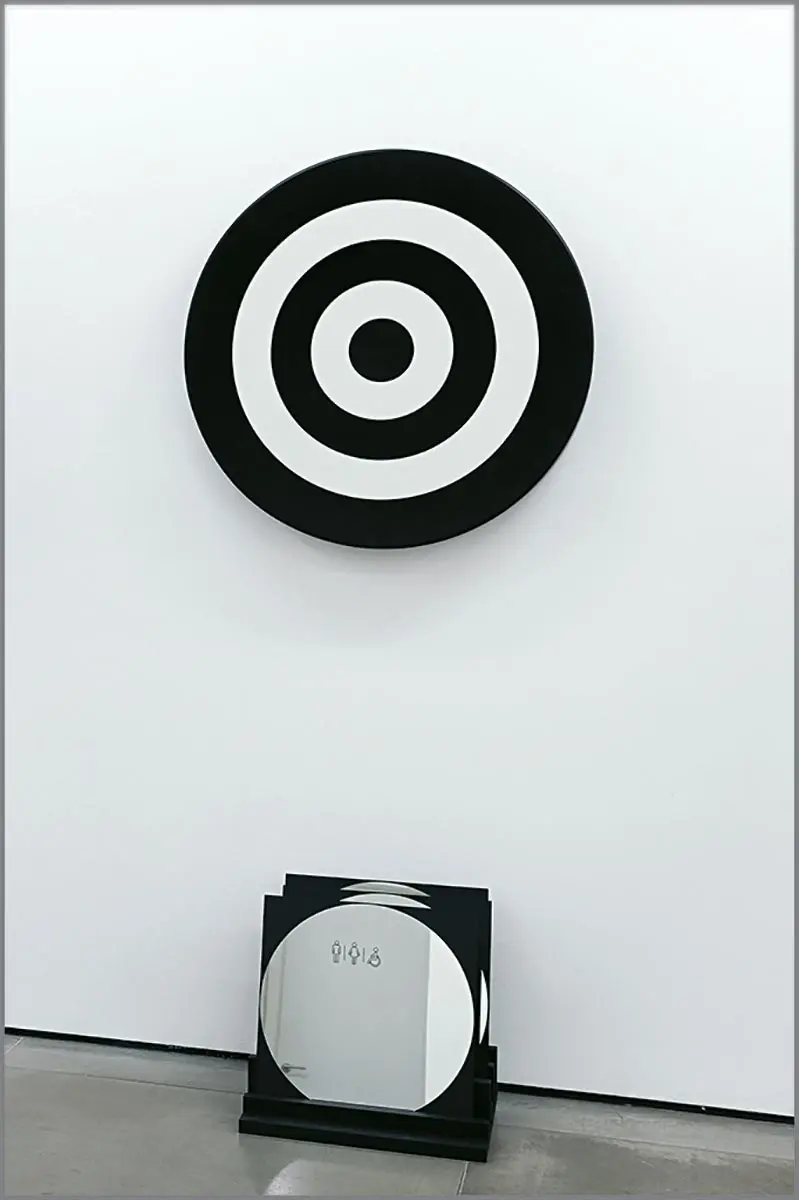
Tiro ao Alvo (Target Shooting) is a proposal originally presented at the First Electrobrás Art Salon in 1971. Specially recreated for this exhibition, the piece consists of a group of mirrors that reflect light whose projection activates a radio. It is an interactive piece that can only be activated by visitors practicing the action that the piece is named after. Tiro ao Alvo was conceived at a time when active participation by the public was not a common strategy. Symbolically, such a gesture evidences a way of empowering the public to have a voice, even as radio programs during the military regime were not allowed to disseminate information freely. Here also operates an alliance between art, science, and technology, but without complex associations, maintaining the modus operandi of proposing reflections without being hermetic. Also included in the exhibition, another of Bruscky’s emblematic actions was publishing classified ads, also included in the exhibition, with content communicated through periodicals.
Paulo Bruscky was always restless. In his own words: “I am constantly alert, I stay very attentive.” His solo show at the Galería Nara Roesler in Rio de Janeiro is barely the tip of the iceberg, an idea within each step.
SYLVIA WERNECK