
The title of Rochelle Costi’s recent solo exhibition at Anita Schwartz Gallery, in Río de Janeiro, gives us two clues for an interpretation of the images organized in it by the artist. While the word contabilidade (accounting) refers, says the dictionary, to “the system and theory of summarizing transactions and calculations,” it can also be seen as a composite of contar (counting; also, recounting or telling stories) and habilidade (skill). It is with this second possible meaning of the exhibition’s title, less scientific yet more encompassing, that the artist’s investigation seems to dialog most immediately.
As we said, the Portuguese verb contar can in turn be interpreted in different ways. The presence of numerical counts and of mathematics is noticeable in the exhibition, connected, it’s my impression, to the definition of contar as a narrative action about a given topic. Here, then, Costi sways between the observation and identification of numbers for different things that exist in the world, and the narrative potential they contain on the basis of those same elements. The latter aspect of the works seems to me to have been constant in Costi’s explorations as a visual artist since the start of her career. Her photographs, as well as her documentation of architectural spaces, objects, and people, are mainly interested in promoting an inquisitive gaze on the part of viewers and stimulating their capacities for imagination and narrative through their encounter with images to tend towards the large-scale and to physical frontality.
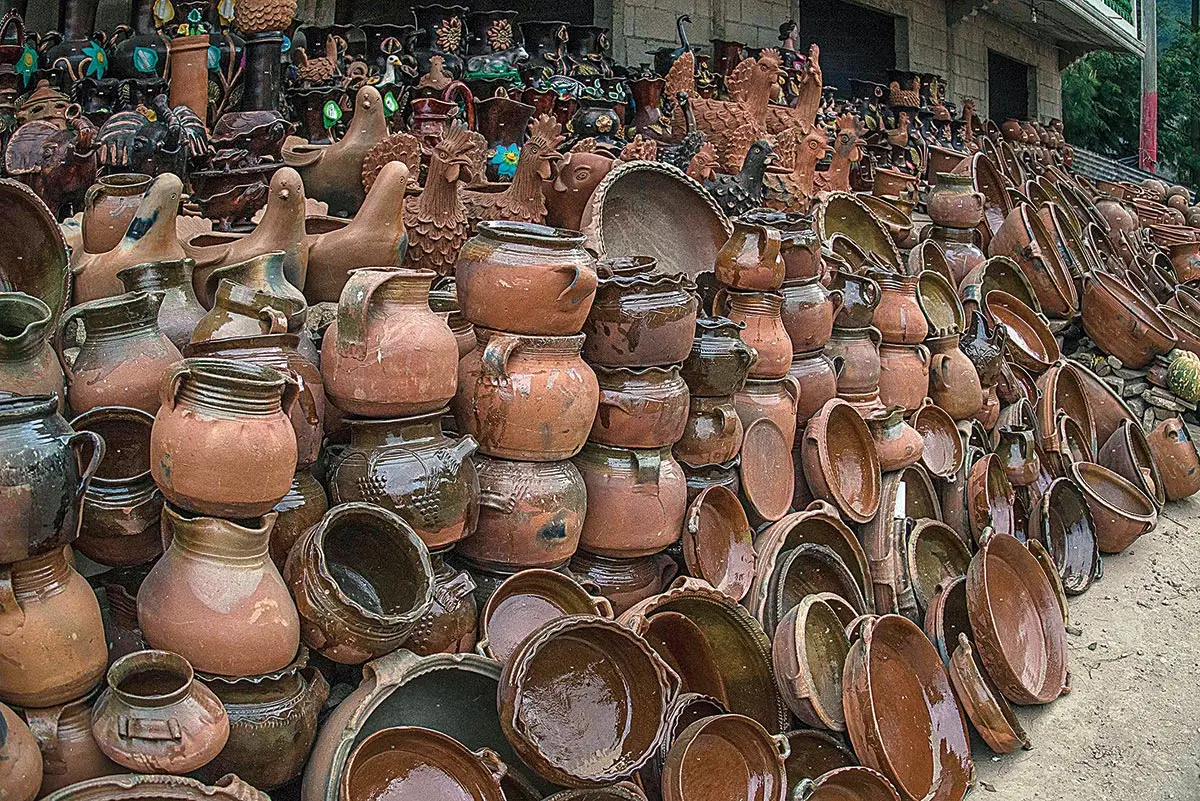
Part of the exhibition speaks about the works that the artist presented at the 20th edition of the Paiz Biennial, in Guatemala. After the experience of traveling to different parts of the country on a research trip for the Biennial, Costi directed her gaze towards the different ways in which products are displayed for sale, and their chromatic and numerical excesses. The exhibition includes five large photographs that present viewers with spaces inside working-class markets where ceramic items, images of saints, clothes, textiles, fruits, and vegetables are on offer. The images certainly display the estrangement between the photographer and the photographed subject; although one could say that spaces just like those can be easily found in Costi’s native Brazil, the Maya references in the ceramic pieces, the Spanish-language signs, and the design of the textiles are all novelties in her eyes.
The horizontal amplitude of the images grabs our attention in different ways than would be the case in a physical exploration of the spaces. Forced to observe the images as photography froze them, we quickly notice the large number of objects organized there by the vendors in order to incite sales. The object’s utilitarian character, then, moves to the background, while an invitation to contemplate them comes to the fore. Our gaze loses itself in that ocean of details, stimulated by the insertion of small numerals that keep count of the elements in each image. As our eyes move across the images, things become numbers, and our inevitable, human desire to organize and collect becomes evident—a desire that is closely connected to the practices of anthropology and ethnography.
However, these photographs were not the only objects exhibited by Costi in Guatemala. She also projected a video of short segments depicting everyday life and work in Brazil’s public spaces, as seen by Rochelle Costi. Moving in slow motion, people set up their stalls and kiosks, carry their loads, and unpeel for us the process of construction of their small commercial spaces, all under an emotional soundtrack. The artist seems equally interested in the creative “behind-the-scenes” that later result in the documentation of these spaces devoted to the display of objects. Finally, besides the video and the photographs, a series of rubber balls, manually produced and painted, also present numbers and bring into the three-dimensional realm the quantification of human experience and the working-class markets that are the exhibition’s common threads.
The works by Rochelle Costi described here are clear examples of her skill in telling stories on the basis of images. One could contemplate these images without any reference to Guatemala, and still, be able to give them possible geographic locations and attribute meaning to the presence of those numerals. On the gallery’s second floor, two further works, emblematic of the polysemic capacity of the encounter between counting mathematically and counting literarily, support this reading of Costi’s production. Coleção de artista (Artist’s Collection) is a collection of hundreds of objects representing hearts, gathered by the artist over the course of two decades. Extracted from her domestic space (to be precise, from her bedroom) and brought into the institutional space, they are also displayed with numbers, which generate more friction than the information they provide. In the absence of any indicators of their origin and history, viewers are again invited to use their imagination. Finally, in the video Dezesseis (Sixteen), the artist pays an affectionate tribute to the passage of time on the subject of her own daughter—who, born in 2000, is sixteen years old and exemplifies a generation whose life is wholly saturated by digital photography— divided into two images, it presents in a backward trajectory, and vice versa, photos, and videos of the girl’s growth and experience of the world.
Be it when looking inwardly into her own private sphere and her emotional world, or outwardly at the public space and the space of the other, Rochelle Costi’s investigation sustains a constant interest in human activity and its vitality. We can catalog our surroundings, but the power of life will always find a way to escape numbers and documents, in the same way in which, I suspect, some of the objects in Costi’s photographs may have been left uncounted. This exhibition and her production help us remember that there is no point in knowing how to count if we remain unaware of what it is that we intend to count. Fortunately, Rochelle Costi continues to experiment and to show us that life can and must still be contada in many different ways.
RAPHAEL FONSECA