
Venezuelan artist Sigfredo Chacón (Caracas, 1950) stands out for systemizing his pictorial processes as a way to reflect on the work of art itself. Félix Suazo said this during a conversation about the exhibition titled Pinturasparadaltónicos/Colorblindpaintings, recently presented at the Sala TAC, in Caracas: “Every period—to call it something—has a specific production system and, therefore, an anti-style. I believe that any idea requires some type of pictorial execution or reproduction method in order for the approach to become the discourse so that an idea and its implementation can form an expressive unity, a work of art.” This measured way of operating his creative processes is what led Chacón to create his well-known series Talkingpaintings, Pureabstractpainting, and Emotionalpaintings. In all of them, color is the central expressive element. He used primary colors (or, with a restricted color palette) as the point of departure for those series, while secondary and tertiary colors appeared during the process of execution, as the brushstrokes combined the dense pictorial material.
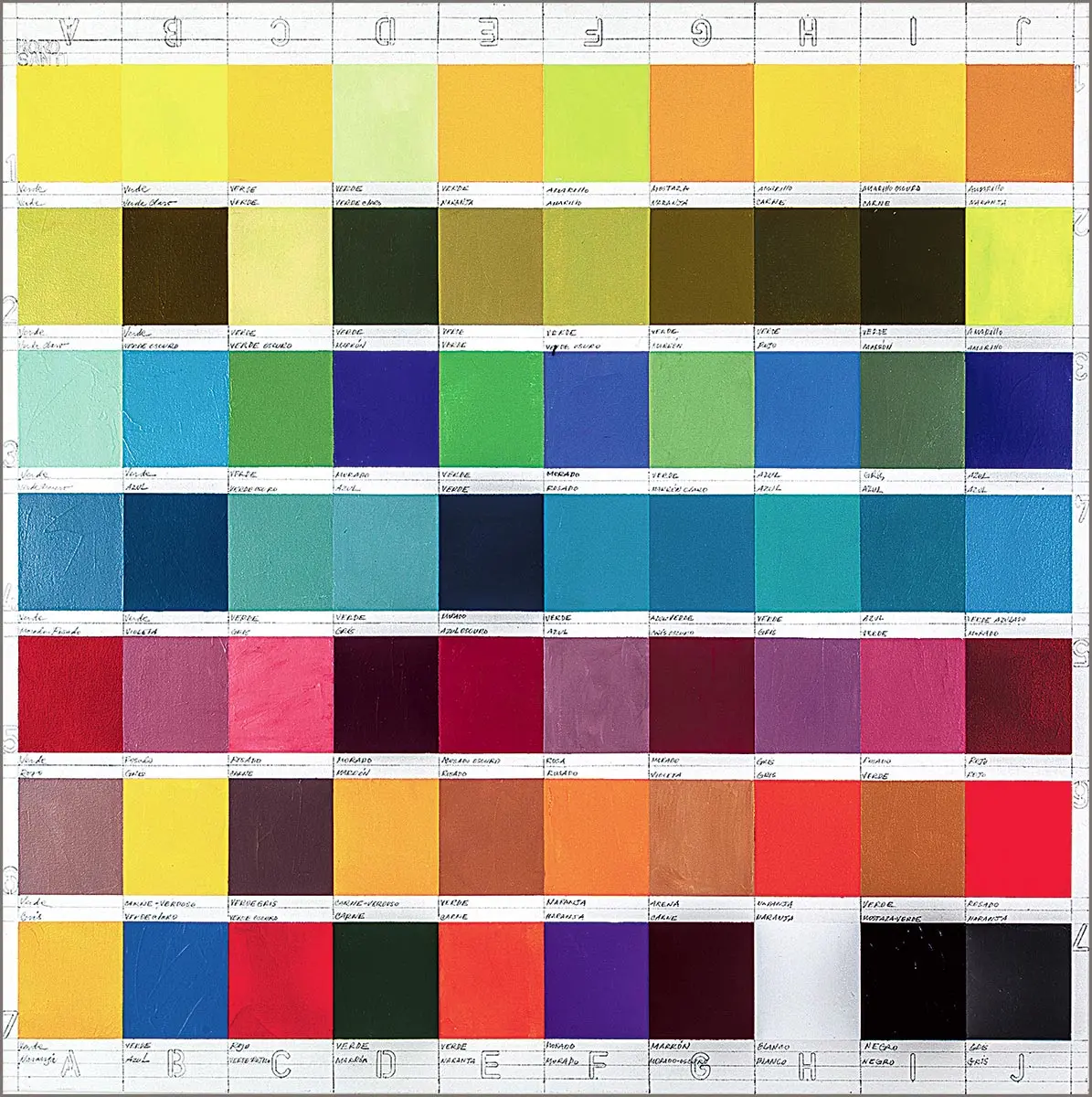
In the series Pinturasparadaltónicos/Colorblindpaintings that is part of this exhibition, Chacón decided to systematically explore the way color is perceived by persons suffering from color blindness. It was a personal interest of his, both as a painter and as a father. It all began when he tried to understand how his two sons, Rodrigo and Santiago, perceived the colors around them. Their answers did not match the way he perceived color. He eventually realized that the names or nomenclature that they use to refer to colors did not match what he was observing. So he began to research this condition, and it was then when he systematized the chromatic range described by his sons. In this manner, he understood that color blind people not only perceive colors to some extent, but also that they mix them or confuse them and, therefore, perceive their surroundings in a very different way than those of us with “normal” vision and in possession of a wide-ranging chromatic spectrum.
The series Pinturasparadaltónicos/Colorblindpaintings uses color ranges that are not what the artist usually prefers. On the contrary, the colors with which he “harmonizes” this series were dictated by his two sons in response to their perception of an object or a landscape. Chacón took note of their visual responses, including any chromatic discrepancies resulting from the different levels of color blindness that each of his sons has. This resulted in the elaboration of a sort of “chromatic dictionary” in which Chacón established a comparative documentation between the “normal” perception of color (his own perception) and the perceptions of his two “color blind” subjects. He not only wrote the results on paper, but also created a sort of pictorial Pantone. Each color and its color-blind variations were systematically classified.
With these results, Chacón developed works that formally correspond to series created in earlier periods but with these new specific chromatic combinations. In addition, he continued integrating the words that designate the applied colors, only that, on this occasion, the words are dissonant given that their actual linguistic designations do not really correspond to the colors observed. This is because Chacón created a sort of “color translation” that relied on the “color blind” interpretations as point of reference. In this manner, the artist becomes a “visual intermediary” that offers to “color blind” people the possibility of making them see his works through the chromatic codification that they are familiar with.
Thus, in Pinturasparadaltónicos/Colorblindpaintings, Sigfredo Chacón continues to use pictorial elements as part of his creative process, relying on signs and the integration of words as images with which to identify his visual proposals. “By integrating typography in the works—he points out in the same interview with Félix Suazo—my interest is to reiterate or complement my ideas with words that help viewers to understand these proposals clearly or, at least, offer clues that help to explain them.” As a painter, Chacón reveals the infinite possibilities that can exist in combination with color; at the same time, by understanding the vision of “color-blind” people, he shows us the existence of parallel words defined by the different manner in which some of us can perceive colors. It all depends on the degree of perceptive variations possessed by viewers.
Color and pictorial matter continue to play a central role in his visual work, and so does the analysis of his meaningful and sensorial resonances. Only that, this time around, the relationship between color and our idea of it drastically changes when the designation that we conventionally use to describe it is altered.
By evidencing these situations, Sigfredo Chacón shows that not everybody perceives our world in the same manner, that there are many reasons behind such differences, and that one of these depends on the differences that exist within our human condition.
SUSANA BENKO