
Established in 1951 by Francisco Matarazzo Sobrinho, the patron of the arts who also promoted the founding of the city’s Museu de Arte Moderna, the São Paulo Biennial launched its 32nd edition on September 7th, and its doors will remain open to visitors through December 11th.
As has been happening for some time in biennial events, this one came wrapped in a thematic proposal. Its curator was an art historian and critic Jochen Volz, working with the support of an international team of specialists: Gabi Ngcobo (South Africa), Julia Rebouças (Brazil), Lars Bang Larsen (Denmark), and Sofía Olascoaga (Mexico). The theme was Incerteza viva (Live Uncertainty), and the exhibition brought together 340 works, many of them commissioned specifically for the event and responding directly to the curatorial theme, by 81 artists.
Jochen Volz’s proposal activated for the audience an experiment in the social use of art. It took into account the general contemporary art principle of giving the work of art a function as an active agent; like a plot or a story, art produces participation and provides personal narratives within social reality.1 Space was thus established at the 32nd Biennial that functioned as a portal generating activities and experiences for the general public.
“Today,” says Volz, “the role of the biennial is to serve as a platform for the active promotion of diversity, freedom, and experimentation, as well as for the exercise of critical thinking and the projection of other possible realities.”
For the curator, the issue of uncertainty is present both in the humanities and in the sciences; it seems to control the way we understand (or not) our being in the world today: environmental degradation; violence; communities under threat; diversity in peril; global warming; economic and political collapse; natural disasters; life devastated by atrocities, sickness, and hunger—issues in evidence all around us today. We live in extremely unsettling times, devoid of any clarity about the future, times of profound everyday uncertainties. The Biennial’s project, Volz explains, pays attention to the disparities between what we believe, know, and experience, and is intent on providing its audience with a space of sensitization around such questions.
In the proposal for this edition of the Biennial, then, we have the conjoinment of thinking and doing, reflection and action, posited as a goal for the arts through the artworks and the visitors of the performance are presented with, and the intense program of meetings and debates that take place during the event.
The 32nd São Paulo Biennial, then, posited the challenge of tracing the course of contemporary thinking about the cosmos, the environment, and ecology. In Volz’s project, the biennial also appeared as a participant in the use of the public space in Ibirapuera Park, extending its community significance. Some artworks were installed in the park. Also, the event opened up a discussion about gender and religious diversity, political structures, indigenous and urban ways of life, and other issues.
By way of historical reference, the curators included in the exhibition a number of artists who in the past introduced language strategies now widely in use. One example is Wladimir Dias-Pinto, a pioneer in the creation of artist’s books (in 1952) who between 1967 and 1972 launched in Brazil the poem-process as a “cultural guerrilla” tactic from below, as opposed to Concrete art, which he considered hermetic and inaccessible.
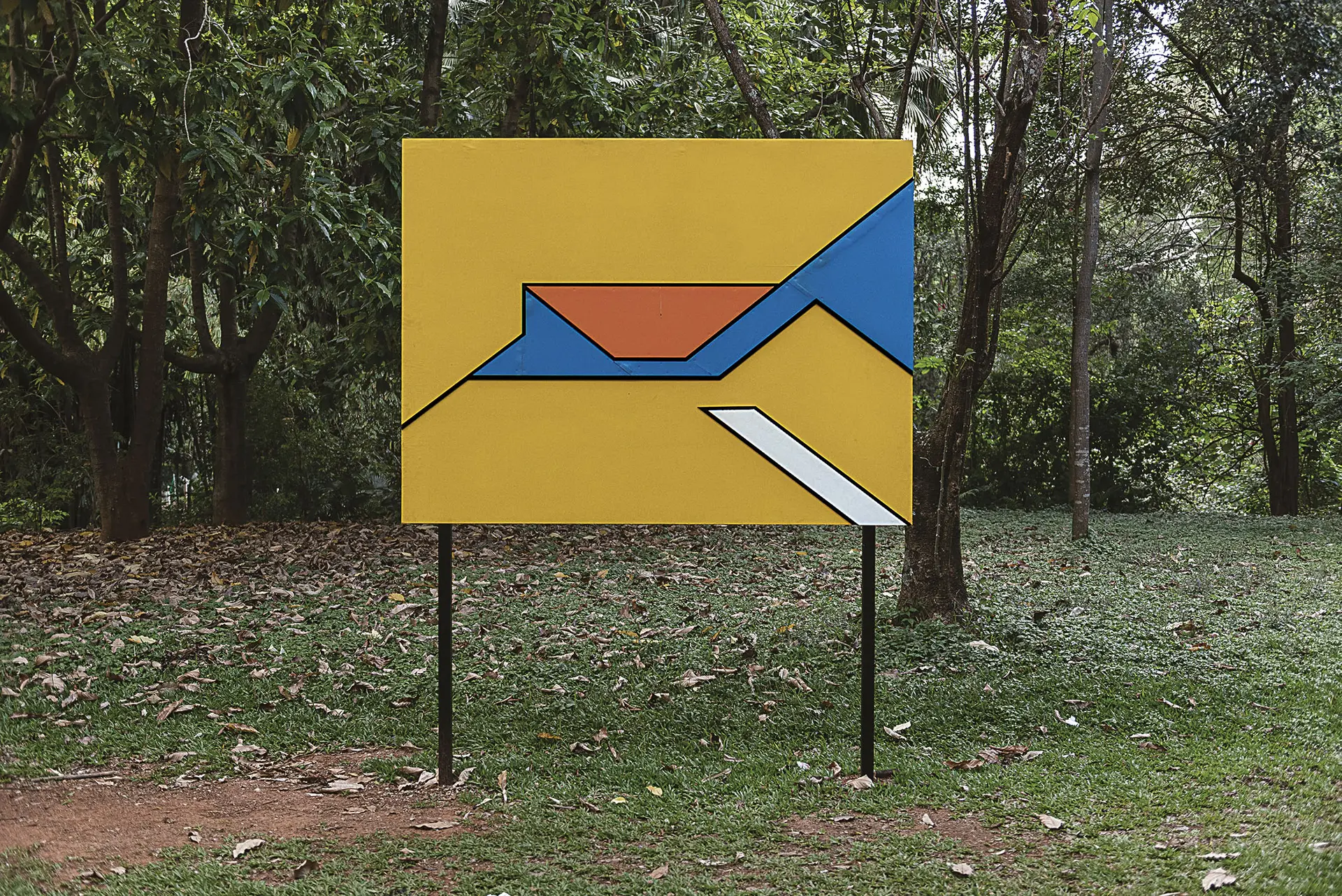
In Dias-Pinto’s work, the printed image, from different cultures and historical periods, functions as a key for reading the world: the artist uses juxtaposition, bringing closer together images and messages from different places and times. Our vision and circulation in the space in which his work is arranged are guided by geometric patterns. Two of Dias-Pinto’s works were on exhibit at the biennial: Outdoors (2014/2016), a series of twenty posters arranged throughout Ibirapuera Park, and Enciclopedia Visual Brasilera (Brazilian Visual Encyclopedia, 1970-2016), installed in the Biennial building. The latter uses, in fact, the method of accumulating and indexing printed images, without indicators of chronology or origin. To build his Brazilian visual encyclopedia, Dias-Pinto works with “imagetic uncertainty,” presenting viewers with a different system of visual reading.
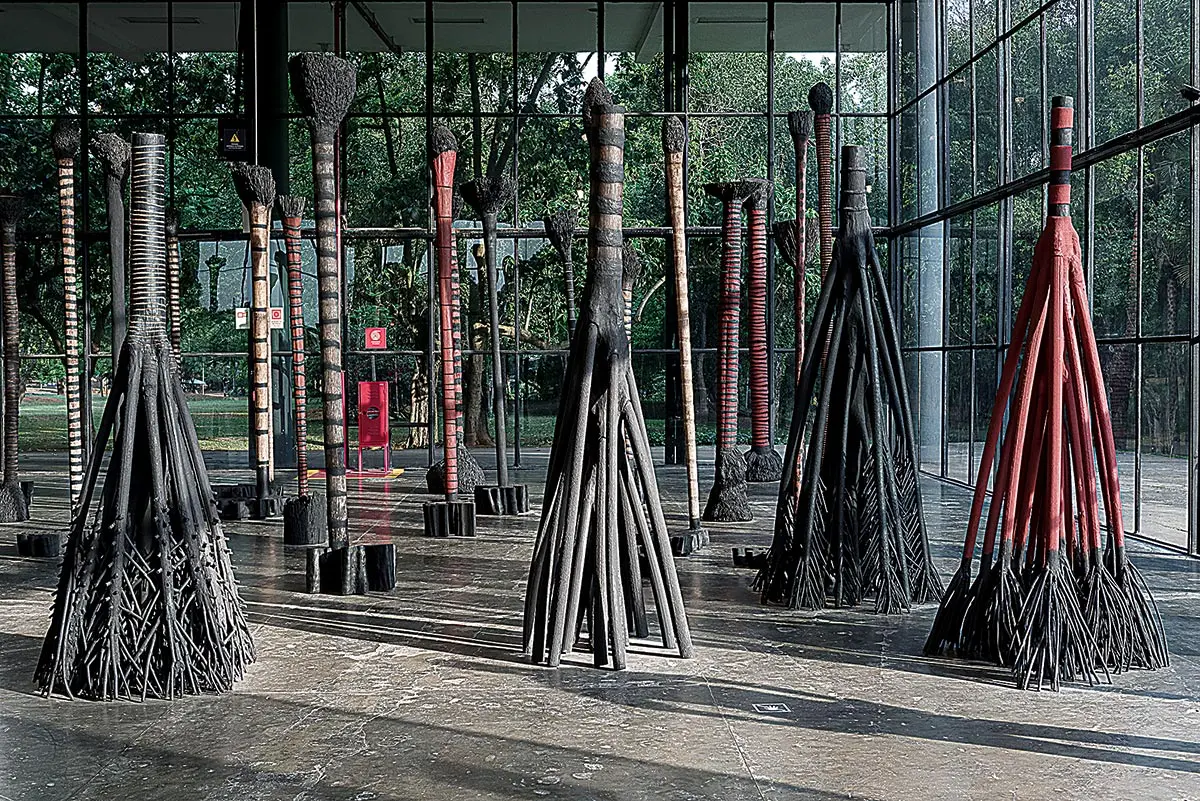
Another key historical reference in this edition of the Biennial was the work of Frans Krajcberg, who starting in 1970 when he decided to settle in Nova Viçosa, south of Bahía, adopted as the subject matter for his meditations on the destructive process imposed by Man on nature. Krajcberg appropriates elements extracted in predatory ways for the construction of his sculptures and installations. The set of these works were on display in the Biennial.
The gallery devoted to Wilma Martins, an artist who proposes a dynamic dialog between drawing and painting, also grabbed our attention. The selection of her works on exhibit featured a project developed since 1979, redrawing compositions made in previous years, as though to produce her own re-reading of her oeuvre. Also on display were paintings and drawings from the series Cotidiano (Quotidian), 1970-1980, which record household life and women’s chores in an environment of the solitude of women inside the home.
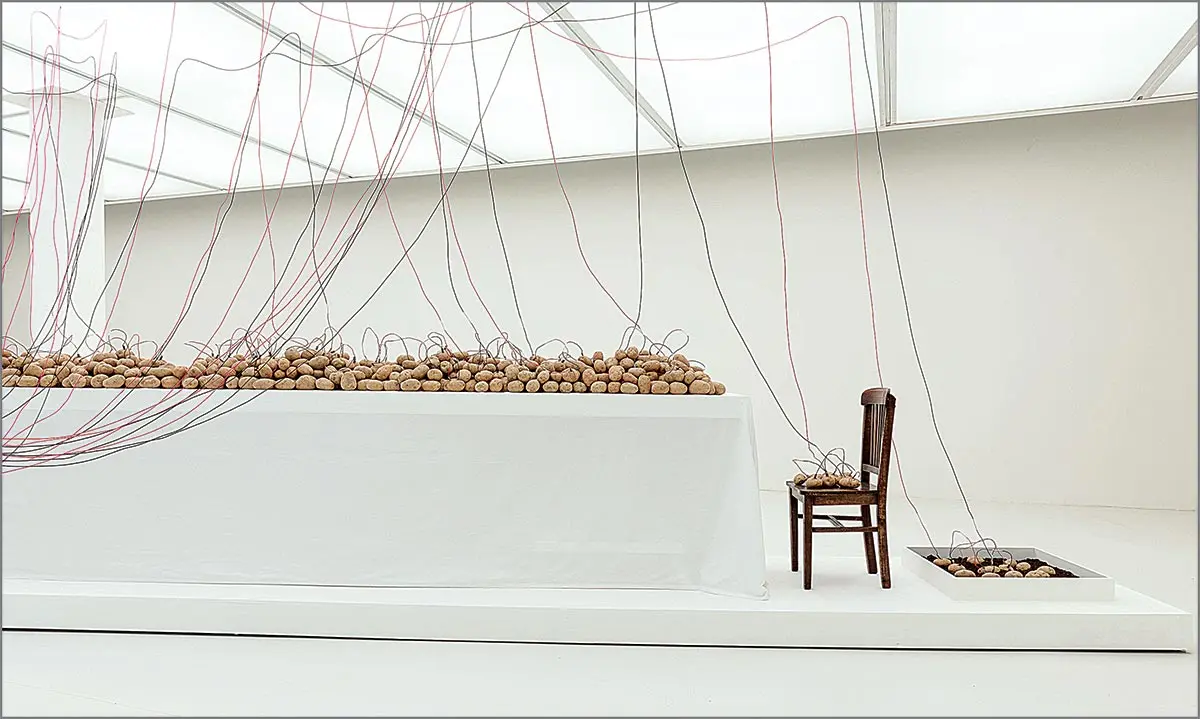
Other historical figures present in the Biennial were Öyvind Fahlström, a pioneer in concrete-poetry experiments; Portuguese artist Lourdes Castro, with her investigation of the immateriality of shadows; and Victor Grippo, who was a member of the Argentinean avant-garde group known by the acronym CAyC2. In his experiments, Grippo seeks to distort the normal context of everyday objects. In this exhibition he presented Analogía 1 (Analogy 1), an installation in which the artist places a large number of potatoes connected to electrodes on a long table and a chair; the electrodes, in turn, are connected to a voltmeter. The proposal is to discuss the notion of decay and the implacability of time.
In what follows, we will highlight some of the contemporary works featured in the 32nd Biennial, with the intention of bringing readers closer to the exhibition.
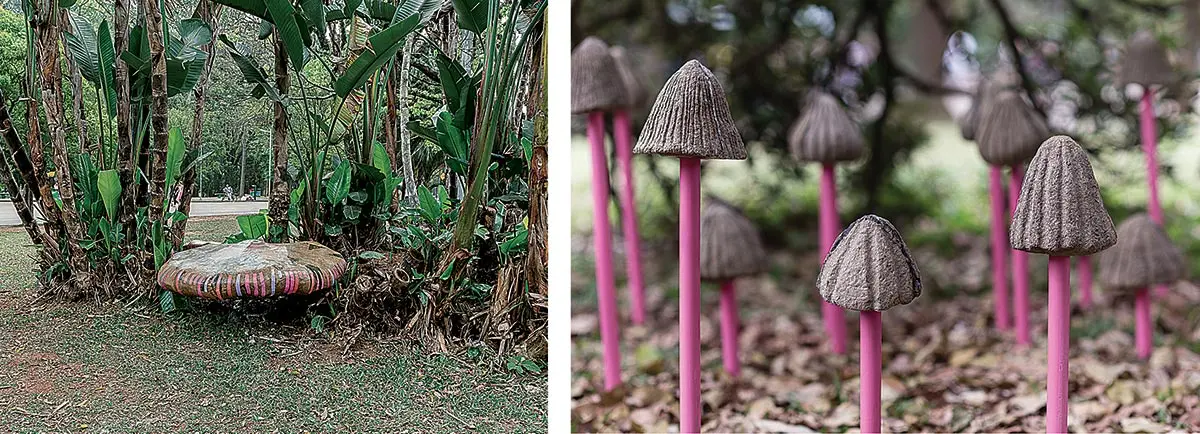
Alicia Barney (Colombia) presented an intervention in Ibirapuera Park where she arranged one hundred paper-and-resin mushrooms near a musical instrument made of tubes that were randomly actuated by the wind. Barney’s work is titled Valle de Alicia (Alicia’s Valley) in reference to the Cauca Valley, in Colombia, well known for its abundance of mushrooms.
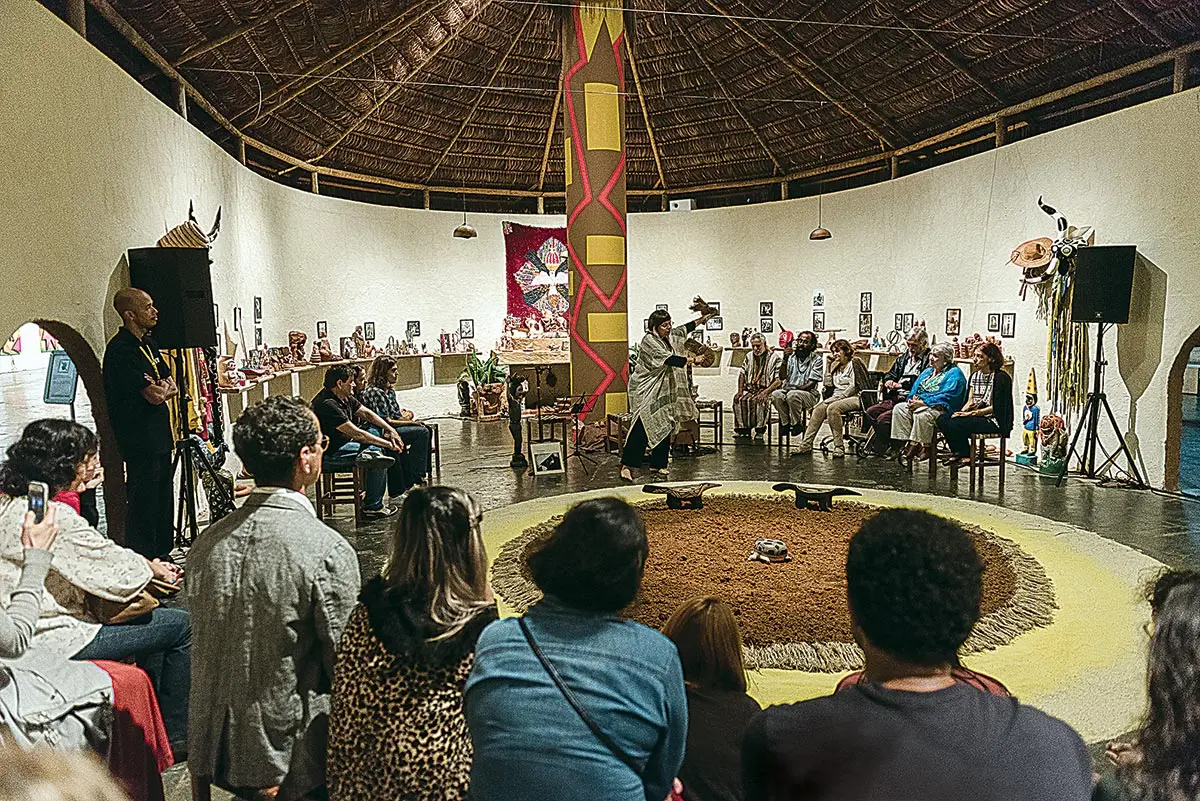
Benê Fonteles (Brazil) exhibited his project titled Oca Tapera Terreiro. It is a circular construction on the ground floor of the Biennial building, made from straw and adobe bricks, a construction technique commonly used in buildings from the colonial period and widely present in the early origins of the city of São Paulo. Oca is a term used to name a place for conviviality, like a home. Tapera means, in the Tupí indigenous language, an abandoned village or hamlet. Terreiro is the name of the space for the practice of candomblé, a religion of strong African influences that is widespread in the country. Fonteles’ interactive, multicultural project was one of the most visited by the public. The artist met visitors in the space he had built, and he promoted meetings with shamans, musicians, and educators in his Conversations to Delay the End of the World. This is how his artistic project was activated. Fonteles created a multiethnic, ecumenical site where the iconographies and actions of different religions and belief systems could be presented, and where different cultural manifestations could come into closer contact.
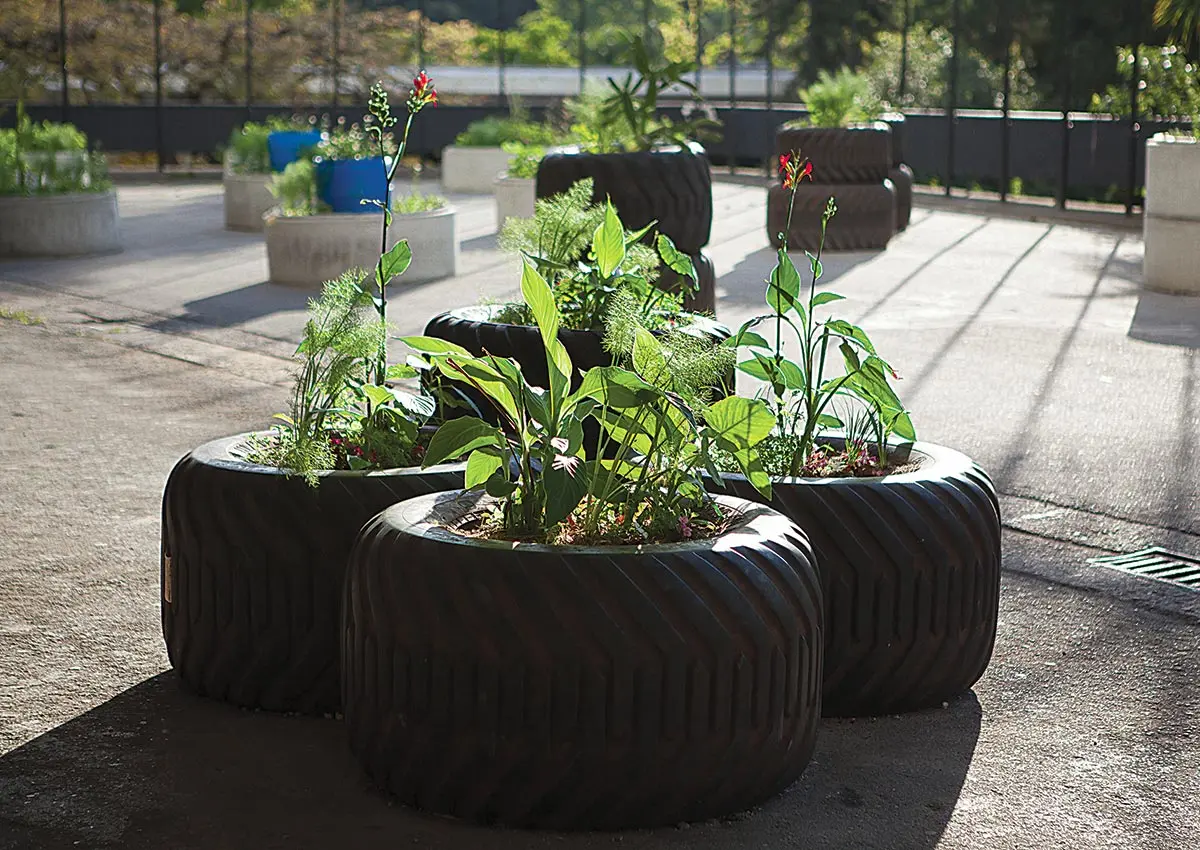
Carla Filipe (Portugal) came to the exhibition with Migração, exclusão e resistência (Migration, Exclusion, and Resistance), proposing the construction of orchards in urban environments, the collective use of spaces in the city to that specific end. For her installation, Filipe used edible plants and also the vegetation that grows spontaneously in the cracks of building walls or cement sidewalks. Her proposal, according to the accompanying critical commentary, “has to do with the guerilla-gardening movement and with practices of urban agriculture.”3
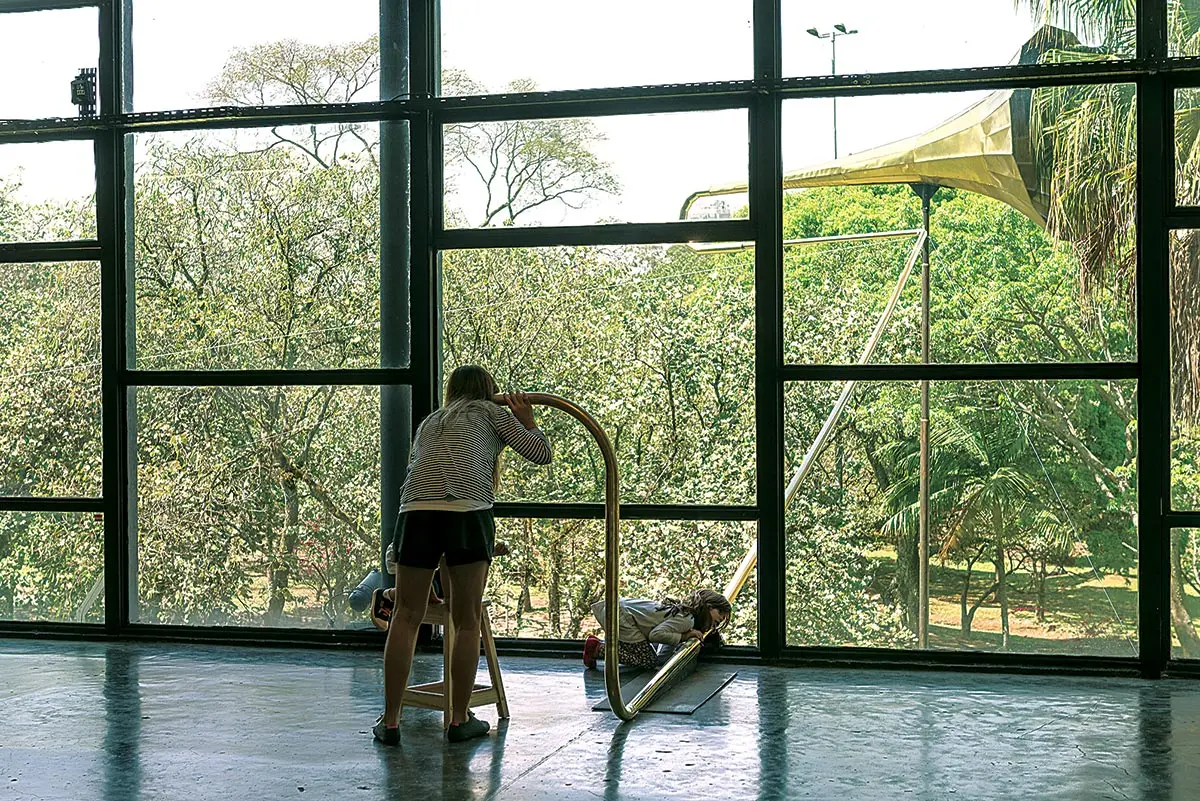
Eduardo Navarro (Argentina) presented Sound Mirror, a tuba-like musical instrument located near the building’s large window in order to generate a process of listening between a palm tree (outside) and the Biennial’s pavilion. Viewers were invited to test and assess the sound. The work’s interactivity fostered a perception of sculpture as a strategy for the activation of aesthetic experience.
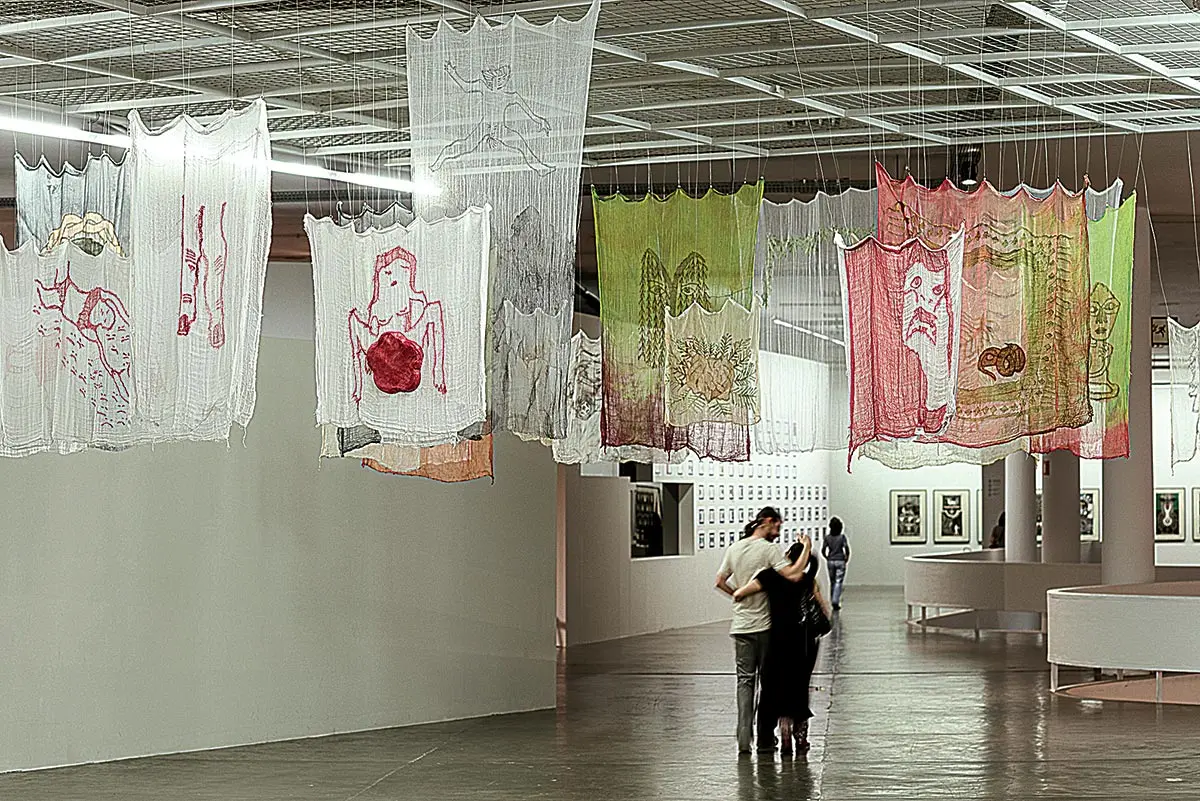
In The Girl Was Not There (2016), Günes Terkol (Turkey) used textile elements—a cotton-weaving as thin as transparent gauze—as the support for the printing of images in inks made from organic natural sources: onion, beets, tobacco leaves, avocado. These fabrics were hung to form an installation and viewers could make out the images painted and embroidered in them from different vantage points, building a narrative of cultural memories around the issue of “the feminine.”
Kátia Sepúlveda (Chile, lives in Mexico and Germany) engages the subject of feminism in a work made in Temuco, in southern Chile. The artist interviewed five Mapuche women and explored whether the role they play in their society is similar to the role played by Aymara women in theirs (in Bolivia and in Acre, Brazil.) Sepúlveda fostered a dialog between two activists, one Mapuche and one Aymara living in the mentioned Brazilian state. Acting as an anthropologist, the artist shed light on the vitality of feminism in the women’s communities, while underscoring the uncertainties that dot the social fabric.
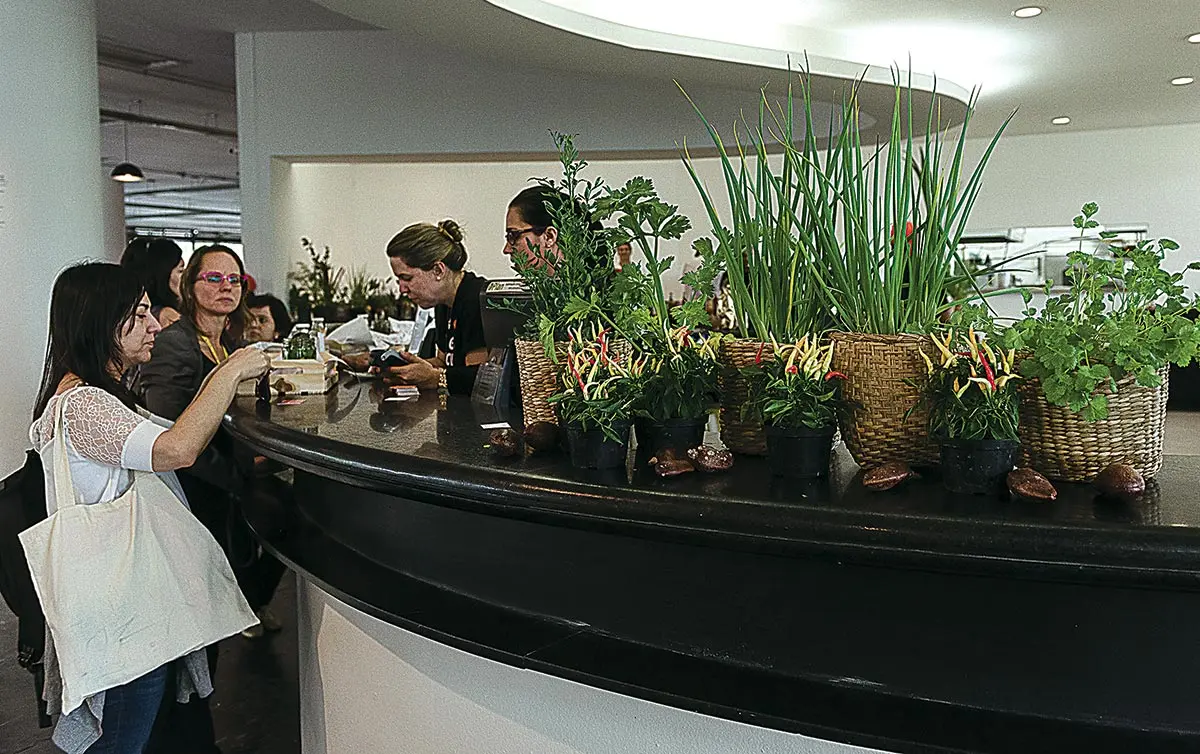
An interactive project that powerfully grabbed the audience’s attention in this 32nd biennial was Restauro, by Jorge Menna Barreto (Brazil). For his installation, the artist created a restaurant in the building’s mezzanine that remained open as long as the exhibition. The restaurant offered dishes made from vegetables produced using sustainable-agriculture systems, with a concern for the recovery of soil. To activate his work, Menna Barreto gathered a team of collaborators who prepared the dishes on the menu and interacted with the public. His intention with this project was to provoke a mediation with the audience, in the sense of thinking about how to “metabolize” art in society.
In statements to the press, Jochen Volz said that in his proposal he intended to avoid impenetrability and obscurity, and to seek artworks to project in the audience “a thoughtful, very clear, often direct immersion.” For him, as we have mentioned, the Biennial is no longer a window into the world; its function is to serve as a critical platform, on the basis of aesthetic experience. The Biennial, as Volz understands it, is a place to think about the dilemmas of contemporary reality and our existence in it. With the themes proposed, it invited visitors to invent and to engage in a narrative exercise about the challenges of uncertainty in today’s life. But, where are the boundaries between art and activism? Something to think about around the 2016 São Paulo Biennial.
In a general way, the most salient aspect of the art on exhibit at the 32nd Biennial, in connection with the theme proposed, was a concern for the crisis caused by the environmental drama. The drama of the relationship of living beings with the environment they inhabit, the devastation of nature, the tensions that emerge from humankind’s relationship with its social and economic surroundings.
NOTES
1. This is the explanation of the dynamic of contemporary art offered by Nicolas Bourriaud in Postproduction: Culture as Screenplay: How Art Reprograms the World. New York: Lukas & Sternberg, 2002
2. Centro de Arte y Comunicación. The group was originally called the Grupo de Los 13 (Group of the 13), but it later became known by the initials of the center to which they were connected.
3. Hortência Abreu, in the exhibition catalog. P.110.
* Courtesy: Fundação Bienal de São Paulo.
LISBETH REBOLLO GONÇALVES