
An art collection will always be a particular vision of reality, one that is built on a specific platform supported on three pillars that make it possible for us to see the horizon with a degree of clarity. Taste, a Nineteenth-Century category sometimes deployed as a pejorative for its aesthetic-gastronomic halo, is the first of these pillars, founded on the life experience of those who dare push for a coming together of symbolic contenders. Second comes judgment, which is the subject’s intellectual training, the condition that makes it possible to assess and classify objects, phenomena, and events—taking, of course, their many nuances into account—as beautiful or ugly; good or bad; and true or false. Finally, this rostrum of a kind for the pleasurable and leisurely contemplation of the world must necessarily include a third pillar, one having to do with the value vehicles that will make the collection consistent and well-planned: its budget. Now, a photography collector is someone who has decided to anchor this tripod on matters much more complex than the materiality of art as such. The intent is to collect gazes and thoughts as they are congealed in specific versions of reality; the material is virtual and no prettiness or price/value is intrinsic to the object, a situation that differs from other conventional forms of art and guarantees photography’s autonomous, non-objectual characteristic, which in turn takes the discussion beyond the parameters established by modernity in terms of the treasuring of goods.
By editorial convention, this article, which seeks to recreate a critical view of a photography exhibition based on two private collections, is labeled as a group-show review. Yet, the individual responsible for the museographic production we are exploring—presented originally as part of the first edition of the Foto México International Festival at Centro de la Imagen gallery, between October 2015 and February 2016; the version under review here was on view later at the Museo de Arte Moderno in Medellin—makes authorial statements that call our attention to the contemporary debates around the understanding of curatorial exercises as works of art, something that certainly challenges a collection (in this case, two conventional collections) to transcend its boundaries and limitations in order to become, following the criteria of an intellectual planner (curator), a creative unit in its own right.
Cámara de maravillas (Cabinet of Marvels) is the title of this exhibition of photographs from the Isabel and Agustín Coppel Collection and the Kadist Art Foundation, both of which hold a significant number of works by important figures yet work under clearly distinct intentions: the former focuses on photographers whose images were markers of aesthetic difference—with names such as Edward Weston, Irving Penn, or Diane Arbus—while the latter has a contemporary profile, where the medium is just that, a form among many rather than an end in itself. The introductory essay for this show makes explicit reference to an “enlightened” practice harking back to the very genesis of contemporary museography: the period’s cabinets of curiosities. This reference already makes clear that the exhibition’s architect (curator) wants to impress his version of events and function as a Romantic traveler through times and spaces others have already traversed with their poetics—actions that have been fostered before from the platform on which collectors operate, since they, in a way, already posited their own cumulative version of a world based on the addition of other worlds. In that sense, and to begin exploring the statement hidden inside this new production, it does not come entirely as a surprise, although it does catch powerfully the eye, that the person signing it, Jens Hoffmann, Adjunct Director at The Jewish Museum in New York, presents himself as a “creator.” Although such bold positioning could have been interpreted as a typo or a mistake, since just one letter separates creador from curador, the English translation confirms the point that the role played by the person responsible for the contents of the exhibition (the pragmatic meaning of the term curator) is to be equated with that of an artist in the ontological sense of the word. The promise is, from the start, powerful and ambitious; let’s remember that the curator’s practice—or, in this case, the creator’s—begins with a review of materials previously collected by others who applied their taste, judgment, and budget to the shaping of a corpus of meaning, a photography collection, which is to say, a collection of images of other times, other places, and other gazes.
Now, photography as medium for communication, artistic expression, or multi-purpose circumstantial testimony, connects to the notion of verisimilitude. “An image is worth more than a thousand words” is a commonplace proverb appropriated by the epistemic teleology of the modern project. One hundred years later, there can be no doubt that the operation is turned around: given the unending possibilities for light-carved images provided by contemporary technology, the power of words is reclaimed and fiction is conjugated between these two creative units; words and images are indivisibly coupled in the construction of poetic meaning. Photography’s probative condition, exalted by positivism, dissolved as fast as its ability to recreate the world was established. Jean Baudrillard finds that “it is perhaps through photography that the world in itself begins its act (…) and at the same time imposes its fiction.”1 Cámara de maravillas is not a history of the photographic medium; rather, it is a singular vision posited by a high-renown actor in the art circuit who, in an eloquent and sophisticated way, reminds us of the enormous power that lies within its nature, as well as the large chasm that opens between those who have decided to inhabit the world from behind a camera and the rest of us mortals who will eventually use the same “ruse” in order to record our presence on life’s stage.
The presence of Latin American photographers is remarkable, although the selection, says Hoffmann, followed no geopolitical or historical guidelines. Nevertheless, names like Mario Cravo Neto, Marta María Pérez Bravo, or Gabriel Orozco, who appears several times along the exhibition (with his restrained gestures, as if setting a standard and reminding us of the futility of the image on the face of the symbolic course it entails), gave great luster to an eminently contemporary medium in the Latin American art scene, where the non-objectualism of the 1980s opened up a wide range of uses for photography.
With a handful of exceptions, the roster of names gathered here has written the history of photography over the last century, and although in most cases what is on exhibit here are not the masterworks in their respective oeuvres, the selection as a whole is rendered especially potent by the addition of each singular item and becomes a new object, a kind of open album put together with great care and judgment by a curator not afraid to present himself as a meta-artist. In sum, this whole is possible only thanks to the triangulation activated by the art system, confirmed, again, by three actors: artist, collector, and curator, a triad of values represented in roles that necessarily entwine and become interchangeable before the visitor’s eyes. Who is the artist, ultimately? This question is inescapable in this “chamber of marvels,” but the answer is neither clear nor univocal; on the contrary, it organically changes the performance of these three archetypes according to the vantage point from where the scene is observed. What may the artist think of the curator or the curator of the collector? Finally, what reasons did the collector have to recruit the poetics of this or that artist in particular? Here is where the staging of this set of images and objects becomes deeply interesting, something that must be analyzed from the ultimate perspective that applies in this case, which is to say, the creator-curator’s review, in his meta-artwork, of the artists, already gathered, studied in detail, and inducted into the collection by the material owners of their production, in an exercise that precedes the curatorship but in a way also precedes and foreshadows this very notion, that of creating something on the basis of other people’s creations.
In that sense, the “artistic installation” is coded in a propaedeutic cipher. This is to say, a first image—which could be any, at any point in the trajectory—is followed by another, which in turn is given nuance by the content of its predecessor; later, a third entry comes into play in the arithmetically progressive discourse, albeit one rendered more complex by the observer’s experience. The random association of images and objects acquires meaning necessarily to the degree that each is deliberately arranged before or after something similar. This strategy evokes the game of the Enlightenment-era traveler who returns home loaded with souvenirs and sets them in a chamber specifically designed or reserved for housing his collection of rarities, a magical cabinet that contains a specific vision of the world filled with capricious, Borgesian inflections.
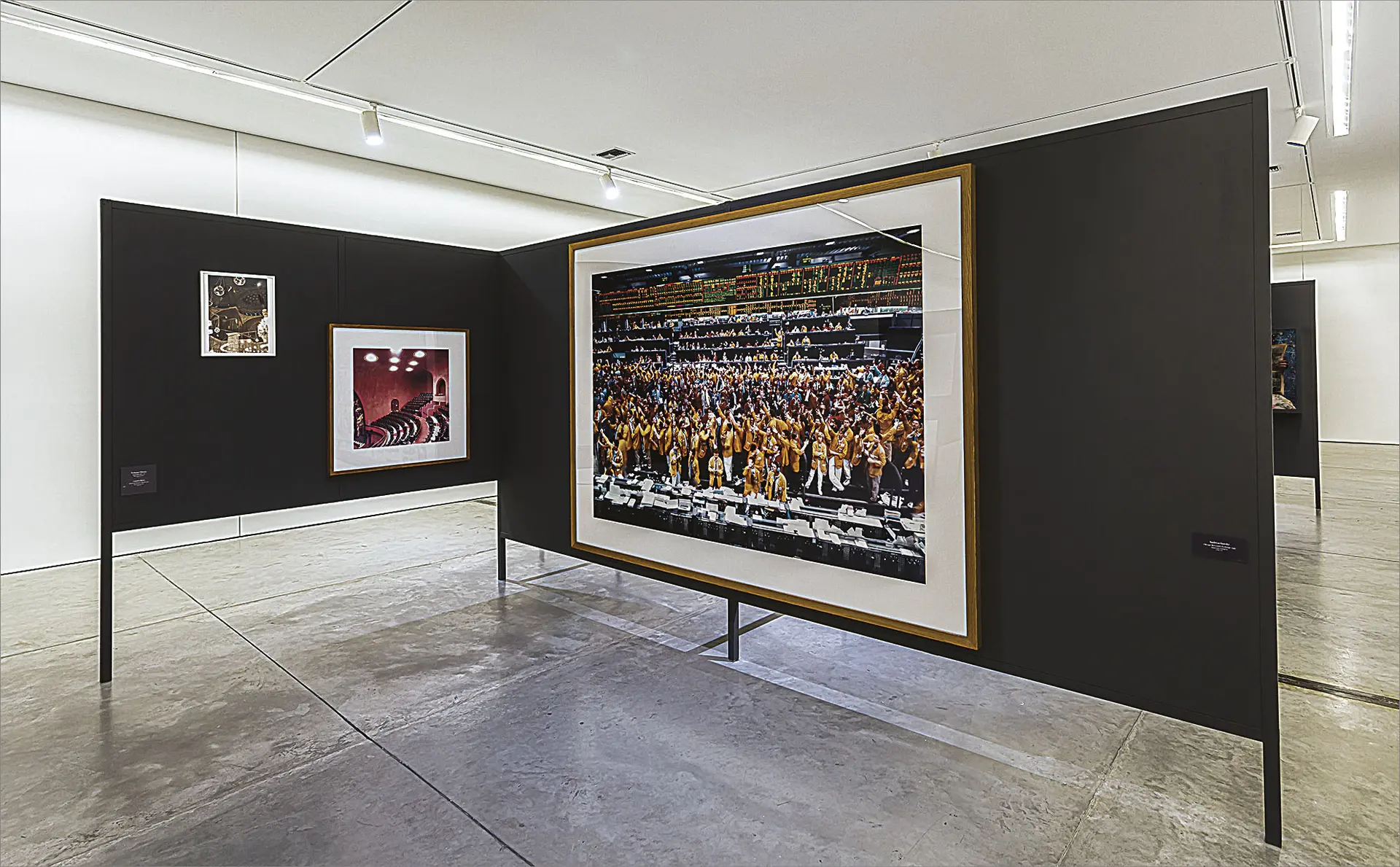
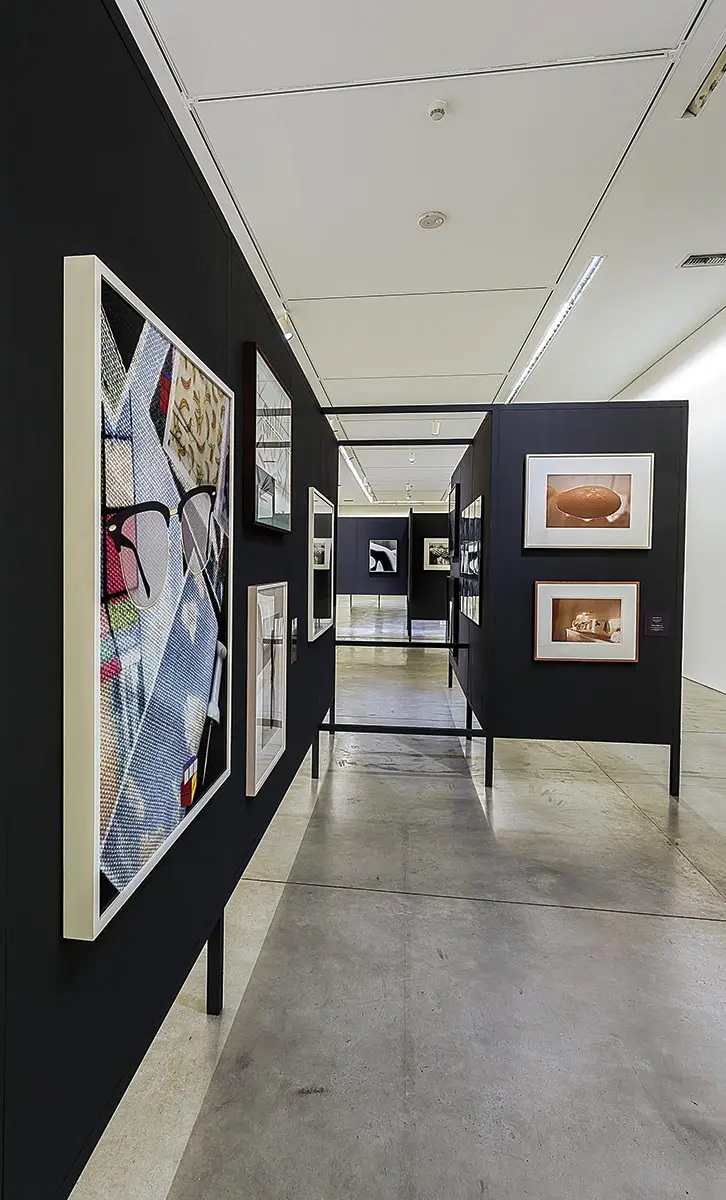
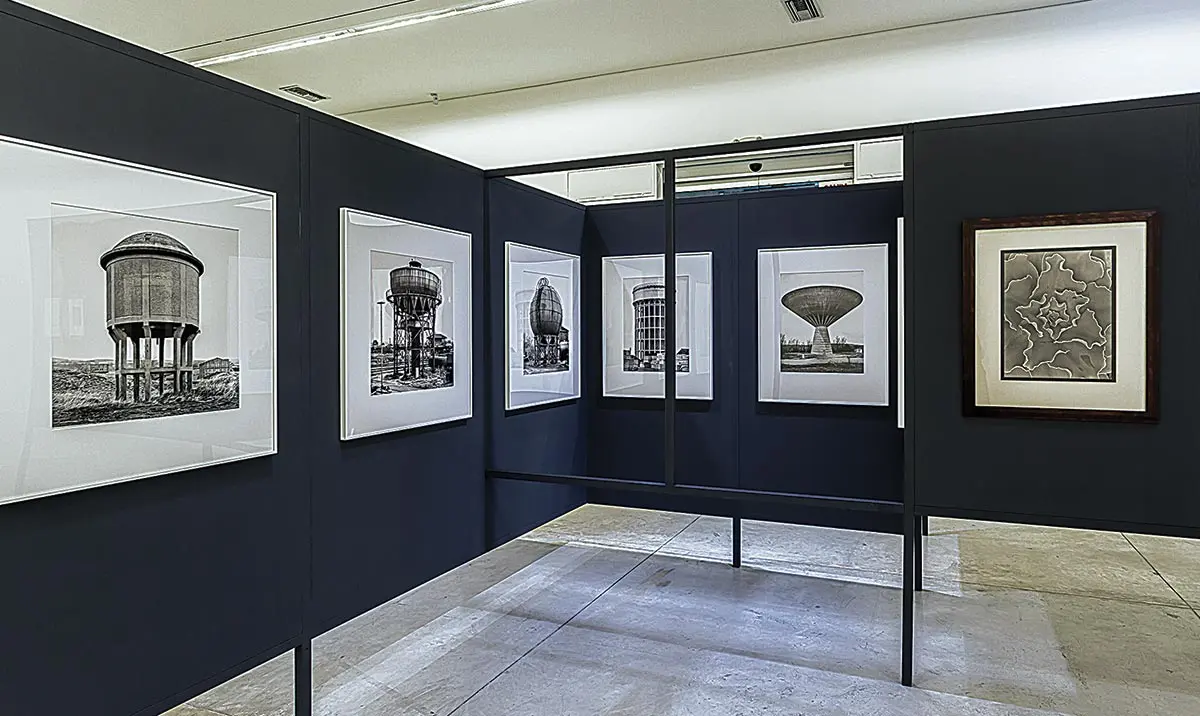
As a discursive mechanism, the game proposed for viewers in this exhibition is well aware of the way in which we learn, how human beings accumulate knowledge, and relate to the world in cognitive terms. Together with what we’ve said so far, this is the most salient point in a mise-en-scène that evades direct contact with the museum structure at any cost. The gallery walls are used only to separate the spaces: there is nothing in them other than light; spotless, the white box’s walls highlight the presence of the volumes generated by the architectural interplay of the dark panels holding the images, which in turn bring to mind the bellows of the first boxes used to engrave light on a piece of glass, cellulose, or paper. It must be remembered that, for his creation, Hoffmann invited an architect to help materialize his vision, which encompasses an exhaustive analysis of the artworks and their components in order to imagine, project, and build a self-supporting architecture that brings to memory the bellows mentioned before.
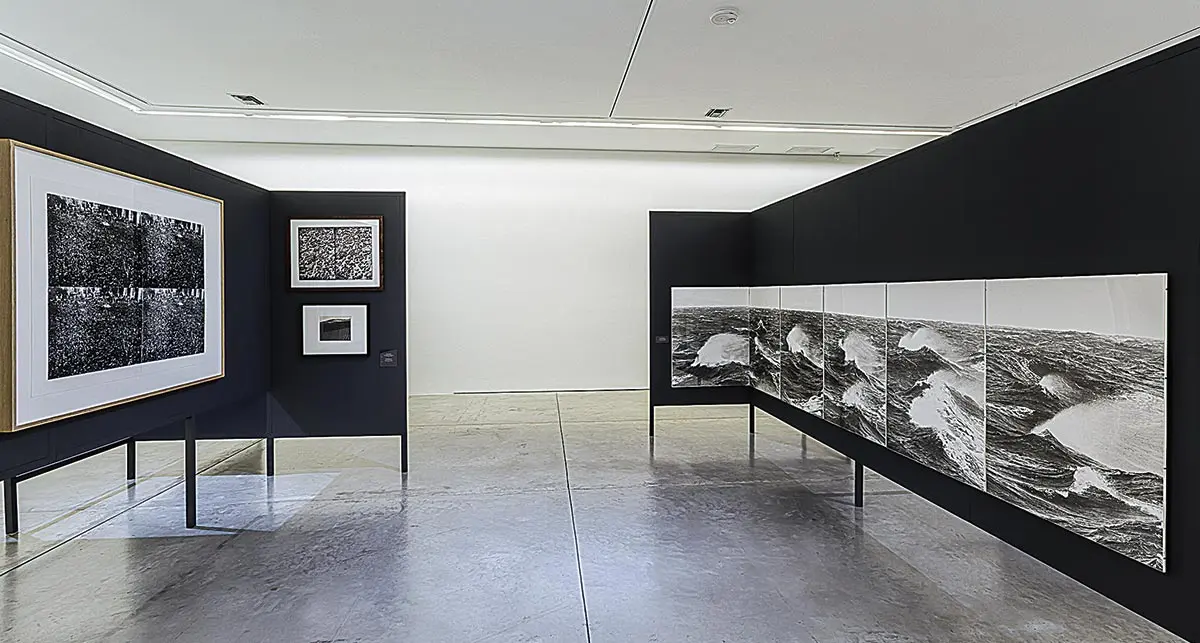
Hoffmann knows the power of human curiosity, heightened by the stenotope of the dark box. He is astute enough to notice the presence of things under the shadow of objects photographed in close up in the different images featured in the show. Verisimilitude is a reliable principle of photography is thus revealed as it disrupts, metaphorically, such condition of truth with the help of a bold superposition of planes, which are the very supports of the installation and the anchor of our trajectory through it. In this way, the narrative is made more complex by such architectural accidents as a corner, a fold, and a vanishing point that juxtaposes one item to another from a different thematic family, carrying out a complex conceptual operation that Hoffmann equates with that of a cybernaut exploring the web. In this way, we are confronted with such unconventional situations as a panel arranged at a right angle less than a meter from an image recreating a tempestuous sea surf, in a clear allusion to the cinema (Jochen Lempert’s creative strategy) that the creator-curator’s vision amplifies to the point of questioning even the content of the image and our capacity to understand it.
In this gambit, the virtual condition that renders photography a Spatio-temporal opening of reality is directed towards its material essence, its factual meaning. Thus, each image is objectualized, highlighted in terms of size, color (or its absence), texture, folds in the support, and even its frame. None stands out from the others, regardless of the weight class of its name or of its maker. Thanks to this astute mechanism, the images are objects that become paragraphs in a story that contains them within a rhetorical amalgam that is the sole responsibility of the narrator. Nevertheless, and thanks to the theatricality implicit in the museographic decisions made for this show (such as the selection of hues for the modules and the labyrinth-like architecture), this exhibition contains a forceful paradox: it jumps sideways into Plato’s myth of the cavern in order to present the makers of images as holders of a truth filtered by light as it travels across the chamber of marvels. At this point, the experience is filled with meaning and allows us a glimpse of the broad spectrum ciphered on the subject matter of the image selection, which covers human geography and its interests, both pragmatic and mystical. In sum, it seems that behind this experience the exhibition’s architect has planned a kind of master class in contemporary curating.
Jens Hoffman is aware that images are occurring wherever there is a mobile device, a tiny chamber of marvels networked into a web that grows exponentially (not arithmetically, as is the case in the exhibition) and is nowhere near reaching its endpoint. The show’s gambit dignifies human creation: as a metaphor for knowledge, it warns, photography can be used to reach whatever we desire, even Art. This Cabinet of Marvels is a centuries-old Möbius strip where attentive visitors would have noted, in the gesture of the self-designated “creator”, an invitation to create their own world, to launch their own journey through knowledge, and, why not, to jump into their own creation.
NOTE
1. Jean Baudrillard. L’Échange impossible, Editions Galilée, 1999.
OSCAR ROLDÁN-ALZATE
Political scientist and independent curator. Professor and director Cultural Extension Universidad de Antioquia.