
Images are not framed only by our visible universe, on a human scale. The observation of the stars and of space poses a dramatic contrast with the life of small creatures like spiders, which play such a central role in this Argentinean artist’s exhibition at MARCO, in the city of Monterrey.
The queasiness provoked by our being such a minimal part of creation is the feeling on the basis of which the work of Tomás Saraceno acquires its pertinence, under a narrative that interweaves artistic reflections with scientific research. These stories expand not under a microscope or a telescope, but through the critical gaze of this visual producer of observation logs for a variety of natural phenomena that impact the Earth’s landscape and atmosphere.
Reflecting about the origin of the planet and the solar system as I visited the exhibition Ciento sesenta y tres mil años luz (One Hundred Sixty-Three Thousand Light-Years) drove me to ask: Is our individual presence important in any way for the memory of the universe? What is the vastness of it all confronted with a tiny spider? What happens when the only relevant thing we can do is to perceive the evocative darkness of an exhibition gallery devoid of temporal references?
The Argentinean artist presents us with a striking, contrast-filled journey in his first solo exhibition in Latin America, curated for MARCO by Gonzalo Ortega.
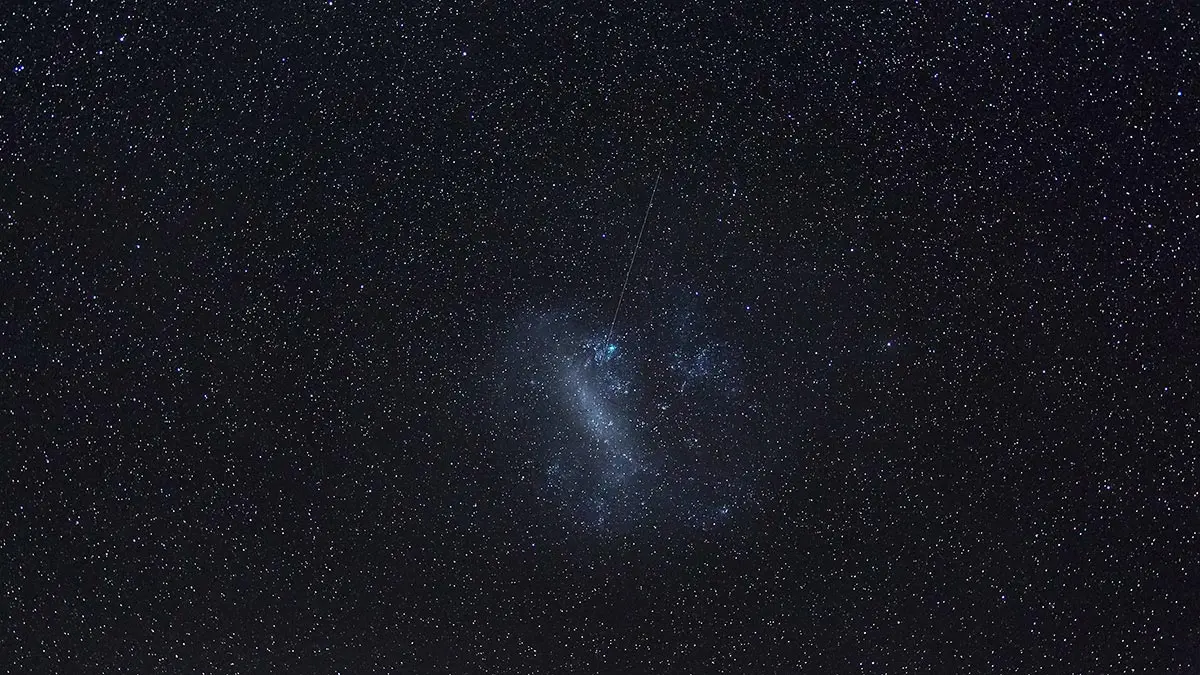
The title of the exhibition comes from the distance, converted to time and space, it would take us to see a light particle coming from the Magellanic Clouds, two dwarf galaxies located 163,000 light-years from Earth. Given this, they cannot be seen in the present. In terms of their visibility, in contrast to the incommensurability of the galaxies, we can say that they are two huge agglomerations of stars, dust, and gas. They usually contain several million or billions of stars and can vary in size from several thousand to hundreds of thousands of light-years in diameter.
The universe contains hundreds of billions of galaxies that appear in many sizes, shapes, and brightness levels. The stars and galaxies found by scientists when looking at space are sometimes alone, sometimes in pairs, and sometimes in large groups known as clusters. The three basic kinds of galaxies are spiral, elliptical, and irregular.
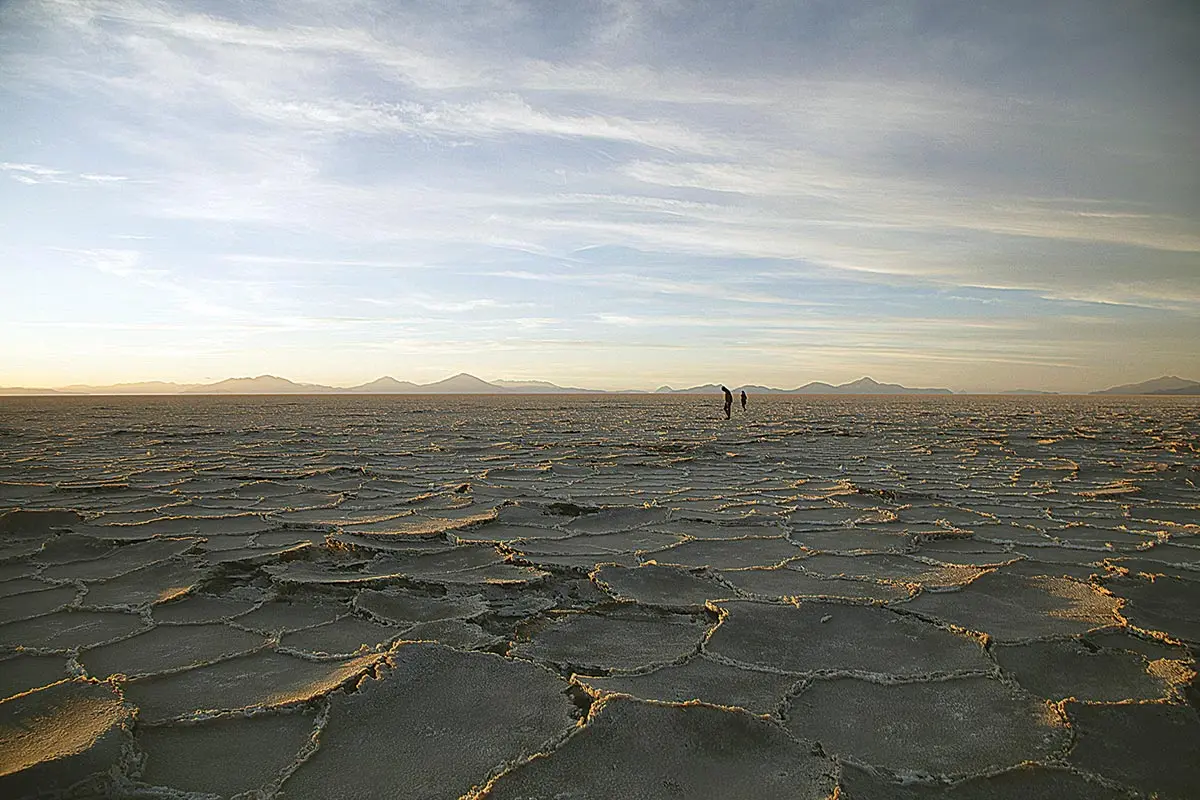
The timelessness of certain sites on our planet, such as deserts, plains, and, especially, Salar de Uyuni in Bolivia, motivated Saraceno to wonder about our perception as we situate ourselves in a specific time and place.
The exhibition curated by Ortega proposes a course based on nuclei or works not organized on the basis of conventional criteria. Rather, it allows for the unfolding of a series of atmospheres that make different sensorial trajectories possible and enable integral experiences encompassing our senses of sight, touch, and hearing.
Saraceno’s exhibition was divided into three sections that function as axes along with the artist’s oeuvre, alternating in six gallery spaces. The nuances of light and darkness determine the character of each area. This contrast is key in building a space that differs from the typical, “white cube” exhibition environment; Saraceno discards this concept and uses theatricality to reject any linear reading of his art, leaving behind the logocentrism of some of the interpretive processes that preexist in a contemporary art museum, such as the reading of two-dimensional artworks hanging from walls, written explanations, detailed technical cards, or rarefied discourses.
In the case of the areas of darkness, it is essential for the artist that viewers experience astonishment and perplexity when confronted by a series of live installations where spiders are the protagonists.
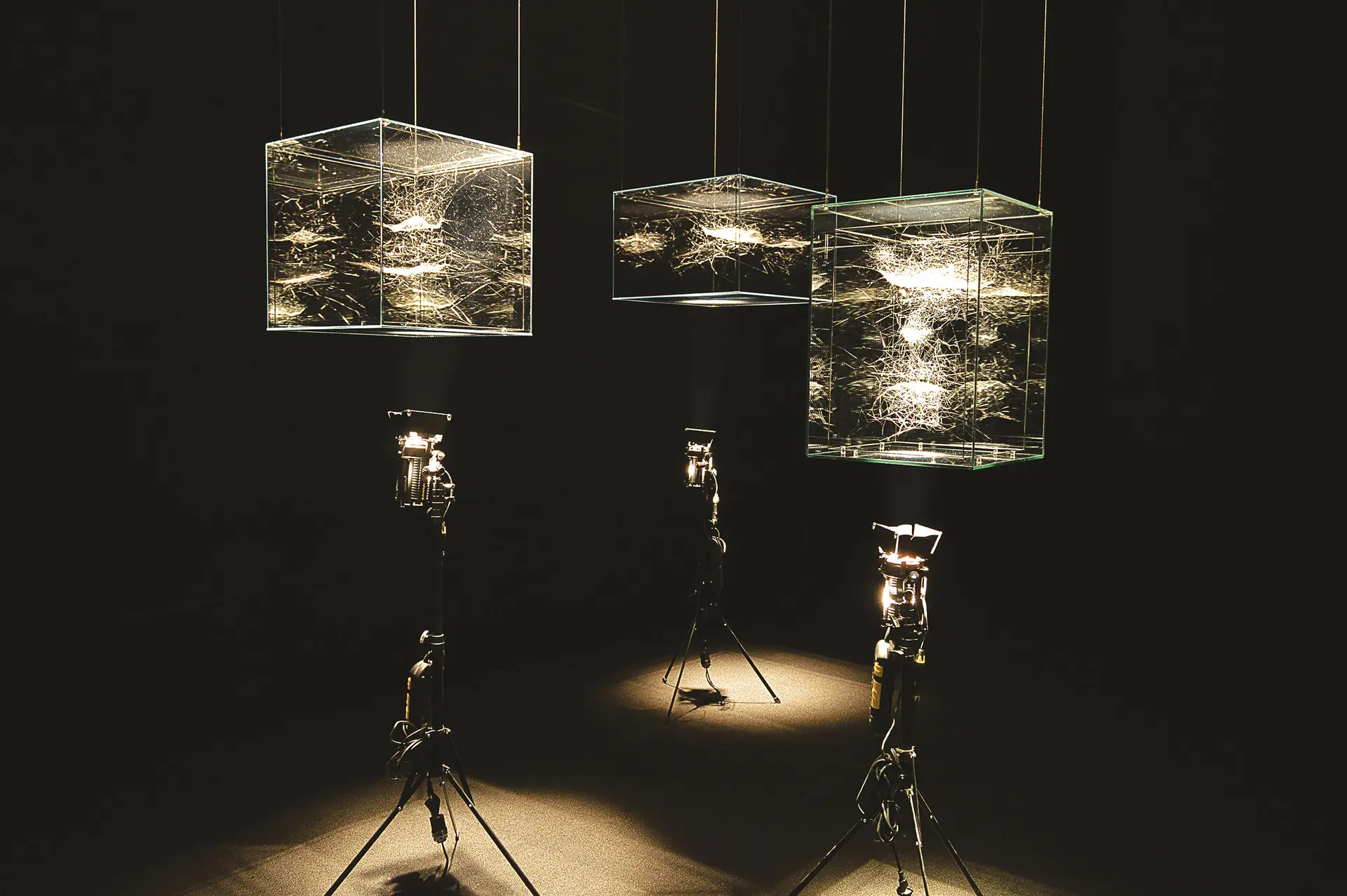
Cosmic Jive (2016) features webs spun by different species of spiders. The animals are encased in a series of floating glass cubes, and inside them, they work actively. The setup works as a perfect illusion, or a marker of the artifice of what we think occurs in nature and its observation.
Arachno concert (2016) consisted of capturing a group of spiders under tree acrylic cubes, where they spun their webs. The webs moved by the action of air, under the heat of lamps that shone on them in an otherwise deeply darkened space. This work harmonized motion, heat, and the sound produced by the delicate spider web threads suspended in a kind of ethereal and spectral symphony.
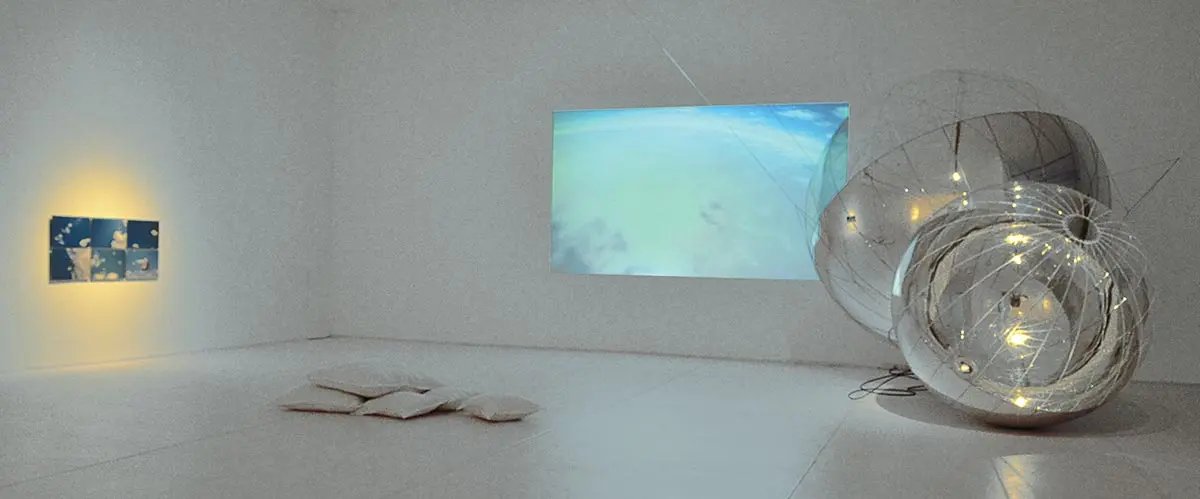
In the next space in the museum, we encounter an entirely aerial, well-lit environment for the display of Aerocene (2015), a series of aerosolar sculptures conceived to travel using the energy of the Sun and the heat of the Earth.
The work that gives the exhibition its title, Ciento sesenta y tres mil años luz, is a video installation of the cosmic image of the Salar de Uyuni salt plains. The sound generated by the clash between two black holes penetrates from the back. At the other end of the gallery, a projection of the universe pulses on a wire net; it is the image that has taken 163,000 years to reach the Earth. One of the exhibition’s most interesting features is the way in which, on the basis of a series of aerosolar sculptures and webs spun by captive spiders, we are prompted to formulate questions about the boundaries between art and science. Tomás Saraceno’s work has an interdisciplinary character, unconcerned with positivist and linear approaches.
One of the exhibition’s most striking works is Aeolic Instrument for a Ballooning Ensemble (2015), where a group of sculptures, giant balloons like those used by space satellites in order to reach areas not accessible to human beings, unfold on an entirely white stage. The balloons were proposed and designed by Saraceno so that solar energy would be used to power their motion.
These sculptures, material processes that are not human-made, and collaborations with other beings such as the tiny spiders as well as with the light of the Sun, demonstrate that art is not bound by an academic form that can be domesticated via specific canons.
The influence of other artists on Saraceno’s work is evident when we see him in connection with León Ferrari or Laurie Anderson, two key figures in the transgression of traditional artistic narratives.
In the vast margin where the universe poses no boundaries to human imagination, Saraceno’s art will make it possible to articulate new frames of meaning for our visual memory, allowing us to break canons or hierarchies between the very small and the very big of the visual memory of life in all its expressions.
ROCÍO CÁRDENAS PACHECO