
Discovered in Berlin in the Eighteenth Century, Prussian blue is one of the world’s oldest artificial pigments. The color has been associated with the history of Germany: it was used in military uniforms during the Eighteenth and Nineteenth Centuries, and later, in the Twentieth Century, it had a sinister connection with the Jewish Holocaust in Europe. The Prussian blue pigment derives from ferric ferrocyanide, a compound similar to the hydrogen cyanide that was the main active agent in Zyklon B, the gas used in the execution of prisoners in German extermination camps.
In the gas chambers that remain as testaments to history in such locations as Auschwitz-Birkenau, Dachau, and Majdanek, blue stains produced by the chemical effects of the cyanide gas on the plaster walls can still be observed; they are the result of an accidental reaction that produced ferrocyanide, the main component in Prussian blue.
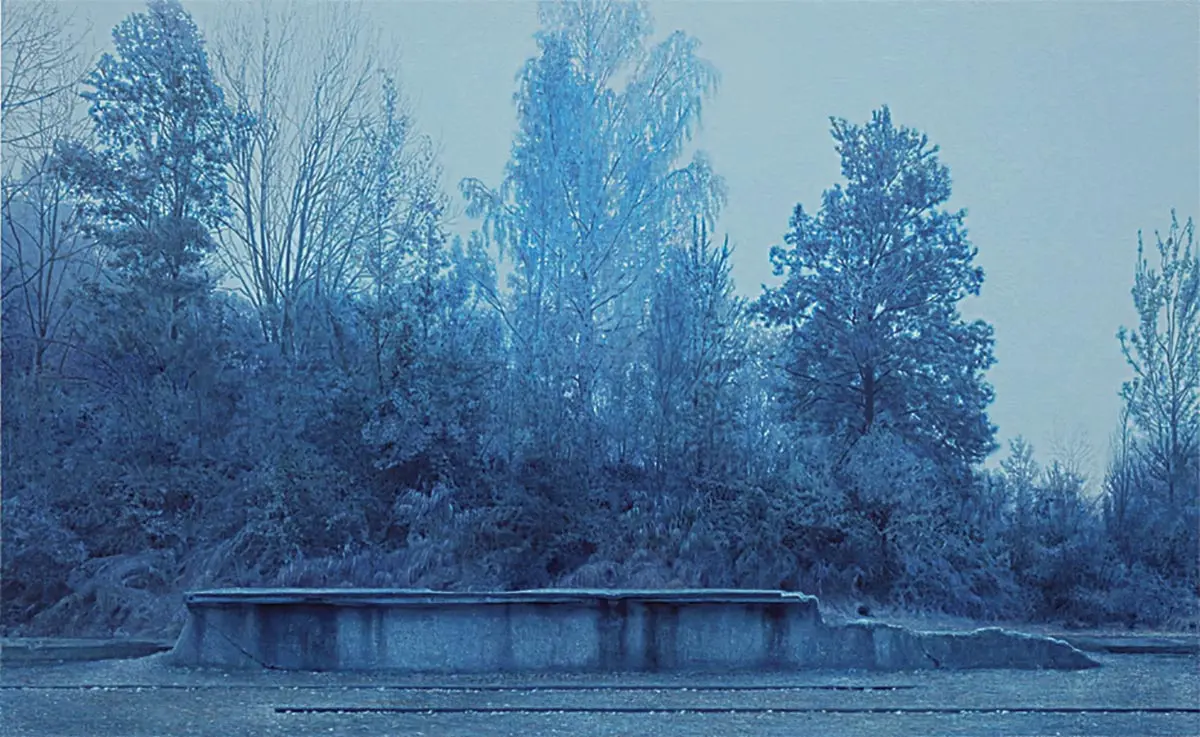
Based on this idea, Yishai Jusidman (Mexico City, 1962) created a series of forty-five works that express the relationship between color and history, perception, and materiality. Curated by Cuauhtémoc Medina and Virginia Roy, the exhibition is intended as an exercise in layering to make what is absent be present, in a dialectic that uses color to give new meaning to the diversity of representation and pictorial practice.
Jusidman’s paintings are based on photographs of the gas chambers and the extermination camp corridors, and they are exhibited alongside snapshots taken by the artist on a tour of the camps in 2012. His intention was not to represent the Holocaust as such but to produce a personal meditation, as a painter and as a Jew, around the concept of memory.
Jusidman uses only three material elements: Prussian blue, ground pumice stone (alluding to yet another compound used in the extermination of Europe’s Jews, as an agent for the spread of the pesticide inside the gas chambers,) and some colors named “skin” or “flesh”, in reference to the millions of individuals murdered in the spaces that the works evoke.
The subject has been explored in literature, film, and photography, and it appears in our collective imagination through those widely seen images; it is interesting that painting is here the means for revisiting it, and indeed on the basis of photographs. This relationship between photography and painting also has a connection with Prussian blue, first in the cyanotypes of the earliest Nineteenth-Century photographs, and later through the use of the pigment by many artists in the history of painting.
In recent years, painting has lost some of its prevalence in contemporary art, in comparison to disciplines like video, photography, object art, and installation; however, Jusidman’s series shows the genre’s Twenty-First-Century validity as a way of representing history via a consideration of its very material components. The meaning of his works is testimonial, yet putting suffering on display in a direct manner is not his purpose; victims and victimizers are not represented, there are no scenes that unfold or a concrete narrative; there are only empty spaces. The events of one of history’s most dreadful periods are evoked simply but forcefully via architecture and the symbolic use of materials.
In connection to this series, Jusidman has said that he wants to provoke in his viewers a pictorial sensation of silence and solemnity that is nevertheless expressive, as an alternative to the fatalistic, even theatrical vision of many works that engage the same subject, especially in film. In the pictorial realm, Jusidman has mentioned the work of Luc Tuymans, from between the 1980s and 90s, as an example of another approach to the Holocaust based on the idea that some events are too horrific to be represented.
In this way, the selection of these images and their detailing in materials carefully chosen to allude to the events in question prompts a series of associations that challenge our imagination of historical facts and create a way of representing them. Assimilating every part of the work, every glazing, every texture, becomes a way of assimilating the events, as though assimilating the density of each element were a way of grabbing onto and attempting to understand the density of history.
This series demonstrates how the boundaries of painting can be more expansive than it seems, and how the tools of pictorial practice can be used eloquently, even in monochrome. It demonstrates that it is possible to go from the figurative representation of a given space to a total abstraction that captures the transformation of a place of death into a vindication of aesthetics and of memory.
ISAURA RUIZ