
Adriana Marmorek’s exhibition Reliquias de amor (Love Relics) presents a selection of photographs and videos of twelve objects associated with love stories, which are burned in a ritual manner after being exhibited at the Universidad Nacional de Bogotá’s Museo Efímero del Olvido (Ephemeral Museum of Oblivion) in 2015. The show is part of a research project that the artist has titled The Architecture of Desire, where Marmorek explores human emotions and feelings, especially love, desire, and pleasure.
The idea emerged from an unusual object, the mold of a woman’s vagina, which Marmorek kept because the original owner didn’t want to save it but couldn’t bring himself to toss it either. After reading Philip Roth’s novel The Human Stain, which mentions the blue dress that Monica Lewinsky saved as a keepsake of her relationship with President Bill Clinton, the artist began to wonder what happens with those secret relics that people keep after the end of a relationship. Objects that at first glance may go unnoticed, like a box of matches or a book, become treasures or significant mementos when they are connected to stories or to the memories of love.
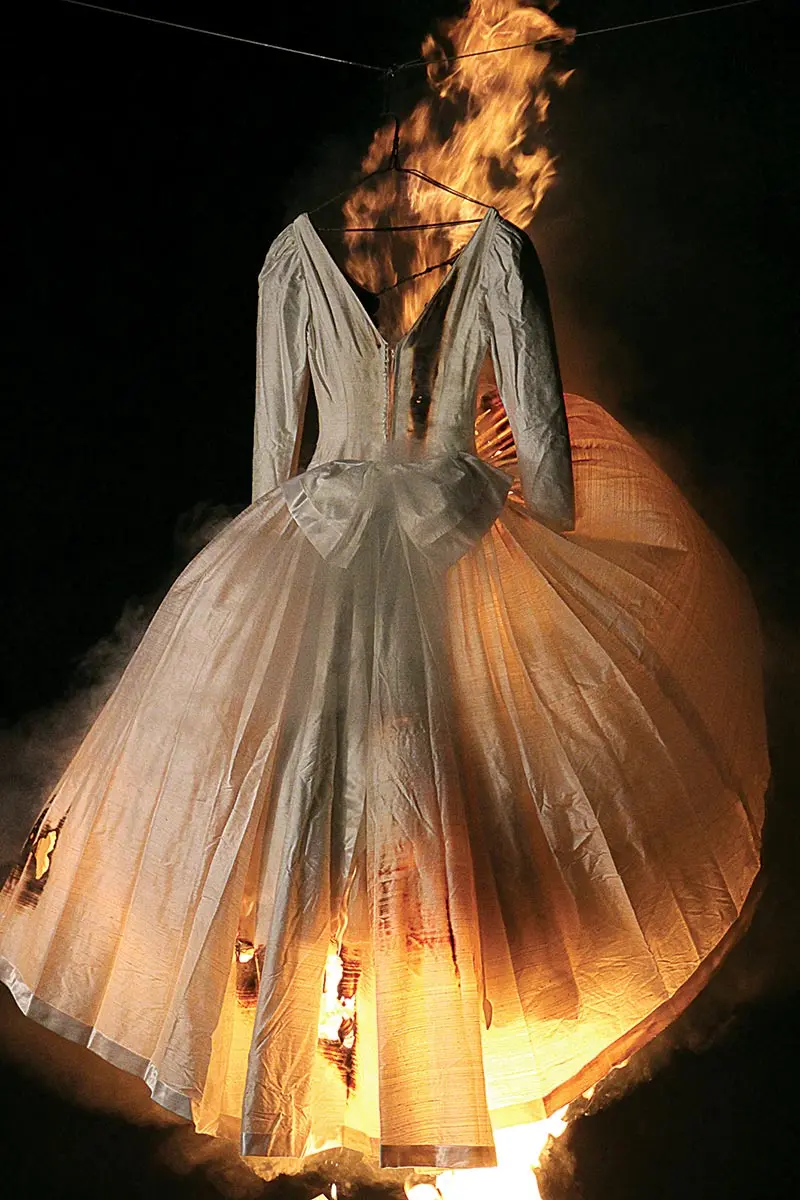
Marmorek began to collect such private objects, which she photographed and presented first in an exhibition titled Anima, at La Galería. A second exhibition, Reliquia (Relic, 2015), featured 51 of these objects in display cases, transformed into valuable treasures. At the close of that exhibition, Marmorek proposed to burn some of the objects in a ceremony in order to somehow free their owners from what ties them to those broken relationships. According to the artist, the action and its documentation prompted interesting questions: on the one hand, burning the relics makes them ephemeral; on the other hand, their documentation rematerializes and transforms them into testimonies of stories that the artist threads together with great sensibility in this exhibition.
Curated in collaboration with the gallery’s Director, Nohra Haime, Reliquias de Amor documents the burning of several objects in six videos and twelve photographs. Two standouts among them are Reliquia #16: Vestido de novia (Relic #16: Wedding Dress, 2016) and Reliquia #17: Vestido de novia (Relic #16: Wedding Dress, 2016), which are videos projected at human scale onto screens facing each other at two ends of the room, and nine photographic prints of different moments in the burning of the dresses, also at human scale, located along the main wall. The choosing of the white gown used by brides in their marriage ceremonies is not random; of all the objects, the wedding dress is perhaps the one freighted with the heaviest symbolic load. The white dress is a symbol of purity and innocence. It represents not only the couple’s union but also the passage from singlehood into married life. In this case, we do not know the reasons why the two women decided to get rid of their dresses. Perhaps the wedding never took place. Perhaps the marriage failed and ended in divorce. The story is known only to Marmorek and to the owner of the relic. All the viewer can do is speculate and write his or her own story around the image of the dress that hangs from a metal hook, twisting and turning as the flames engulf it.
Painted in black, the exhibition space emphasizes the dramatic aspect of the burning, and allows viewers to experience, in a way, the moment when it took place. The show also includes four videos of the burning of different objects presented in a more intimate way on iPad-size screens, and large-format photographs of a selection of burned relics, including a box of condoms, an appointment book, and a bouquet of dry flowers. Unlike the videos, the photographs depict the precise instants in which the different objects are consumed by flames. In each of the images, Marmorek documents a specific moment in which an object that can still be identified is finally obliterated by fire and reduced to ashes.
In burning the relics, Marmorek questions the ephemeral character of the relics and their meaning. Each one of them is accompanied by a story that in principle should end when it is burned. However, once they are recorded and photographed, they are documented and become a permanent testimonial of the relationship. At the same time, presented in this show without context or explanatory texts, the relics acquire a new meaning, to the degree that whoever sees the videos or photographs provides a story for them.
An illustrated catalog and a new monographic publication with an essay by Paula Silva, Desire: Poetics and Seduction (New York: Nohra Haime Gallery Editions, 2016), accompany the exhibition.
FRANCINE BIRBRAGHER-ROZENCWAIG