
In a literal way, Carla Rippey’s recent works sew together (using a machine, I’d like to think) the images that have defined both her sentimental education and her personal history. This sewing of the images, which stands out as a large work in progress, Cuando mi sangre aún no era mi sangre, 1890-1910 I. Pradera, frontera y campo, 1890-1910 II. Ciudad de México y Revolución Mexicana (When My Blood Was Not Yet My Blood, 1890-1910 I. Prairie, Frontier, and Field, 1890-1910 II. Mexico City and Mexican Revolution,) reflects the ars poetica, as obstinate as it is filled with lyricism, that has characterized her production: the appropriation by a variety of means (but especially charcoal drawing) of the images that have defined the modern world over more than one hundred and fifty years. The result is the immense tableau that presides over her first retrospective, which features more than ninety artworks displaying the variety of resources and techniques she has used for that appropriation of the world (understood as a representation based on images that function as its key and its referent in a multi-referential discourse tending to simultaneity.) Although seemingly personal—like a diary—the visual catalog Carla Rippey has appropriated in the course of her career has sought to materialize those images, to give them weight, to take away their characteristic volatility (which has become ever more evident through digital media).
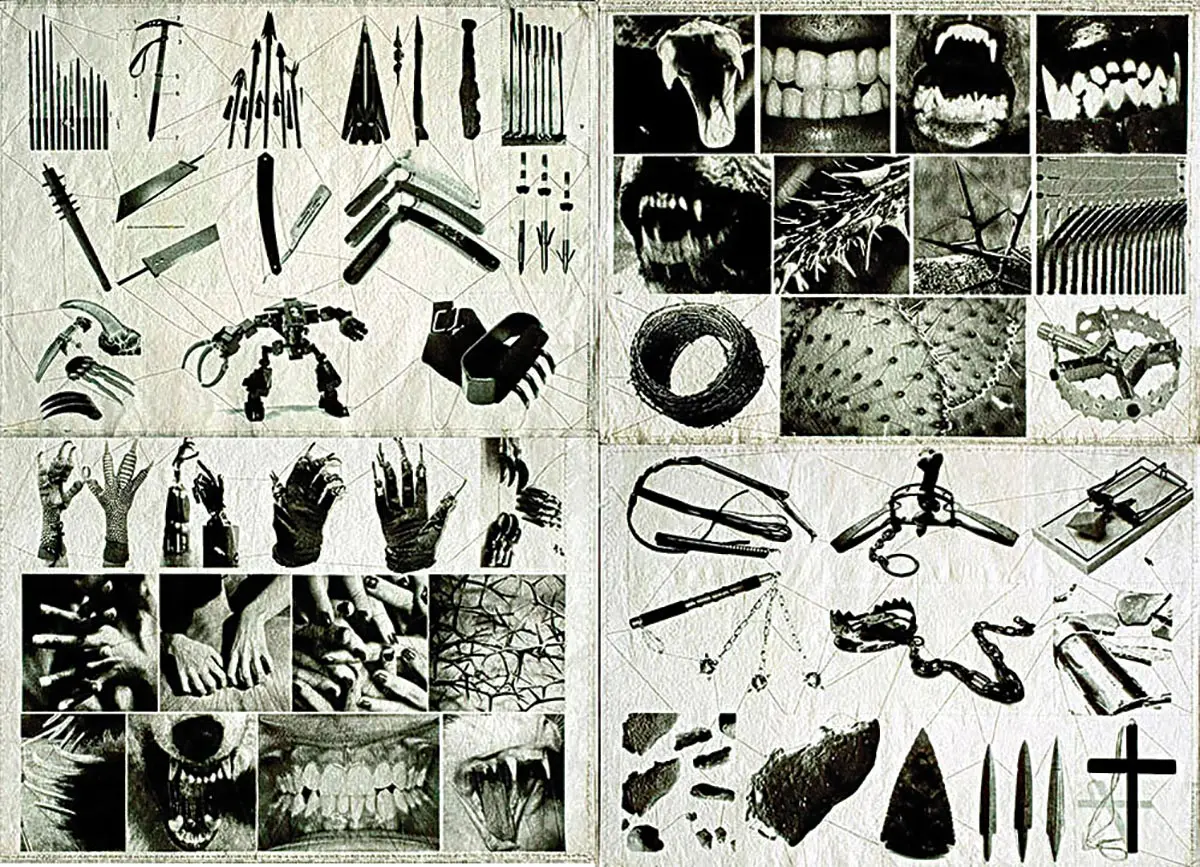
On the basis of the drawing, collage, and the graphic arts, and working with a variety of materials, Rippey has wanted to conjure the levity of the image, the character of a contemporary world that is as immediate as it is evanescent, beyond her supports, in order to fix them in a body of work that insists on raising questions about the immanent territory (the explicit narrative) that lies between representation and the process of representation. The process, which involves a detachment—or disembowelment, depending on your point of view—is not as evident in Rippey’s charcoal drawings (the copy becomes the original of a copy) as it is in her artist’s books, which are, as objects, copies of an original lost in repetition. Carla Rippey opens up the images like one opens up an apple, to show—in a manner that is as candid as it is perverse—what is inside. The text in the book, or better yet, the lines that the book comprises, are cut out and arranged in a thorough labyrinth around the covers, which in turn serve as the anchoring niche for a lamp. Arranged on the walls, the old papers, tapestries, and frames tell the story of their travels through flea markets and shape a multiplicity of narratives and compositions.
The different pieces of cardboard and paper that Rippey use as supports are portable museums that open up and unfold like an accordion to display their contents. Rippey draws in order to make the images that have caused an impression throughout her life her own (on the display cases, along with the period publications and the catalogs, the original sources of the images she has repeated and transformed clearly stand out). She copies and photocopies in equal measure, in an imaginary that ranges from the history of Mexico (represented in the work mentioned above) through the exotic imagination of the world cultures captured and put on display (literally) by publications like LIFE and National Geographic (liberated—if one is allowed to take the poetic license that speaks of work as a liberation—by Rippey’s transcription or repetition) or stills from terror films of the 1950s and 1960s, which are similar (and even have secret connections) to such images of remote peoples, as a visit to this exhibition allows us to infer (or discover). That visit is underpinned (or counterpointed, if you will) by a timeline that reviews private and public events in the artist’s life, peppered with the exhibition of the variegated memorabilia that has gained a degree of media relevance (such as her connection with the Infrarrealist group, as attested by different publications and a letter that Roberto Bolaño wrote her from Barcelona before he became Latin America’s greatest literary star). There is also her relationship with Ricardo Pascoe and Taller Martín Pescador (which speak of the—still pertinent—relevance of the artist’s book in Mexican culture). Left in evidence are, of course, the connections and affinities between Rippey’s work and the formats of the Avant-Garde, but that evidence (which can be described as a painstaking raid into the keys that have defined the Twentieth Century imagination) allows us to glimpse in her oeuvre a process that remains fresh and current, navigating with good winds through a contemporary world that has not overwhelmed her. The originality (if it can be called that) of Rippey’s work resides in the way she has learned to be a copy. The exhibition was created by Carlos Palacios.
RICARDO POHLENZ