
Coco Valencia, a Puerto Rican artist born in Valencia (Spain), was walking one day along the rocky coastline of Playa de Jobos beach, near the small village of Isabela, in Puerto Rico, when he found a large one-story barn slated for demolition. He immediately grasped that the structure’s materials could become a work of art and visualized what would later be his exhibition titled Evidence Room.
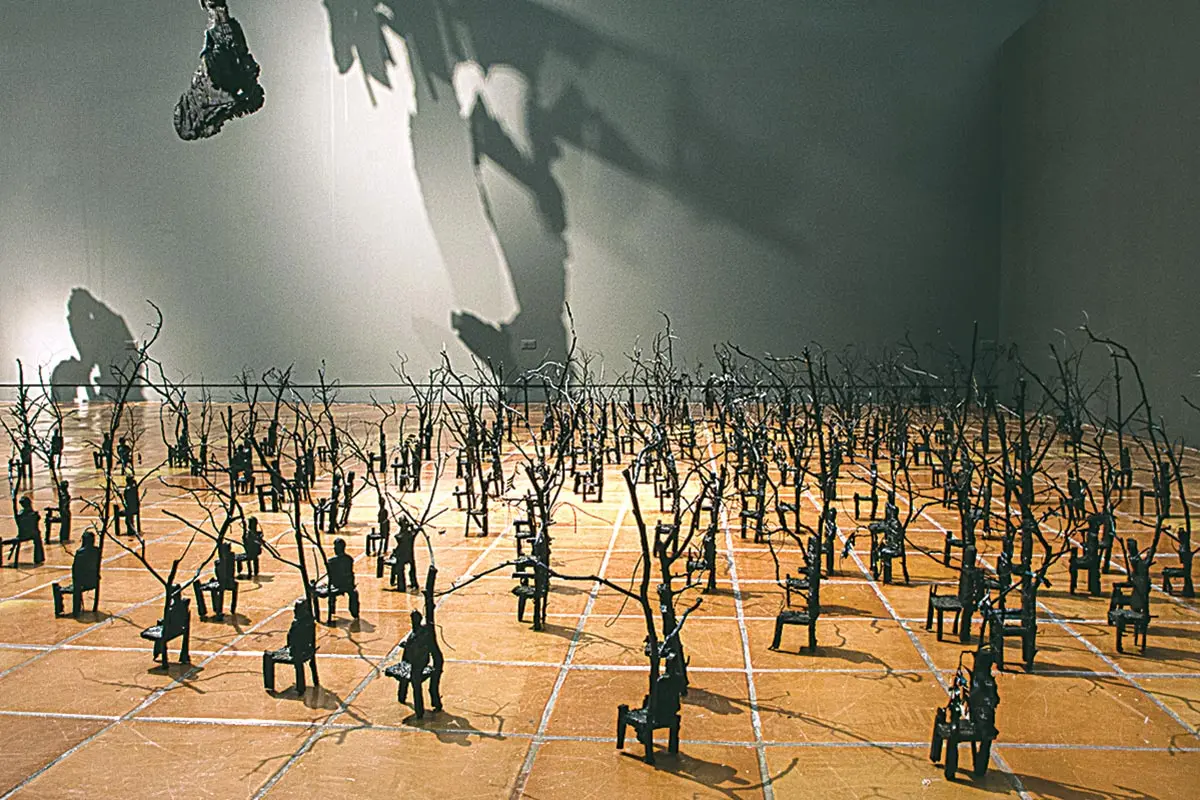
Valencia recycled the wood and the iron from the Playa de Jobos barn into a series of reliefs and bulk sculptures that express a poetic and terrible vision of what remains after a conflagration: a world scorched, ruined, darkened. These are the keys on which the protagonists of the saga that connects the past, the present, and the future in Valencia's work. Among the characters in Evidence Room we find dictators, presidents, and other politicians; they are all embodiments of barbarity, unchecked power, and undue political authority. Valencia represents them with great expressive force and a masterful command of his technique, using the color black to suggest death and manipulating the figures’ scales. The sky, the sea, and the earth are part of the scenario suggested by Evidence Room. The large sculptures hanging from the gallery ceiling are men-machines, in some cases resembling dragonflies, drones, or airplanes. Two hundred sitting politicians form a forest of men-chairs-trees. Yet, the forest of trees has no flowers or branches. It is a barren forest built at a small scale, like the politician’s actions and ideas. The small scale of the politicians contrasts with that of the President atop amount that seems more Sancho’s than Don Quixote’s. Large ships join the scene, presided over by figures resembling nikes and evoking an ancient Greek tirreme vessel, or perhaps the boats used by ancient Egyptians.
Valencia alludes to human cruelty and ignominy in the experience of war. This is the dark side of human nature that Sigmund Freud saw manifesting itself in Europe devastated by WWI. Freud wrote: “When the community no longer raises objections, there is an end, too, to the suppression of evil passions, and people perpetrate deeds of cruelty, fraud, treachery, and barbarity so incompatible with their level of civilization that one would have thought them impossible. Well, may the citizen of the civilized world of whom I have spoken stand helpless in a world that has grown strange to him - his great fatherland disintegrated, its common estates laid waste, his fellow-citizens divided and debased!”1
Evidence Room suggests the destruction left by the war in its wake in paradoxical ways. The recycling of old, well-worn materials results in a new work that nevertheless suggests that which was burned and destroyed. The poetic power of Valencia’s work awes and moves us. Several works titled Swifter refer to the Jews that were tortured and murdered in Nazi concentration camps. The bodies of the Holocaust victims were placed on large “trays”, or swifters, and sifted out by their murderers. Valencia’s sculpture technique suggests the violent process of death, as he uses a saw and a chisel to repetitively mark, cut, and wound the surface of the wood. The traces of the process, like the traces of a crime, have a profound effect.
The bas-reliefs set on the gallery walls resemble large canvases on which figures appear in front of ominous and sublime landscapes. The beauty of the shapes and the terror of what is coming or has just occurred in those landscapes are joined to create a delirious and staggering sensation. Valencia’s sculptures of men-cannons, lethal machines set adjacent to the bass-reliefs, leave no doubt as to the plot that is to be inferred from this selection of works. The room with the evidence is conclusive because the proofs are self-evident: they are the heralds of a desolate future for humanity—if we refuse to reflect on the past, we are doomed to relive it. The story Valencia tells is not one of heroes and dignitaries, but one of the individuals so consumed by their will to power and their greed that they chose destruction over life, Thanatos over Eros, and barbarism over civilization. The only being capable of creating culture is also the only one capable of destroying its environment. Such is the paradox presented by this poignant exhibition as it explores a universal subject.
NOTE
1. Sigmund Freud, “Thoughts for the Times on War and Death.” 1915. https://www.sas.upenn.edu/~cavitch/pdf-library/Freud_War_and_Death.pdf
INGRID MARÍA JIMÉNEZ MARTÍNEZ