
Art is a body that emerges from language, time, and space. David Lamelas proposes with his recent exhibition at the Galería Parra & Romero, in Madrid, meticulous observation of the temporal experience, words, and narrative. Titled Territorial Intimacy, the show alludes to the limits of subjectivity and expanded knowledge; to the manner in which the borders that separate the body from the structure of the real dissolve.
The striking piece titled Piel Rosa (Pink Skin) works precisely with those ideas. The very display of the piece takes us to the beginnings of David Lamelas as one of the leading figures of Latin American conceptual art. In fact, the piece was created for the 1965 Braque Award in Buenos Aires.
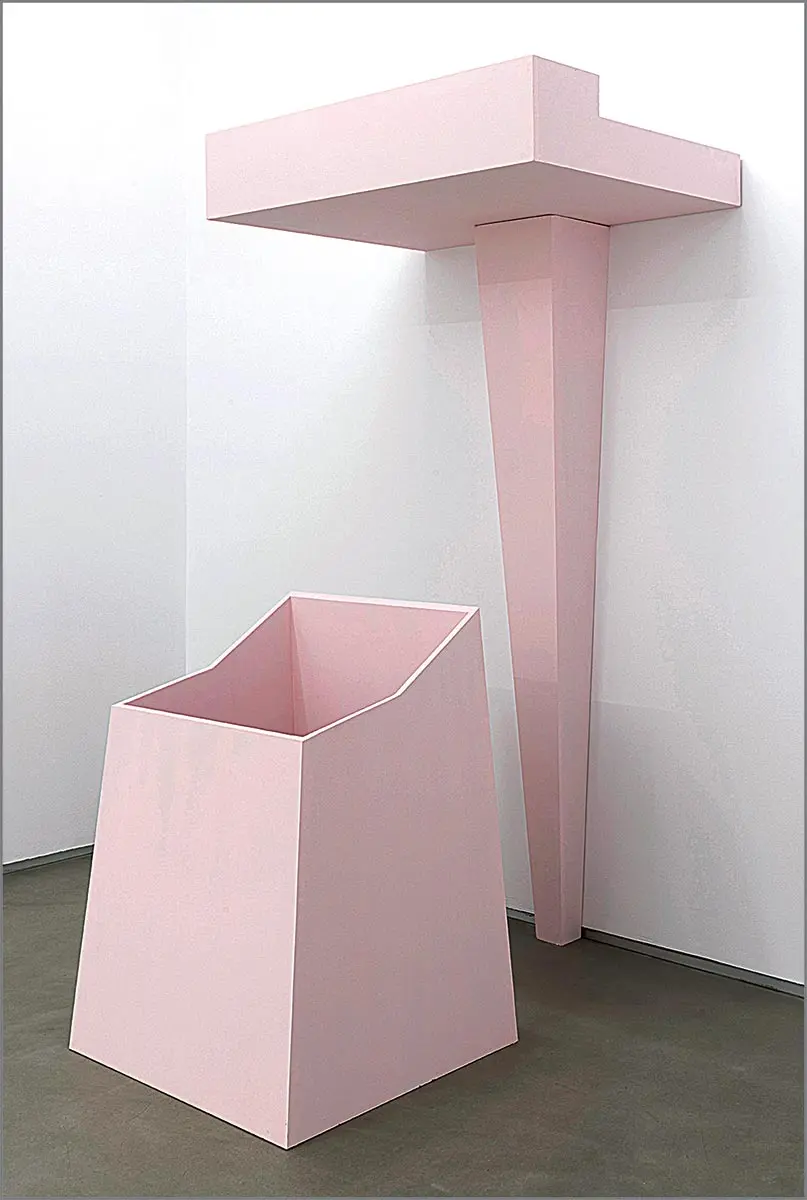
On the one hand, we observe the illusionist perspective of a column, a ceiling, and a prism in front of it as a sort of cavity. With a highly abstract language (architectural-like shapes that are pure geometry), the artist develops a connection to more intimate and recognizable notions: every day and the body. The ceiling, column, and “container” allude to the space of a house, to a habitat in which life unfolds. In this manner the sacredness of the “white cube” is fractured: that which apparently refers to a museum discourse is actually a recreation of daily practices. On the other hand, the chromatism of the piece favors the color of the skin (Lamelas has drawn inspiration from his own hands). In this manner, the pink skin offers a connection between objects and the artist’s own identity. This is one of the central contributions from the art produced in Latin America to a certain abstract current: impregnating the concept with the body itself.
The piece is accompanied by two black and white photographs that document its past and also act as a tautology. It is a resource often used in conceptual proposals to confirm the same idea through different elements. And the same mechanism is used in the mythical work titled One and Three Chairs by Kosuth, in which a chair was accompanied by a definition from the dictionary and a photograph of the chair. Establishing this analogy, we must point that in Piel Rosa we encounter the same metalanguage, but this time through the body and not only through intellectual means.
Following this same display approach, the work Vortex operates in an identical manner, but it searches for something more emotional. We observe an aluminum conic sculpture and its corresponding drawing on the wall (in that typical display by the conceptual gaze that we have already seen before). The drawing shows a vortex drawn with ink—as if it were a sea storm, a concentric point of energy—that dialogs with the sculpture of the cone because of their complementary natures. The two-dimensional space created by the drawing is unified with the volume of the cone. On the one hand, the coldness of the sculpture acquires greater emotional intensity through the pencil drawing, which is more closely connected with the intimate, familiar and smaller scales.
The third work on display, Lectura (Laberintos de J.L. Borges) [(Reading (Labyrinths by J.L. Borges)], is based on another historic work by David Lamelas titled Reading (1970). While a movie is projected—without audio—showing a woman reading fragments from a collection of Borges’s short stories, several frames or still photos of that same recording are exhibited on the wall where it is possible to read the fragmented text. Our voice as readers consists of the narrative process and the time needed for the narrative to unfold. We walk through the gallery reading the subtitles (which, for instance, include statements like “the idealist argument is admitted,” “form and color are the line,” etc.). Three levels are structured in this manner: the visual, the narrative, and the experiential. The piece explores the components of a commutative structure in order to reflect on the body of the text and on the manner in which subjectivity builds the experience. Perhaps, art functions and operates in contexts where bodies are produced: bodies that read, listen, touch, wander and write while everything else is happening. It is no accident that Lamelas chose a work by Borges since it references postmodernity and certain characteristics found in his production (metalanguage, deconstruction, reality/fiction, and a vision of literature as infinite text). Borges’ legacy expands from the fragment to the notion of art and words in spatial and visual terms. In the words of Roland Barthes: “I have a disease: I see language […] hearing deviates to scopia: I feel myself to be the visionary and voyeur of language.”1
NOTE
1. R. Barthes, Roland Barthes por Roland Barthes (Roland Barthes by Roland Barthes), Paidós, 2004, p. 214.
ANA FOLGUERA