
Both edgy and solid in her production, Mexican sculptor Edna Pallares has developed a presence in stone, marble, and, more recently, wood; now paper, concrete, ceramic clay, silicon, and epoxy modeling clay have come to converge in her hands. The different periods in the evolution of Pallares’ career can be described as figurative and minimalist, opposed as to those approaches may be; she has also developed baroque variations. The recent exhibition to which the artist devoted several versions of El viaje (The Journey) responds to a text Pallares wrote that navigates as well as her ships do. The text is written in the first person and it is meant to be understood as autobiographical, although it does lend itself to several symbolic interpretations. The gallery felt inhabited by the exhibition featuring the materials mentioned above, which have not been dominant in Pallares’ previous work (stone and marble.) A few years ago, the artist presented a solo exhibition, all in wood and at a miniature scale, in a Mexico City institutional space. If today, in our digital era, critical thinking is to become letters, here it would seem that that exhibition proposed something that was subtle yet lacked the black, structured density that is usual in Pallares’ work. At the G.A.M., in turn, that structure is ever-present.
The new exhibition is titled El viaje (The Journey). We don’t know whether Pallares traced her route beforehand or it came impromptu, but we do know that it is a journey towards flexibility: from the hardest materials to others with varying degrees of rigor and resistance, and to different processes. Natural materials hardened under deep layers and over very long times—such as marble—met inside these galleries with others equally natural yet soft, flexible, dry, and muddy. And with others, also natural, derived from trees, industrialized, and fragile, such as paper.
Edna Pallares starts with everyday objects, which she interrupts, analyzes, and presents beyond their functionality, as in Media olla (Half a Pot), a work in marble from 2014, or Marquesita (Little Marchioness), in marble and wood. The works in concrete exhibited by Pallares here are like a pre-molded block of the kind used in wall construction, with a hammer embedded in the upper section and surrounded by irregular zones where the material was still soft when the hammer fell and hit it. These “burials” have a powerful and very current voice that is able to refer to today’s buildings as well as to archaeological testimonies for the future biography of Pallares and of humanity as a whole.
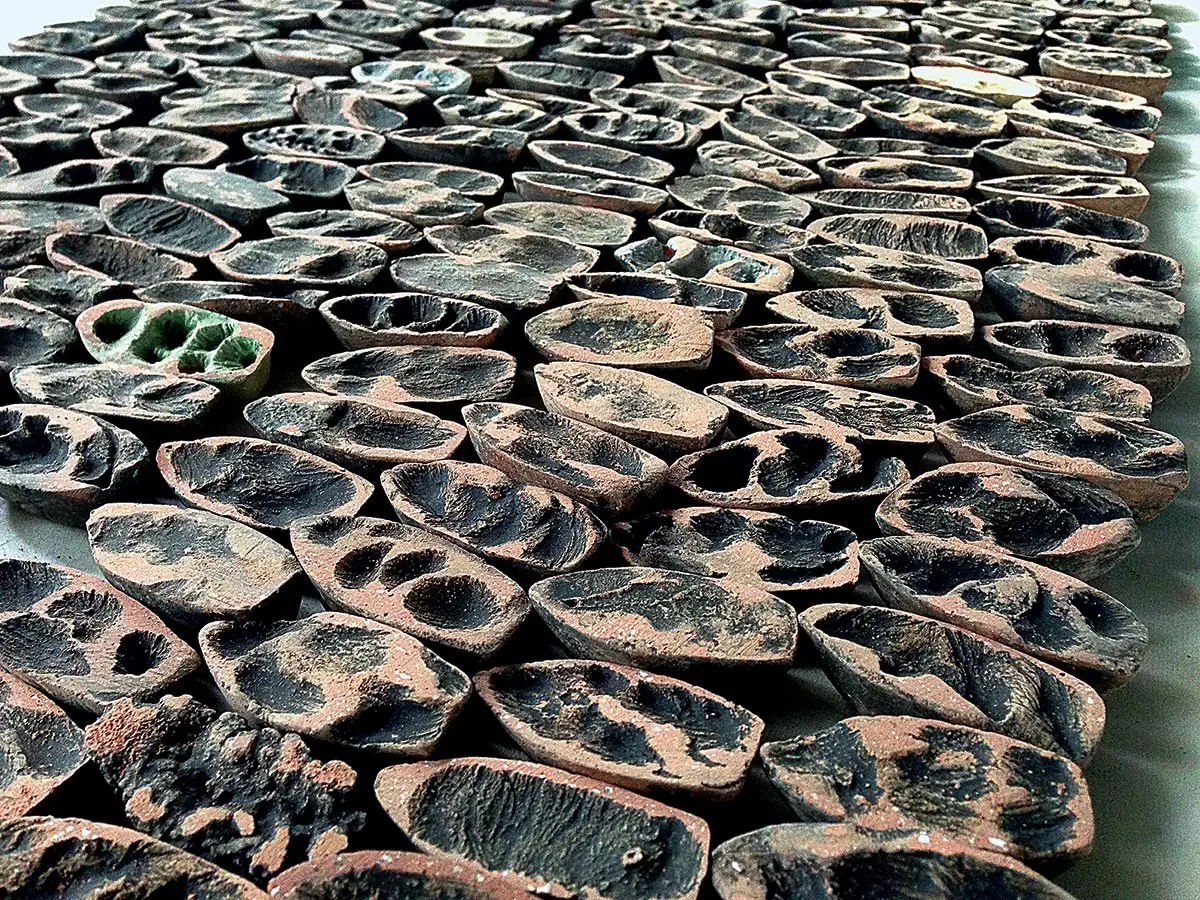
In the chapter on watercraft, the presence of ships is concentrated in the installations that Pallares conceived for this exhibition. Our “journey” begins with a thirty-boat installation. Let’s begin by picking apart the presence of the thirty sundry small ceramic boats that allude both to the ship shape and to diverse expressions and vestiges of life. Each has been work produced individually, and the finishes vary. There will for sure be those who say they have different decorations. But what each boat has are treatments alluding to diverse cultures and shipwrecks of today’s society. Besides this installation, Pallares’ installation of 250 ceramic clay and slipware mini-boats deserves special note.
In a different section of the show, let’s analyze Plato grande con círculos (Large Plate with Circles), in paper, ink, pencil, and watercolor. The paper circles in varied sizes preserve the caliper markings made as their diameter was traced. They are irregularly arranged on a base, partially or fully painted in watercolors; some are not painted but display markings in various types of pencil, scribbles, and drawings. Sgraffito and painting manifest themselves in a wide range of colors. The pigments are on the grayscale, pastel-like, never wholly saturated. The delicateness of the sculptures on paper is particularly remarkable in contrast with the dense, tough sculptures on concrete and marble.
This section of the exhibition includes Pallares’ circles, cakes, and fruit bowls, proposals that continue to be based on the everyday. Her fruit bowls can be understood in connection to the Day of the Dead. The language of this selection is particularly rich, and the addition of Pallares’ plates and mounds substantially modifies the vision that the artist has been unfolding for us. These variations are part of what is happening globally in the arts of the last two decades. Artists are blazing simultaneous trails for different expressions. Impermanence is the style of the present, and mutation is its system.
GRACIELA KARTOFEL