
Traveling. Sightseeing. Thinking. Uploading a picture to social media. Getting paid. Paying. These could be some of the “transitive states” that give Glenda León’s exhibition at Juana de Aizpuru Gallery its title. Like a kind of futuristic archaeology, the exhibition shines its spotlight on some moments or features of contemporary life, from money, politics, personal relationships, through travel and religion.
The exhibition begins with the video Inversión III (Inversion III; note that the Spanish word inversión also means investment), where a locked-down high-angle camera shot shows a pair of hands scratching a one-dollar bill with a knife. The resulting dust is rolled into a cigarette, which is then lit. The metaphor leaves no room for doubt: the subject is capital, investments, and financial movements in their most bald-facedly consumerist aspect, connected to the culture of leisure and the destruction of the body. The hands in the shot carry out a ritual, with the patience and attention required for such processes. The paradox is that they do this with something as noteworthy as a dollar bill.
Along similar lines, the collage La Internacional III (The International III) mixes cotton paper with fragments of different banknotes from around the world, to trace the musical notes of The Internationale. This visual synesthesia makes the message perfectly clear: internationalism, seen in its day as a unifying movement able to articulate the entirety of the working-class around the world, has now been reduced to a single melody, comprised by different currency signs. Right across from it is La Santa Biblia (The Holy Bible), a small volume formed by one-dollar bills. Once again we see an unambiguous connection between faith and economic philistinism, between the “spirit of capitalism” mentioned by Weber and religious practices. Thus a line is traced between morality, success, and financial comfort.
One of the exhibition’s subtlest works is El mundo (The World), featuring a world map made using ink and hair. The figure is flat, devoid of color, shadows, or volume, and it rests quietly among other, much “louder” works. The hair alludes to the fragility of a world that contemplates, in silence, the events of the era. Next to it, in strong contrast, is Juegos carnales (Carnal Games), composed of two silicon dice set on what appears to be a casino table cover. This presented sexual relations as a game of chance; the casino may be a symbolic allusion to a space that is the radical opposite of intimacy. The silicon of the dice is striking, as it emulates human skin in an artificial, industrial way. Across the gallery, on the opposite wall, rests Campo de juego (Playfield), a mattress in the shape of a soccer field, where the relationship between bodies is to be negotiated as combat, a struggle, a competition.
In Estados transitivos. Mundo religioso (Transitive States. Religious World) we are presented with five pendants representing five different religions and the way they fuse to produce a single piece. The exhibition includes, along with the video about the foundry process, the new item produced, displayed with a documentary intention. Immediately next comes Estados transitivos. Mundo político (Transitive States. Religious World), following the same logic, this time with the flags of different countries. Here the video depicts the process of recycling these flags in order to shape a new one, combining politics, abstract terms like nation and identity, and serial production.
The journey—that which is transitory, the continuous displacement of bodies and meanings—is a central idea in Glenda León’s exhibition. Her triptych Viajar viviendo develops the concept on the basis of an iconographic motif that multiplies—an airplane—on the outline of something that resembles an airport. The sensation of length, repetition, and even a certain degree of weariness fills one of the gallery’s walls.
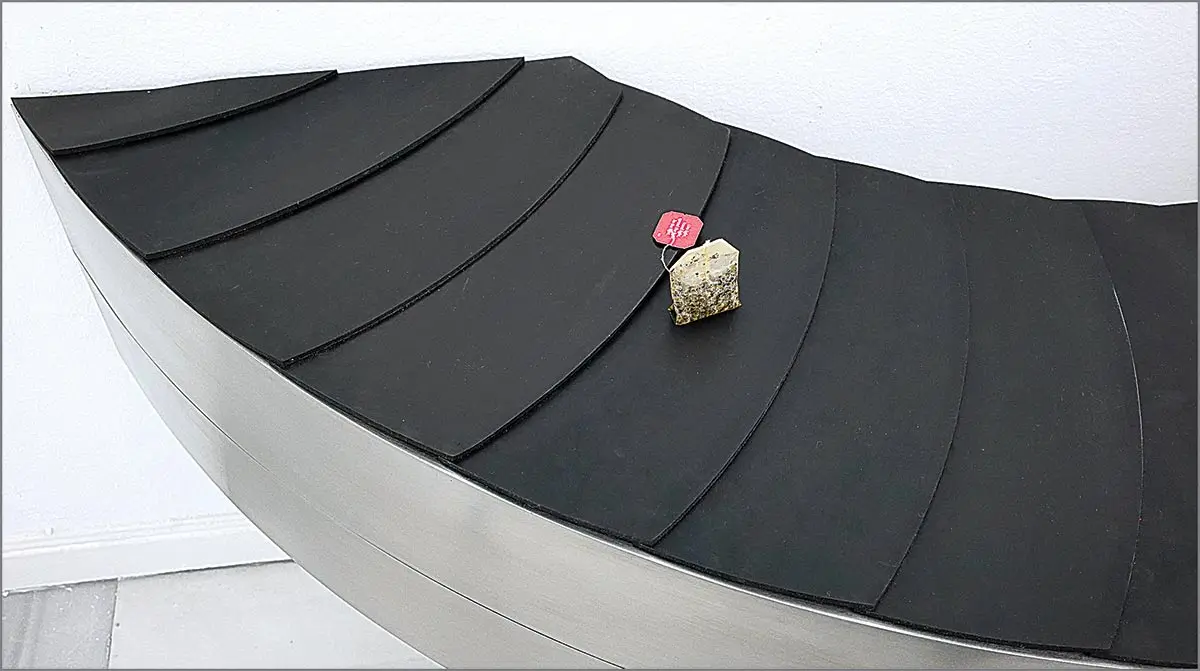
But perhaps it is Viajar ligero (Traveling Light) that best summarizes the exhibition’s proposal. This installation features a conveyor belt carrying a tea bag that appears already weathered by time and use. On the tea bag is the following message (in English): “Live light. Travel light. Spread the light. Be the light”. A forceful observation about the ephemeral character of philosophy—where has philosophical reflection ended up, if not in marketing and merchandising messages?—knowledge as consumption, the politics of the body and of health, as well as about our nomadic, constant-motion lives represented by the conveyor belt (of the kind used in luggage carousels.) In sum, an exhibition about the different moments that comprise the (bewildering) landscape of the contemporary world.
ANA FOLGUERA