
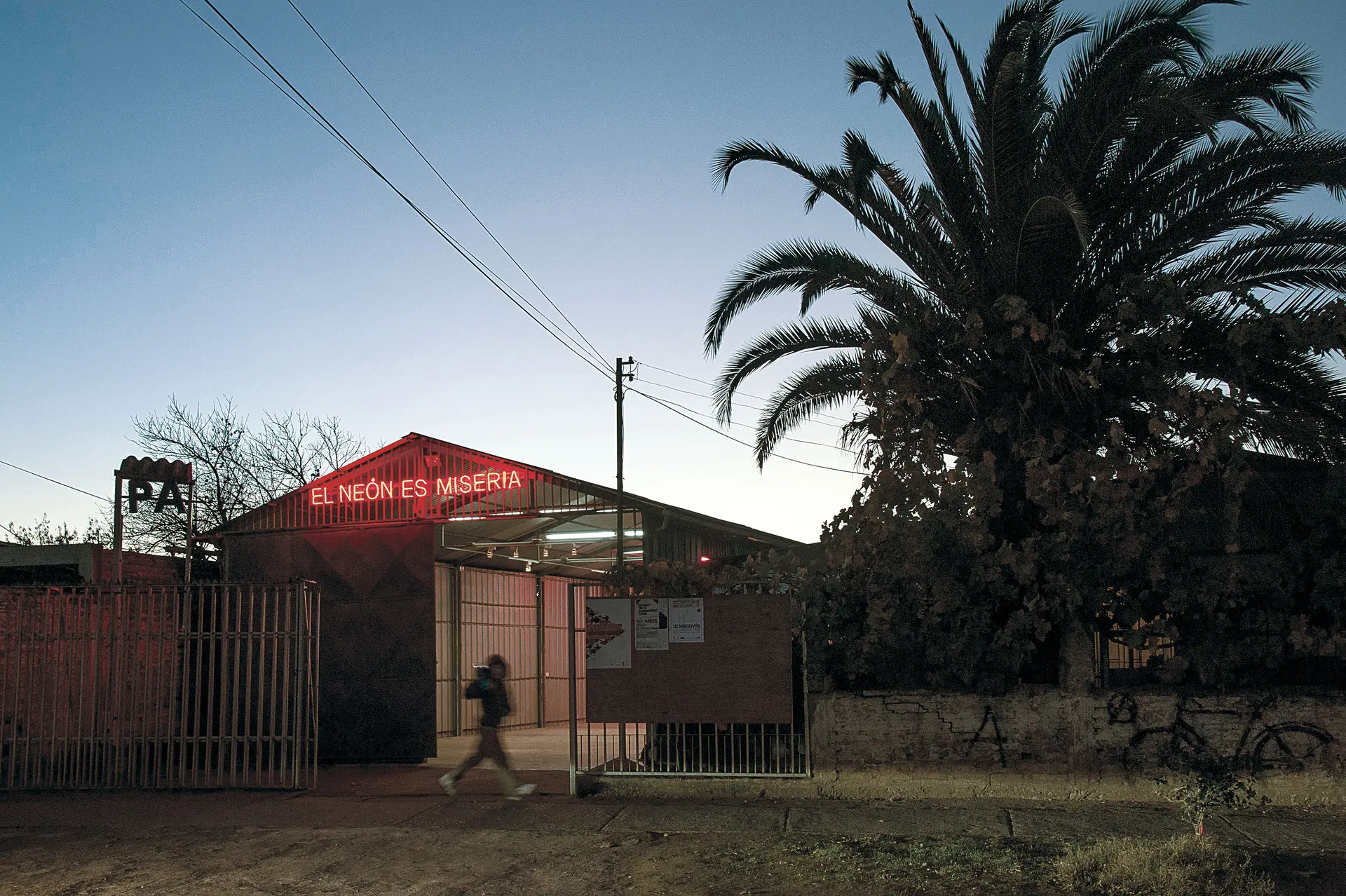
A young fine arts student confronts the awesome Apollo, the god of beauty, harmony, and perfection. He could be said to be the god of “grace”. Nobody truly knows how a plaster copy of that Roman copy of a Greek statue—or, for that matter, any of the other plaster versions of Roman marble figures the students use to learn how to draw volume—found its way to the School of Fine Arts in Santiago de Chile. Of them, the Kassel Apollo (there were many Apollos) fascinates this absent-minded student the most, by far. Asked why he would be at a loss for an answer. And he doesn’t understand the name of the sculpture. Kassel?
At his disposal at home was a large library with several books on classic art. Young Gonzalo would leaf through the images and be mesmerized by the reproductions of medieval paintings. Yes, this is one of those insubstantial anecdotes we often find in biographies of artists. But the fact is that, to a large extent, an artist’s career is punctuated by happenstance and accidents that at first seem minor but prove, in the end, to have been watersheds. For example: walking around the streets of Santiago, a teenaged Gonzalo Díaz finds a catalog of Lily Garafulic’s works laying on the ground, featuring her forceful, Modernist-inspired sculptures. Catalog in hand, Díaz watches pretty female art students walk by. Between one thing and the other, he had an epiphany: he’d study art.
Admitted to the school, Díaz worked with Matilde Pérez and José Balmes, among others. But he was an absent-minded student, as we said before. There were detours, some forced and some voluntary. Díaz left art school and decided to study philosophy. After standing in the wrong registrar’s queue, he ended up enrolled in the Spanish department; rebelliously, he attended classes in Philosophy anyway. Perhaps to remedy such a monumental tangle, or perhaps tired of his low grades, Díaz returned to the University of Chile’s Art School. After a while, his professor, the artist Adolfo Couve, took him on as an assistant. It was 1969. Around that time Díaz also joined “the Party”—the Communist Party, that is. And as you may imagine, the early 1970s were not the best years for a left-wing artist in Chile. After Pinochet’s 1973 coup, there was a purge at the School (led by Matías Vial, also a professor and artist). Díaz, however, remained under Couve’s wing as his assistant until 1975, when, right after being promoted to a professorship of his own, he was kicked out. And here is another one of those anecdotes that reveal more than they seem to at first glance. There was at the time an overt tension between students interested in exploring new ways of expressing their creativity, and those more attached to the traditional ways. In the former group was Juan Downey. He did something at the school that we would today call an installation, inserting calligraphy on a plant’s leaves. Professor José Balmes (a representative of “gestural” painting) rejected Downey’s work and, ultimately, that entire confusing line of artistic expression. Witnessing the skirmish, Díaz empathized not only with Downey’s idea but also with his personality. They became fast friends and remained close all through the 1980s. Another artist Díaz met and frequented in those years was Francisco Smythe.
Newly married, almost out of a job, and unable to sell his art, Díaz taught at a number of bohemian-type studios located near the Art School, while continuing to work there on a part-time basis. It was at those studios that he met Smythe, starting a friendship that included shared artistic discoveries. Díaz’s Paraíso perdido (Paradise Lost) dates from 1978. In it, the artist’s inclination for intellectual and historical quotation (among his readings at the time were Virgil’s Georgics) is already on display. But the work that marks a before-and-after for him is Los hijos de la dicha (Children of Joy). Inspired by Pop Art, classical painting, and Francis Bacon, Díaz conceived a triptych in vivid colors, depicting chaotic scenes and elements—for instance, horses—that would recur often in his later work. Then, his luck turned, and then some. The purchase of one of the triptych’s panels by an American collector was a decisive event. Instead of money, Díaz requested payment in the form of North American art catalogs; in this way, he discovered one of his greatest influences, Jim Dine. The year he painted Los hijos de la dicha was also the year he won an award from the Colocadora Nacional de Valores bank (US$7,000, no less) and a US$2,000 grant for a stay at Florence’s Universitá Internazionale Dell´Arte, given by the Friends of the Arts association. In Florence, he joined Smythe, who had moved there sometime before. Díaz rented a space in his friend’s house. And again, a happy coincidence: a book on Marcel Duchamp authored by Achille Bonito Oliva—who, by the way, coined the term “Italian Transavantgarde” to describe the new painterly aesthetic that, some say, influenced Díaz and Smythe (something that could be contested, since the Italian Transavantagarde was more influential in the US than in Italy)—and an encounter with the work of Mario Schifano, another Pop-inflected influence.
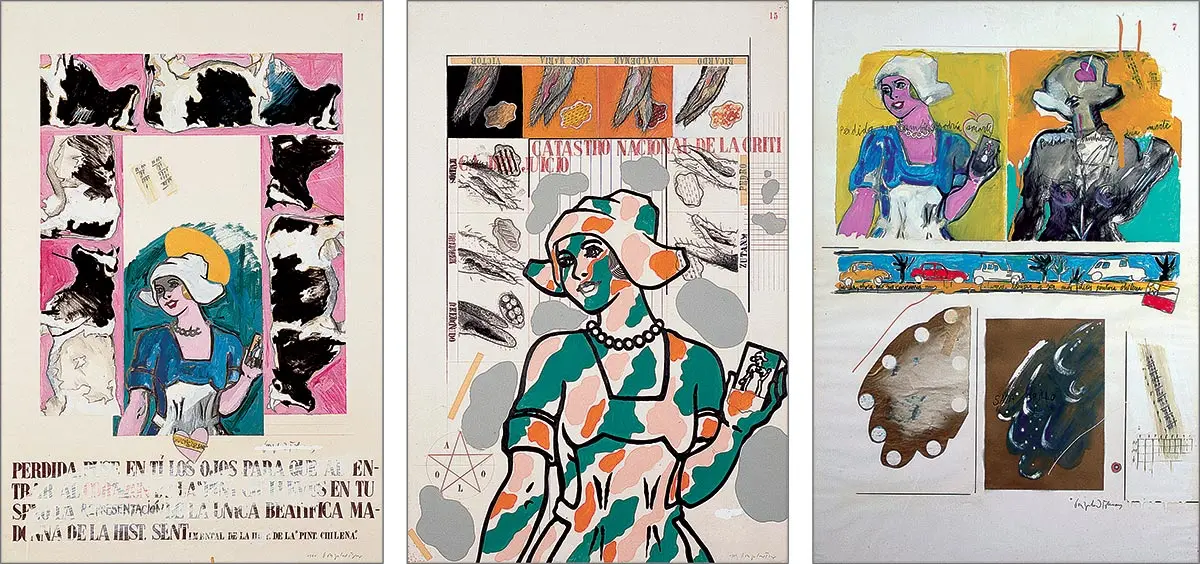
Gonzalo Díaz returned to Chile in 1981 bringing with him new ideas, a new way of understanding art that was not common in the country, and unusual ingredients (such as sprays and industrial smalts) combined with collage and oil painting techniques. One result of all he had learned (and, why not, unlearned) was Historia sentimental de la pintura chilena (A Sentimental History of Chilean Painting, 1982). Politics, conceptualism, and Pop came together in this work conceived in and for Chile, with the image of the Klenzo brand of detergent posited as an icon.
Gonzalo Díaz, man of grace
I interviewed Díaz in his studio and also at the University of Chile’s Las Encinas campus, where he has taught the Painting Workshop for decades. From our conversations, I retain many and various statements, and a general impression that is shared by all who know him: his unique, ironic, direct, occasionally cutting sense of humor. Díaz is funny. He cracks me up with such assertions as “Philip II was a sacoewea” (a saco de huevas, or roe sack, a very Chilean insult); “As a painter, Adolfo Couve was weak and fome" (Chilean slang for dull); or “Justo Pastor Mellado is from the Islamic State.” But the interviews also give me a different kind of knowledge. One of the words Díaz uses most often, deploying it like a conversational wild card, is gracia (grace, but in Spanish also “joke”, or “the quality of being funny”). When I ask which of his own works he finds most satisfying and suggest titles like El jardín del artista (The Artist’s Garden) or El festín de Baltasar (Balthazar’s Feast), he describes them as graciosas—“in the sense of grace,” he emphasizes. This clues in a different perspective from which Díaz’s art can be appreciated: the perspective of balance, harmony, beauty, and perfection.
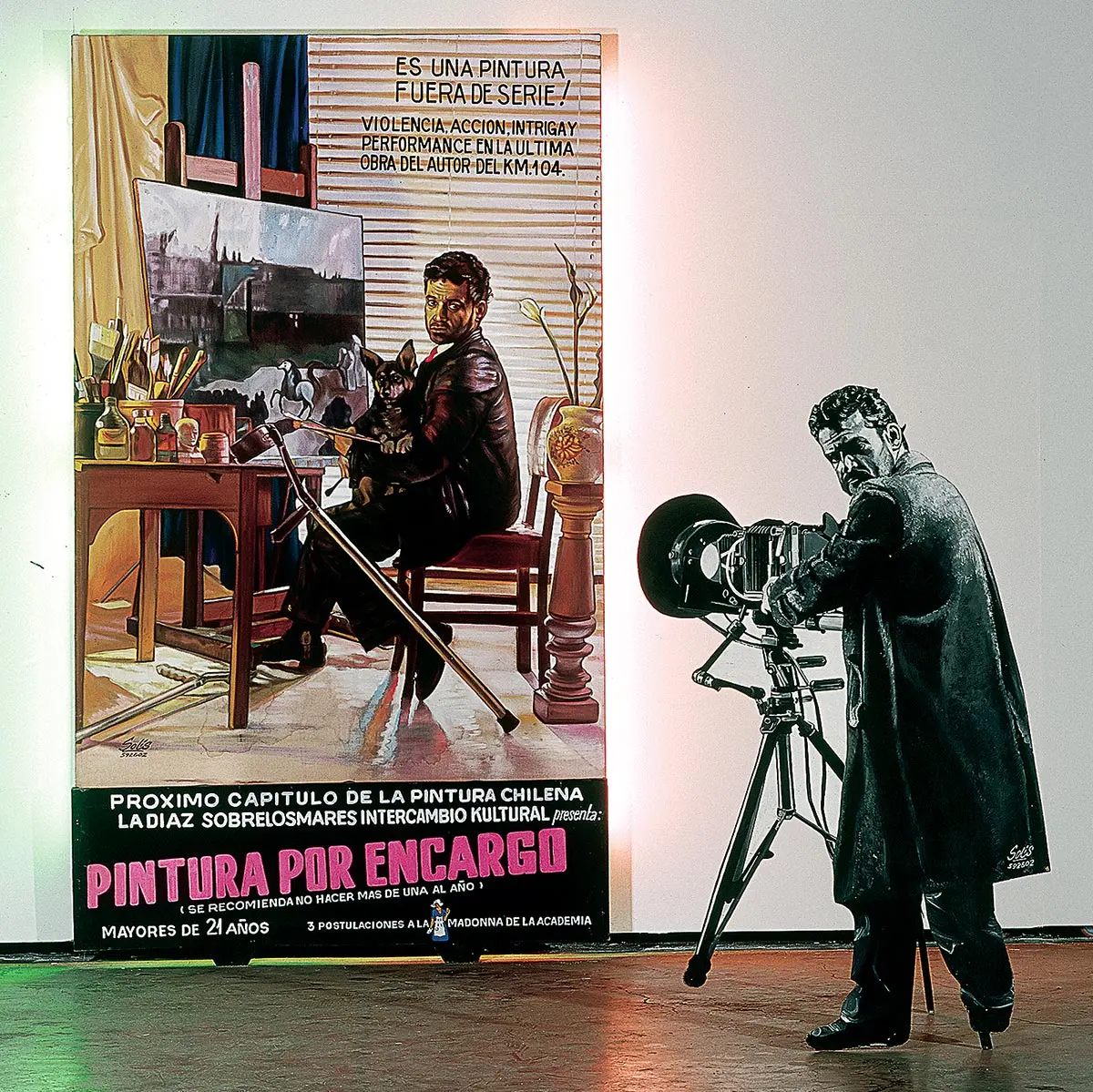
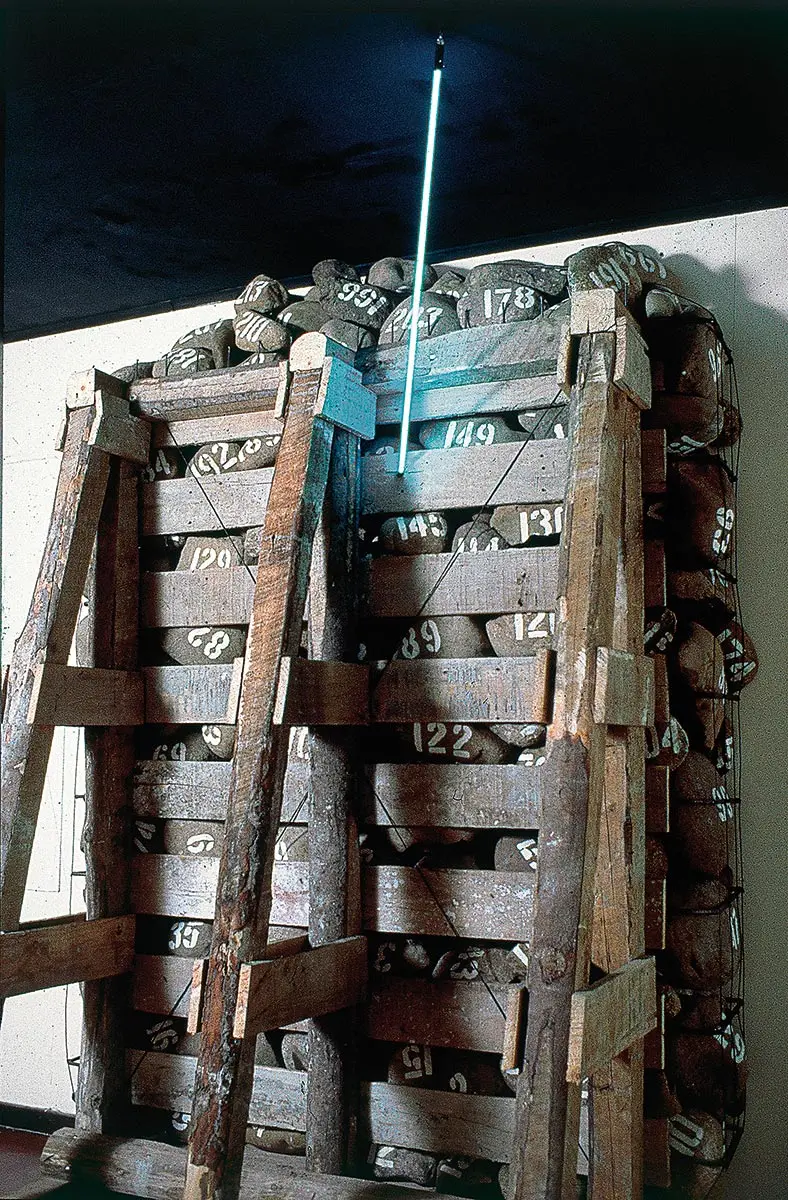
In Díaz’s work, described by many observers as “intellectualized” or “erudite,” we often find the same sense of humor the artist displays in person. Pintura por encargo (Commissioned Painting, 1984), for example, features a satire of the painter’s a trade and position. In the words of Adriana Valdés, “It is the production of a pose, of the artist as poseur. A painting is an object made under commission to validate that pose, to surround those who pose with the instruments of their craft, giving their eyes the appropriate expression; in sum, to install the poseur.” About the local art scene debates, always heated and intense, he offers a different analysis, more subtle this time, in his first installation: ¿Qué hacer? (What Is To Be Done? in collaboration with Pastor Mellado, 1983). Here, Díaz uses scaffolds and neon lights, two references that also recur in his work, as aesthetic sources and signifiers.
Díaz’s use of local references, language, repeating motifs, and a pop aesthetic deepened in his silkscreen’s Let´s see if you can run as fast as me (Chile’s representative at the 5th Sidney Biennial in 1983) and El kilómetro 104 (Kilometer 104, 1985). Two works from the 1980s are particularly complex both in their construction and their analysis: Banco/Marco de pruebas (Proof Bank/Frame, 1987) and Lonquén, 10 años (Lonquén, 10 Years, 1989). In Banco/Marco de pruebas, Díaz reflects, among other things—among them, the relationship with the artist’s craft and that of the artisan—about the copy in Chile: a fragment, a section of a plaster balustrade imitating the stone or granite decorations typical of Western art, but made from more humble materials. And in Lonquén, he attempts to construct memory around people murdered by the dictatorship in a small Chilean locality. Díaz began this work in 1980 when he clipped a report in Hoy magazine about the Lonquén massacre. The images, by Luis Navarro, showed an expectant group of villagers at the entrance to a limestone mine, waiting for the excavation of the victim’s corpses. One architectural detail was surely significant for Díaz: the half-point arches that shaped the mine’s threshold. The photographs “decorated” Díaz’s studio in Florence, along with a container of Klenzo detergent. They were with him in a physical—and mental—way until, a decade later, he figured out how to show his concern with the tragic events. Between the initial encounter with the images and the decision to complete the work, the reading of Freud’s Collected Works was decisive. This literary encounter, along with the real events (the Lonquén victims were located thanks to one of the killers’ confessions to a priest), was determinant for the concept of the installation. Consciousness and subconsciousness float in this allegorical work, whose suggestive power and visual impact prompt an emotional response and create an unsettling atmosphere.
Despite their eminently local subject matter, these works extended Díaz’s reputation beyond Chile. We are talking about an artist who is not market-oriented, while not necessarily opposed to commerce or the market. “It is not that I don’t sell, but that no one buys from me”, he told me in one of our interviews. Díaz has usually received institutional commissions or public financing for his large-format installations, works that stand out for their visual impact and for the way they deploy a variety of mechanisms—such as their inclusion of texts, the conceptual payload in their use of light, their dramatic stagecraft, their use of the spatial context—to provoke in their viewers an interior sensation, a state of unease that is difficult to forget.
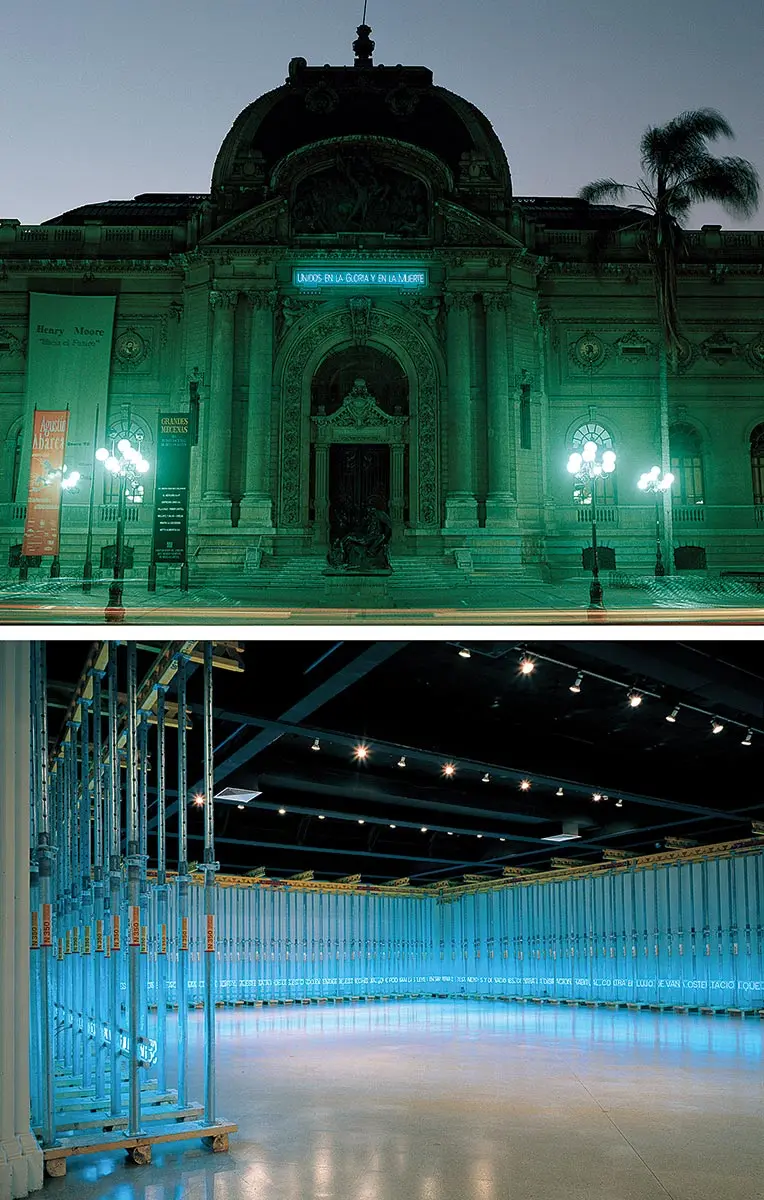
Let’s look at two specific examples: Unidos en la gloria y en la muerte (United in Glory and Death, 1997) and Rúbrica (Signature, 2003). The former, occupying a large gallery and part of the façade of the Museo de Bellas Artes, talks about the relationship between art and power. In the exterior part of the work, Díaz superimposes his titular phrase, written in blue neon, to the building’s name, right across from Unidos en la gloria y en la muerte (Ícaro y Dédalo), a 1922 sculpture by Rebeca Matte Bello (the first female sculptor in Chile, according to Wikipedia, and a professor at the Art Academy in Florence). Díaz also intervenes the space inside the building with fragments of Chile’s civil code written by Andrés Bello (was Rebeca Matte Bello’s great-grandfather), also in blue neon. Here, the conjunction of happenstance (we have already established its importance), a connection with the past, and contemporary re-readings produce several layers of meaning.
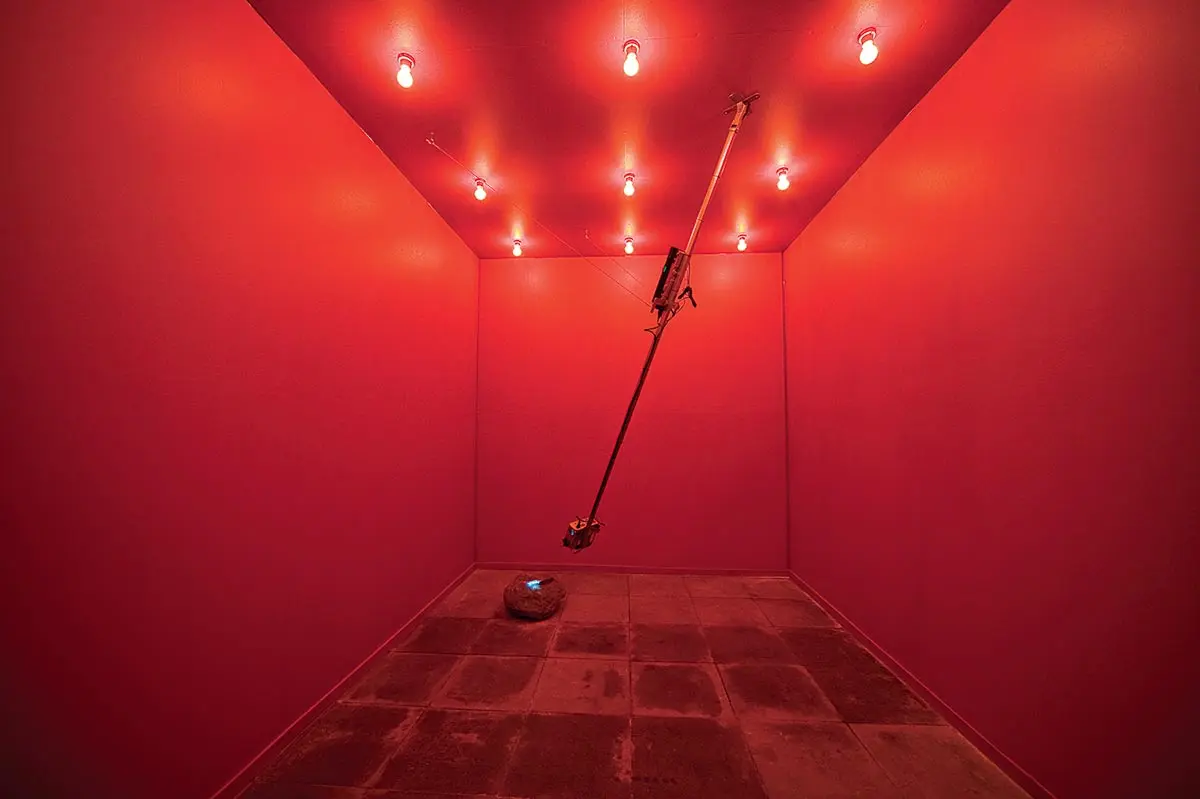
In Rúbrica in turn, Díaz takes over the main building of the Matucana 100 Cultural Center. Thirty years after the Pinochet coup, the artist “occupies” the gallery with light, messages, and audio. Fourteen phrases in red neon (neon is misery, neon is suffering, neon is insanity, neon is a misfortune, neon is anguish, neon is secrecy, etc.) comprise a kind of via crucis—something already present in Díaz’s Lonquén—and launch their meaning towards the viewer in two ways: through the suggestiveness of the phrases and through the oppressive red light that inundates the space, which even raises the temperature by a few degrees and in that way limits how long visitors can stand to remain there. The audio combined the noise of a poorly tuned radio and a repeating fragment from María Marta Serra Lima’s version of the song Los enamorados. Again, this exhibition produced a lugubrious, macabre effect. It lasted for 10 days and was open 24 hours every day.
That same year, 2003, Díaz was awarded the National Arts Prize for his career achievements.
The Word “Art”
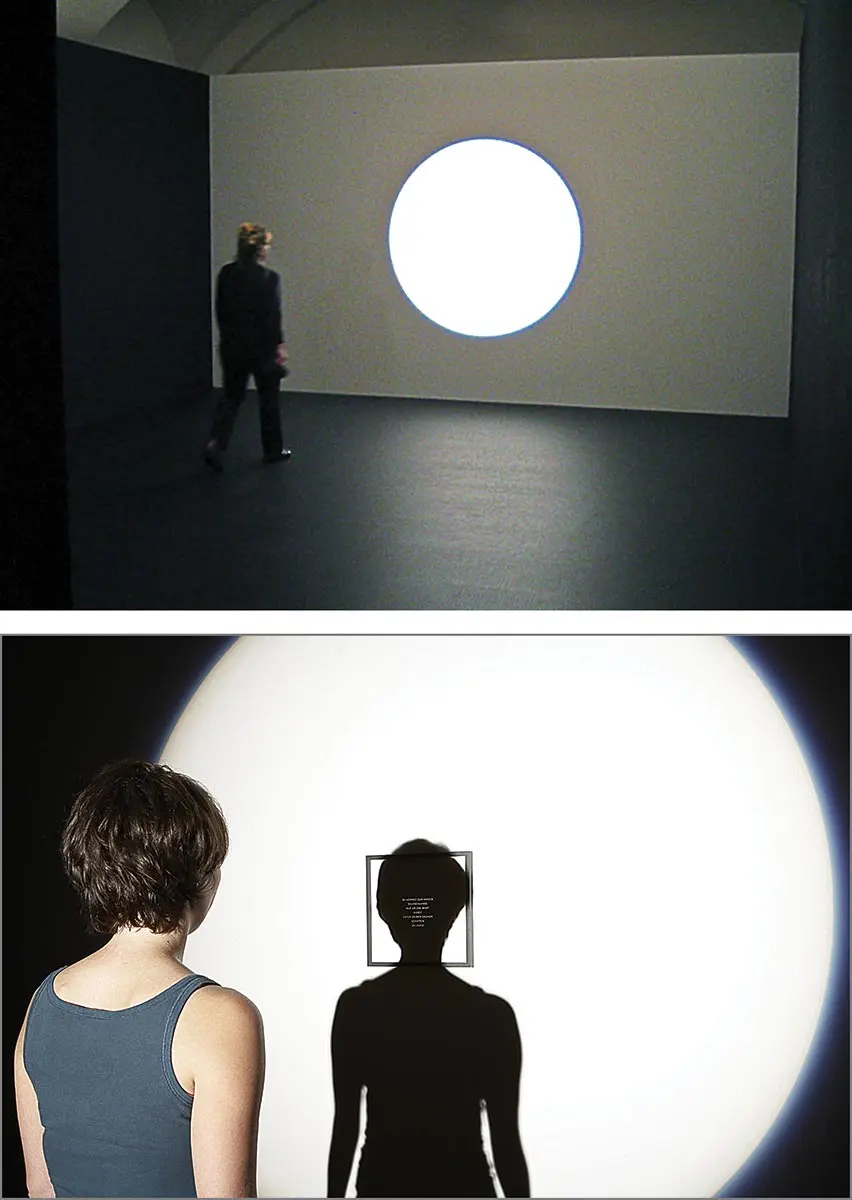
The man who as a young art student confronted the Kassel Apollo was now, by one of life’s “coincidences,” in front of the “original copy,” in actual Kassel, Germany. Invited to dOCUMENTA in 2007, Díaz presented two installations: Eclipse (Eclipse) and Al calor del pensamiento (In the Heat of Thought). Eclipse is an interactive installation rendered legible only by the viewer’s participation. A circle of light focuses on an empty painting; if anyone stands on the way of the beam, a sentence in German appears in brilliant typography: “You have reached the heart of Germany only to read the word ART under your own shadow.”
The Kassel Apollo—based on the Apollo Parnopios, attributed to Fidias—has been kept at the city’s museum, Wilhelmshöhe Castle, since 1779. The clumsy charcoal sketches made by that Chilean art student transformed into the imposing image reproduced in the Castle’s store. What a journey, the Apollo’s, from Greece to Rome, from Rome to Kassel, from Kassel to Chile. What a journey, Gonzalo Díaz’s, from Chile to Germany. He arrived in Kassel to write the word “Art” under his own shadow.
Genealogical Tree
Many of Díaz’s installations are warehoused at the University of Chile, where he teaches. Hidden away in dust-covered wooden boxes, scattered and shrunk, an entire retrospective awaits. I walk around them with him; “Here is the Venice Biennale,” he says, pointing to a series of five medium-size boxes. Yet far from remaining stuck in his past achievements, Díaz continues to work.
Visiting his studio, I see an amalgam of history books, sketches, outlines, and a large genealogical tree that begins with Philip II. Díaz’s interest in this king is manifold, and includes what he terms Philip’s “unhealthy Catholicism.” The tree’s branches grow downwards to, in my calculation, twenty generations. As Díaz puts it, this is an ongoing investigation into “endogamy, power, politics, and the inquisitorial and racist facets of Chilean society.” Some of it, still in progress, will be shown in Zurich. I attempt to sketch a genealogical tree of my own. Starting with Díaz, it could branch out to his teachers and assistants, and to his past, present, and future disciples (counted in the thousands). It could also be a tree of things that Chile has copied from Europe, or a genealogical tree of the Chilean oligarchy and its current hold on power, or one of all the students who copied the Kassel Apollo. The artist bids me farewell. “Will you be kind to me?” he asks. Indeed, he’s got gracia.
JUAN JOSÉ SANTOS