
Inti Hernández is not Plato or Kanye West, but on the night of the inauguration of his exhibition titled Daily he served a scandalously perfect dinner like the one in Runaway. The luxury displayed on the table was gradually dismantled as the members of the public drank and ate, laughed, and greeted each other, oblivious to the video projection showing dozens of persons passing by along the sidewalk who were unable to participate in the “actual” feast. It was at this level of indifference and alienation that the cycle of the piece titled A la cabeza de la mesa se sienta la gente (People Seat at the Head of the Table), the main course of this Havana night, came to a close. This proposal was aimed at the very heart of the art world by evidencing the cynicism, irresponsibility, and hypocrisy with which the elites rule—those indifferent bulks that happily continue on their ways crowned with myrtles.1 But Inti Hernández is not against fortune per se but rather against the manner in which it is used.
Exhibited under an excellent but soul-crushing lighting design that underscores a certain type of oppression or bad living, Daily contains several converging axes: elitism and the collective experience; the metaphysical nature of time; the relationship between social responsibility and free will; and, lastly, an illusion. These conceptual rivers run through the exhibition as a sort of recreated inventory of an insular home in any given day and as the ideal scenography for Aire frío (Cold Air), the classic play by Virgilio Piñeira; or, they could also be part of a treatise about new enterprises and Cuban pragmatism, incredulous about the epic and forgetful about history—so much so that Hernández does not hesitate to follow the money trail in the piece Tras la pista del dinero (After the Money Trail), a piggy bank that shows short video sequences through its slot that explores the current Cuban reality.
Daily is an exhibition about Cubanness as attitude that reaches beyond a mere collection of wood carved Objetos inútiles (Worthless Objects).2 These would not be more than mere empty and formalist things if it were not their ability to speak to us—from the loss of their practical value—about that swamp whose “undercurrents of indifference, insignificance, of nothing that is vital”3 invade our lives.
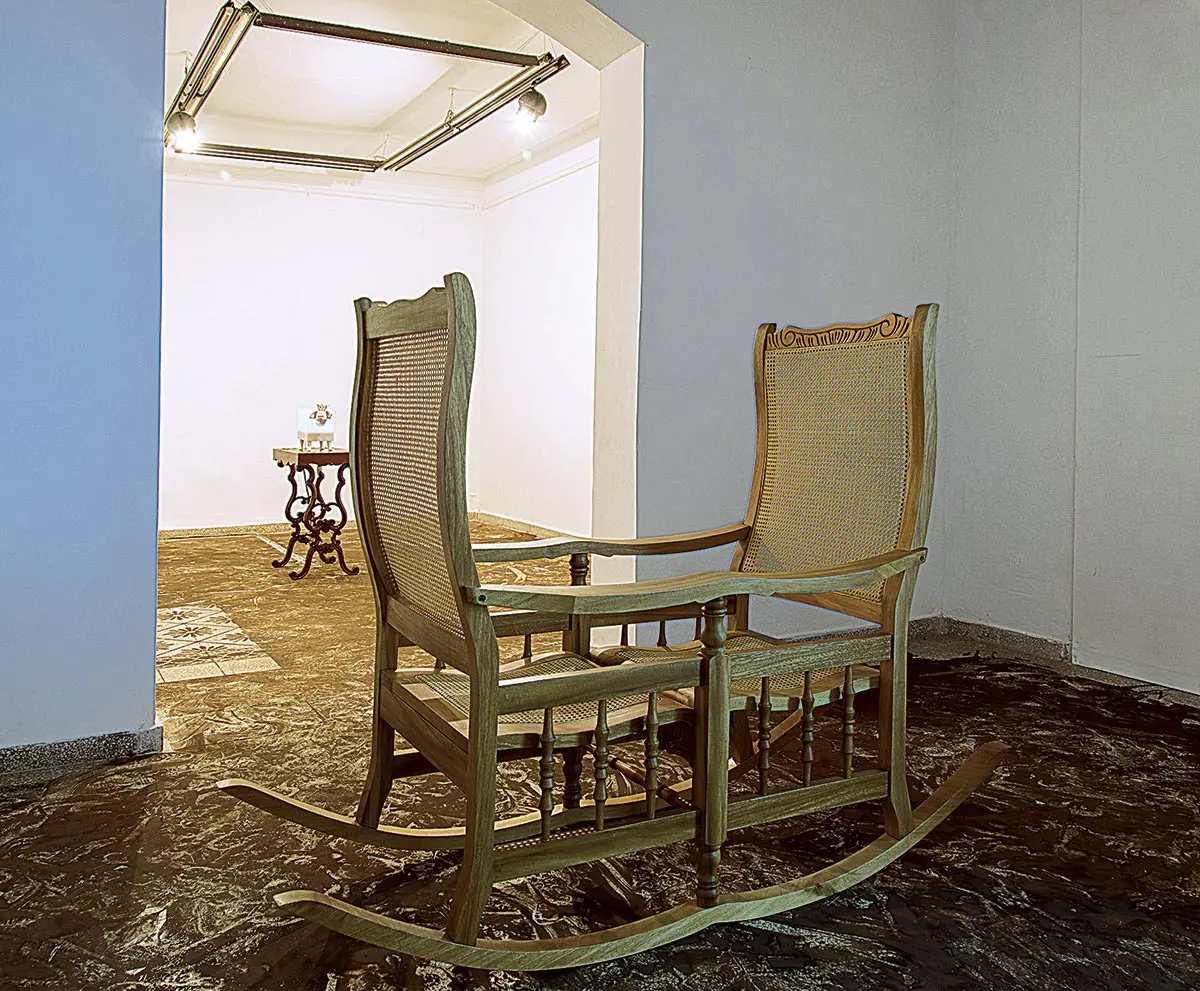
Cubans experience time in an unmeasurable dimension that is closer to the absurdity of ineffectiveness and the cynicism of patience or, philosophically speaking, to the saeculum, “a unit of time which […] is essentially imprecise [...] with floating limits.”4 Time for Cubans perhaps belongs to the aesthetics found in pieces like Balance cubano, two rocking chairs that cannot rock back and forth because they are connected to each other. In this piece, the individual is placed in a collective experience that is rigid, static, passive, and rusty. The piece speaks of survival that is no longer “a lived experience, but only its slough, residuum, corpse, skeleton or fossil.”5
Perhaps, Hernández’ stay in Holland and his experience with DUPP6 (both his performance and group work and the flexibility to intervene spaces that are far from the gallery circuit) predisposed him, as it occurred with many others and way before Chanel, to turn the Paseo del Prado into the ideal scene to “launch” his Propia iniciative (Own Initiative), a statement on the new entrepreneurial scene and the role of individuals in the new sociocultural currents. Inti Hernández went from artist to new entrepreneur, teaching about the utility of virtue, speaking about a new type of leadership and the aesthetic and economic way of cleaning. He became a public servant, like in the best tradition of Cuban thought.
In 1968 Borges spoke in Austin about Don Quixote. Among the brilliant ideas he exposed on the subject, he said that “after all, there is one thing that we are not willing to forget, one thing that gives life from time to time.” He only needed to add that that was the quality of that which is endearing, often also associated with the intimate, the familiar, and home in a more filial sense. The work by Inti Hernández, at least the works that I know by him created between 1944 to this day, contains that affective condition that leads to tenderness. The reason for it perhaps resides in the new humanism that has been worked on and that is based on a poetic and noble relationship with everyday life.
NOTES
1. Paraphrase of Amor de ciudad grande (Big City Love), José Martí
2. The title of a piece in which, like in Balance cubano (Cuban Balance), Inti Hernández resumes working with wood, one of the distinctive elements in his creations from the 1990s, when marquetry transformed his paintings into objectual and sculptural pieces. Wood allows him to develop his designs from a warmer place connected to manufacturing and handmade work.
3. Cintio Vitier, Ese sol del mundo moral. (Than Sun of the Morel World)
4. José Ortega y Gasset, El hombre y la gente (Man and People)
5. Ibidem
6. DUPP: Desde una Pragmática Pedagógica. Con un mirar abstraído (With an Absorbed Gaze) could be the prologue of Propia iniciativa (Own Initiative). Hernández is well aware of how the experience of the ego can give in to the collective experience, and vice versa. On Paseo del Prado avenue in Havana, he superimposed a design of clean tiles from republican era houses on dirty tiles from the public space.
ELVIA ROSA CASTRO