
Curated by María José Herrera, Materia, forma y símbolo (Matter, Form, and Symbol), a retrospective exhibition of works by José Gamarra, was presented at the OSDE Foundation’s Espacio de Arte, an institution established in 2006 which has hosted anthology shows of works by Argentinean sculptures like Juan Carlos Distéfano and Norberto Gómez, while at the same time opening its doors for the display of more recent three-dimensional objects like those by Débora Pierpaoli and Andrea Moccio. Equally worth mentioning is El espacio en cuestión (Space in Question), an exhibition conceived by the Foundation’s team, coordinated by María Teresa Constantin, in response to the challenge of studying and propose critical readings of contemporary productions about space.
José Gamarra’s career began in the mid-1960s, in a context of the great effervescence of new tendencies and expansion of disciplines in the art field, focusing his explorations on the issue of space. Avoiding a chronological organization, the show at OSDE began with a selection of works where the monumentality of forms asserts the presence of matter and pledges itself to its service. In counterpoint, the next group of images featured works based on the line in space that Gamarra began in the 1990s and continues to this day. Both those slender, ascending wooden totems and his monumental geometric shapes in granite or stone display a delicate formal synthesis and remarkably skilled sculpture craftsmanship.
The show included the main axis of Gamarra’s production, developed in a career that spans 50 years, and also reminded us of the connections between Gamarra and other Argentinean artists like Manuel Espinosa and Víctor Grippo. In 1974 Gamarra presented an exhibition alongside Espinosa, a founding member of the Arte Concreto-Invención group and a kinetic-art pioneer in Argentina. In that exhibition, Gamarra showed his geometric sculptures carved in acrylic, where light and space gain great centrality. In the catalog, Argentinean critic Basilio Uribe noted: “Gamarra’s acrylics invaded the exhibition space and altered Espinosa’s paintings.” Besides offering viewers an opportunity to explore these works, Materia, forma y símbolo presented projected images from that 1974 show, allowing its audience to study the interaction between the two artists that Uribe described. The action unfolded in three moments: the construction of the oven, the baking of the bread, and the distribution of the bread among passers-by. Staying close to his chosen craft as the architect of forms in space, the action of constructing an oven in the public square and handing out bread introduced the issue of the importance of work and its social function, notions that traverse this artist’s universe of images. In that connection, we can mention Herramientas (Tools, 2006), where Gamarra used a recycling process to transform a bunch of confiscated weapons into building instruments. This work, comprised of two chisels and a hammer, was part of a project titled Convivencia y desarme (Comunal Living and Disarmament), driven by Mendoza-born sculptor Eliana Molinelli, which provided several Argentinean artists with confiscated weaponry to be reused in the creation of art.
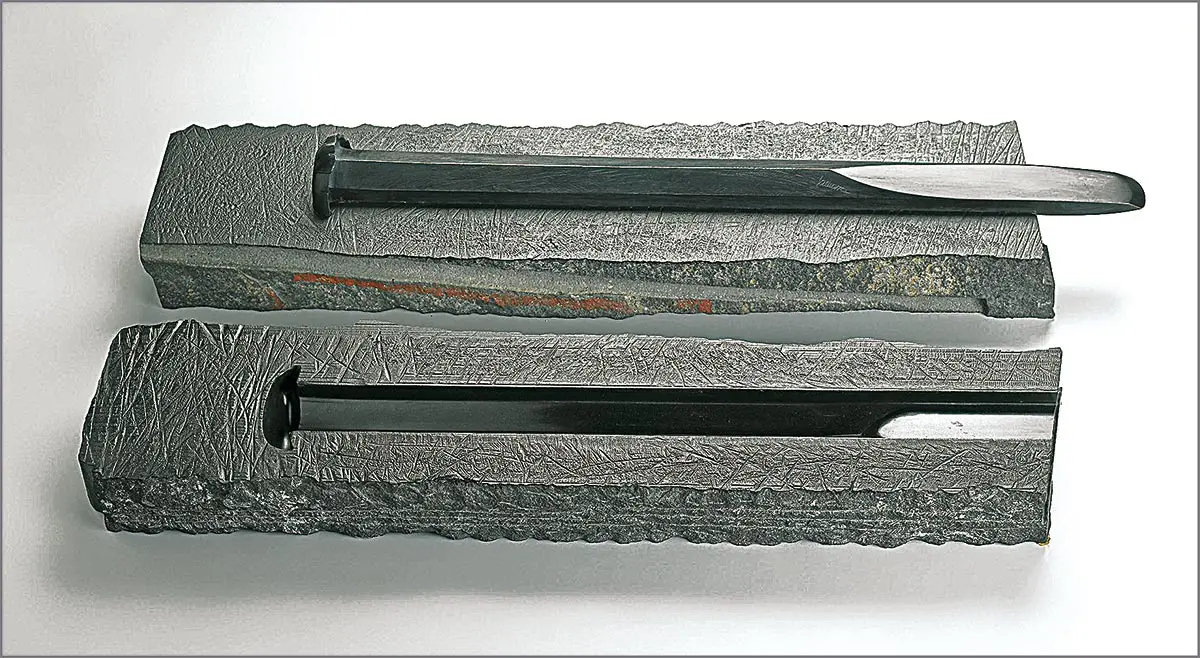
Tools, implements for our everyday tasks that are invisible in the efficiency, appear in Gamarra’s work as a vestige of labor. Under the heading of La Belleza de lo Útil. Herramientas (The Beauty of the Useful. Tools), bronze chisels, and axes impact on wood to replicate the exact moment of the action of a sculptor on his material. On other occasions, the tool acquires greater relevance and unexpected dimensions, as in Equilibrio (Equilibrium, 1994), where the large chisel is out of proportion to the support and needs to be balanced. Gamarra exposes the beauty of utilitarian objects at the same he constructs a paradox where the instrument is no longer such. In Fósil II (Fossil II, 1999), work tools are exhibited like ironic archeological finds. In a way, the tool transformed into a fossil becomes the symbol of an entire set of contemporary issues, where the disappearance of jobs, often as a result of technological advances, appears as a significant social challenge.
AYELÉN VÁZQUEZ