
In 1994, Chilean Juan Dávila generated great controversy with his representation of Simon Bolívar as a cross-dressing mestizo. Displaying his characteristic pictorial operation, this work—now emblematic of Dávila’s career—sought to give new meaning and bring down from its pedestal the idealized image commonly held of the Latin American liberator. Many were offended and labeled it blasphemous. The artist describes his intention as updating Bolivar’s figure and says he was surprised by the reaction.
A similar portrait of the national hero—now clumsily riding a donkey—was recently seen at Matucana 100 (M100), in Santiago de Chile, in what has been Dávila’s first and most important exhibition in his native country (he has lived and worked in Australia since 1974.) For a variety of reasons—according to him, for lack of interest—Dávila had never before shown such an ample body of work in Chile: fifty items, including oils-on-canvas, silkscreens, gouaches, and posters, all made between 2000 and 2016. He also painted a mural specially for this exhibition, curated by Spanish curator Paco Barragán, in charge of Visual Arts for M100.
The show was widely commented in Chile, not only because of its novelty but also because it strongly revealed, through Dávila’s formal imprint—a pop-surrealist style with forceful political and social content, which connects both with the tradition on painting and with popular culture—the always present contradictions that exist in matters of race, social class, gender, and colonialism. Over the years, Dávila (1946) has allowed himself to counter the West’s white male official story by complicating identities and reverting the hegemonic symbolism the Western story has established.
Dávila’s 2016 Bolívar shared its space with other images in Representación performativa 3-D (Performative Representation 3-D), a mural conceived and painted specifically over the course of several days at M100. This large hybrid, mestizo work, was a reflection of Latin America’s complex and impure identity in the Twenty-First Century—the identity of a region still marked by violence and colonized by power hunger, social injustice, and economic crises.
The exhibition’s title, Imagen residual (Residual Image), has to do with the image that appears when we close our eyes. We assimilate it as a memory, a snapshot, or an automatic flash. Residual images of the past and the present that Dávila merges in his compositions as in a collage, and which appear slippery and indecipherable at first glance. In order to make our first impression of his works more complex, Dávila decided to narrate his corrosive, uncomfortable stories with a formal treatment that is filled with color and information or, as he puts it, “a degenerate formalism.” This is how Dávila understands and experiences today’s society: frantic, confounding, practically adrift under the toke of consumerism and the mass media. Advertising, according to Dávila, is the visual language of the Twenty-First Century.
The M100 exhibition explored the chaos of today’s life through a careful selection of works in which social, political, racial, and gender issues recur, as do landscapes, women, enjoyment, colonization (both physical and mental), ideological tensions, modernisms and postmodernisms, refugees, and dictatorships. According to Barragán’s curatorial text, “Dávila situates himself on the side of the terminally neglected, the refugee, the immigrant, the native, the broken, the mestizo, the hermaphrodite, the homosexual, the persecuted, the mutilated… wagering, in sum, in favor of the anti-subject of history, of those too different to be a part of History with a capital H.”
Dávila has sustainedly reflected on history and society in a provocative way, presenting an incisive analysis of what he sees as the complacency, monotony, and questionable ethics of much of contemporary culture.
One of the show’s most emblematic works, Wallmapu, takes distance from a directly social narrative in order to engage other equally contingent themes in a more lyrical way. The large, two-meter-by-ten-meter canvas is mounted on a semi-oval structure and painted outdoors in Phillip Island, two hours from Melbourne. Forcefully against the grain of today’s digital-dominated trends, this work reclaims the open-air painterly practices of the Impressionists in order to approach the political meaning of the landscape for today’s world in a more poetic and dreamlike way. Here Dávila speaks of ecology, humanity’s disengagement from nature, property rights, speculation, and access to natural resources expropriated from indigenous peoples by the State and the corporations.
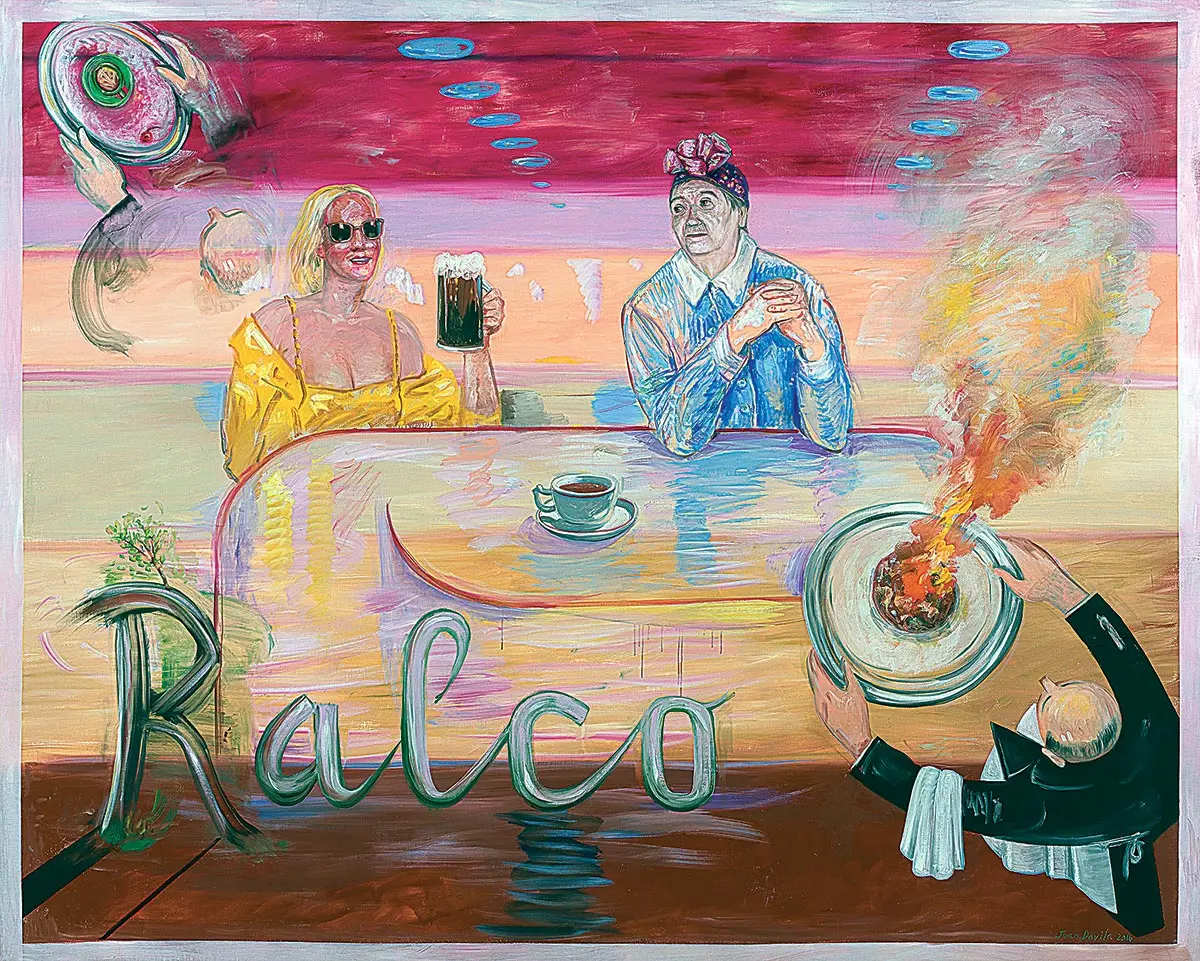
This critique is also evident in Ralco, a painting where Dávila proposes a possible conversation between the white race and the indigenous race. The composition presents us, on its left side, with a perhaps overexcited white woman drinking beer, and to its right an indigenous woman with a calm, patient visage. The word RALCO, spelled in large letters, immediately helps us make the scene more precise. Unlike many of Dávila’s works, where referents are subtle, almost imperceptible, here the allusion is direct and salient. Dávila is commenting on the Ralco dam and hydroelectric central, located in the Alto Bíobío region of southern Chile. Hundreds of families belonging to the Pehuenche ethnic group, inhabitants of the area, opposed the Ralco dam for years and finally gave in due to a powerful combination of state pressure and compensations offered by Endesa, the company behind the project.
By means of art, and of painting, in particular, Dávila reveals himself to be a sensible and committed citizen, that other artist we need to confront the destructive practices of a part of humanity.
ALEJANDRA VILLASMIL