
Outside the Academy, outside the circuit, but not out of focus. This retrospective—and introspective—exhibition reveals for us a unique Chilean photographer who for decades worked from a different distance, in different instances, and with other dissidents. Julia Toro (1933) began her career in painting and drawing, but at the age of 38, leaving behind her well-off family life, she devoted herself to photography as an autodidact. She fell in love with a photographer, Jaime Goycolea, and with a craft. She decided to portray private lives and spaces, her own and those of people around her, and captured a “B-side” history of Chile, away from the canonical and from journalistic testimonials: “It never occurred to me to go to a rally or a protest and take pictures, and I wasn’t interested in the landscape, either,” she said in an interview. The protagonist of one of her first series, Historia de un niño chileno (The Story of a Chilean Boy), was born on September 12, 1973, a day after the Pinochet coup. The last image in the series depicted the boy 17 years later, at the end of the military dictatorship: it is a photograph of his first kiss. In this “B-side” history of Chile, also recorded by other female artists like Leonora Vicuña or Paz Errázuriz, there is room for neighborhood pubs, alternative artists, eroticism, and everyday life. Always in black and white.
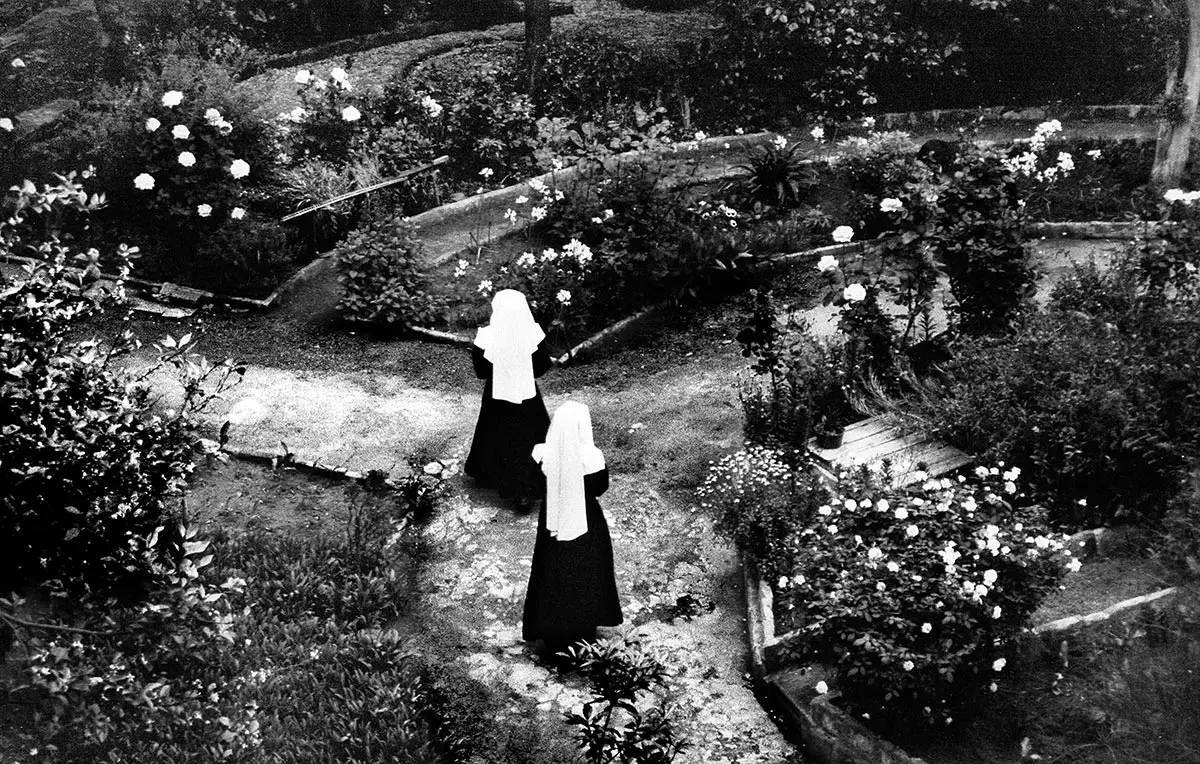
But there is also room form a more detached kind of photography, with greater narrative intent, such as her photographs of nuns and those that include literary references, like La vida instrucciones de uso (Life a User’s Manual, alluding to Georges Perec); Los detectives salvajes (The Savage Detectives, in connection to her admired Roberto Bolaño); and El jardín de los senderos que se bifurcan (The Garden of Forking Paths), which, interestingly, connects with Toro’s tribute to Borges in her first exhibition, held at the same museum in the mid-1970s. The interest in these photographs resides in the plot that the viewer can weave around them—the viewer’s initiative in connecting what Julia Toro includes in her frames and that which is suggested by what is inside the frame. Toro’s photographs are timeless; they could have been taken today or at any point in decades past. They are not testimonials, but moments in time. Poet Claudio Bertoni (the “victim” of several of Toro’s shots) wrote about her: “[Toro] is never cruel, because she is always enamored of what she photographs; she never mocks, exposes, denounces, or takes advantage of anyone; she is never inconsiderate.” The care with which she engages that which is “on the other side” of the lens is evident in her proposals.
Julia Toro says that she has always worked on the basis of suffering. When she was troubled or living through a negative period, she went out and photographed. And something of those emotions, of that charge, peers through and undergirds her images—the stolen nudes, the deserted streets, the self-portraits with such an intense, communicative, questioning gaze. The selection, curated by MAC director Francisco Brugnoli, encompassed Toro’s production from 1974 to the present, including recent photographs made using a digital camera, nighttime city scenes in which anecdote and silence are the main characters. These are still transcendental instants that become, through the photographer’s eyes and lens, suspended times, secrets exposed to the light. Brugnoli’s selection touches on every period in the artist’s evolution, occasionally choosing a single sample from a broader series. Although the selection displays coherence and internal affinity, the thematic diversity of Toro’s oeuvre threatens to turn the show into a kind of gourmet sampling menu, and index of works. Perhaps a larger space, or a focus on a single decade or a specific period, would have been more adequate to bring us close to the work of a photographer who, outside the profession but very much within the craft, spied the nooks and crannies of otherwise neglected characters and spaces with a unique gaze all of her own.
JUAN JOSÉ SANTOS