
Lorenzo Jaramillo was born in Hamburg (Germany) in 1955 and died in Bogota in 1992. During his life, he traveled to multiple places around the world, including to the US and to several countries in Europe and Asia, which helped him speak several languages and learn from different and contrasting cultures. Besides speaking Spanish, Jaramillo also spoke English, French, and German, which granted him access to literature, poetry, and theatre in their original languages. Passions of his that, like cinema and art, were central to his life.
While Lorenzo Unlike Others is an exhibition centered on Jaramillo’s artistic work—including drawings, engravings, paintings, illustrations, curtains, and masks—it also offers visitors a view of the soul of this artist.
The unusual and innovative curatorial strategy, designed by Diego Salcedo-Fidalgo, the exhibition’s curator, and his research assistant, Manuel Londoño-Mejía, invites viewers to enter spaces, unusually hidden or inaccessible for most people, to view both the works as well as the accompanying material (photographs, poetry, objects, videos, notes, and sketches). Such spaces keep, prepare, and produce objects and activities that, when they eventually emerge from them, appear organized and structured. They are the spaces behind the camera or the stage, where actors prepare and where scenes are filmed before being edited: or the storage rooms of traditional museums, where works and objects hang above shelfs or racks, often without frames or tags with which to identify them.
In these spaces one must get lost in order to search; one must descend from the exhibition rooms or transcend the stage in order to find key pieces and establish connections among them.
In this manner, in the temporary exhibitions area of the Museo Nacional visitors can, like Lorenzo, “become lost because we are nosy” if they follow the suggestions written with neon lights near the entrance. Like the catalog that accompanies the exhibition, the space is structured in thematically organized sections: “The Female Body,” “Life-Death Cycle,” “Celebration of Tragedy,” and “The Birds of the Soul.” Each section is visible from every angle in the room because it is interconnected with the others through the racks over which most of the works have been hanged.
In this manner, visitors can explore and find out about what is going on in the other places while they visit other underworlds: the world of cabarets suggested in Suite de las Mujeres Extravagantes (Suite of the Extravagant Women); the nightclubs and baths of Paris in La Fiesta (The Party) and in Gaieté Parisienne (Parisian Joyfulness); the backstage theater areas, literally behind curtains, designed by Jaramillo for the play Sobre las Arenas Tristes (Over the Sad Sands); the mystic places inhabited by the Ángeles (Angels) and the interior dimensions in Talking Heads and Piezas en Forma de Pera (Pear-Shaped Pieces).
They are places in which it is possible to discover “normalized” aspects of human beings like desires, needs, emotions, and sentiments, as well as activities that intentionally go unnoticed like makeup, and the direction and edition processes. These constitute behavioral substrates, gestures and actions that acquire an order and are visible on the theatre stage, the film screen, and in everyday life.
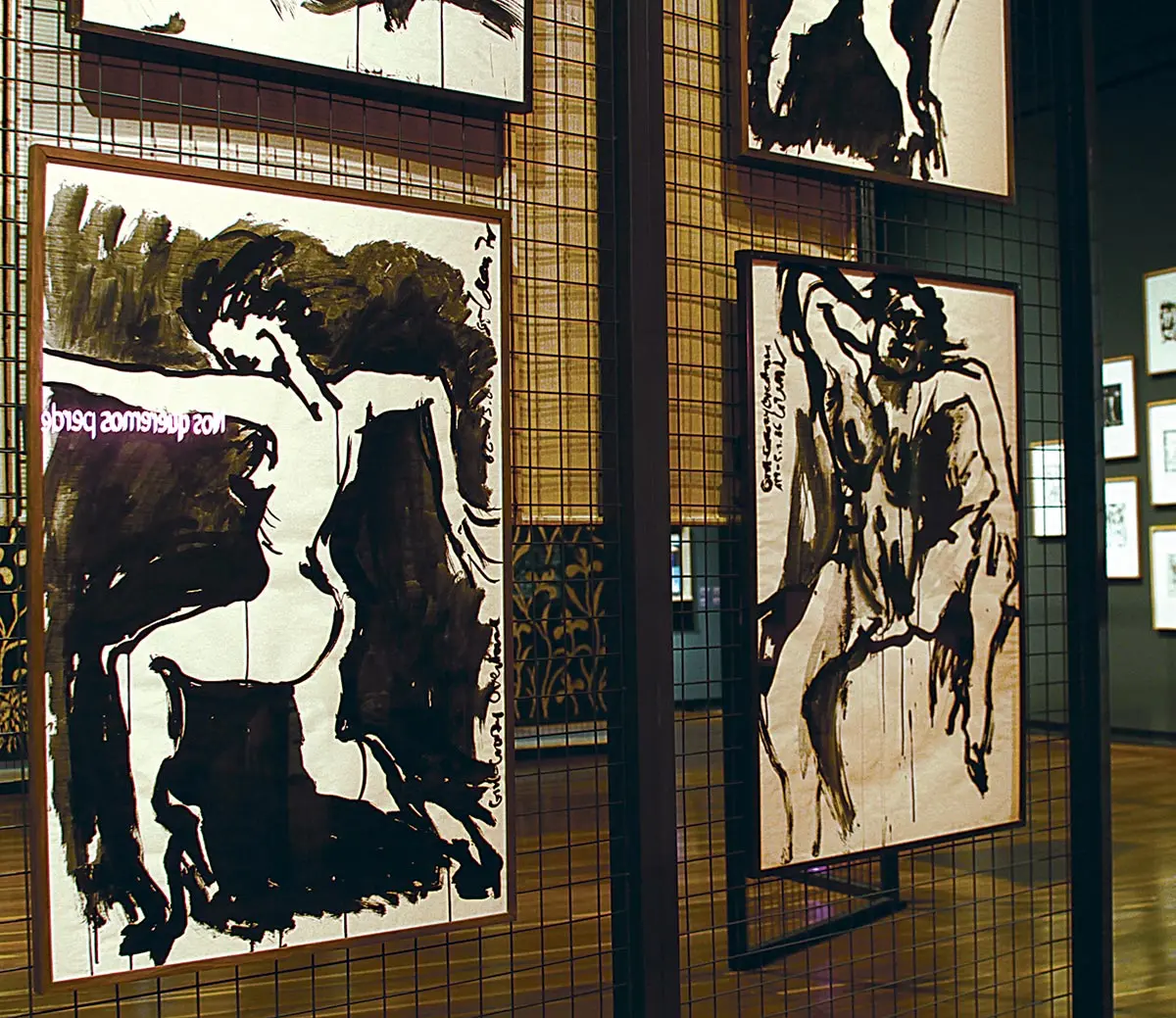
For its part, the exhibition area of the Museo de Artes Visuales becomes a place to access a human dimension that also tends to be hidden: that of the individual—mostly male—in all his fragility, vulnerability, and defenselessness. There, the excitement, tension, and throbbing rhythm of the exhibition area of the Museo Nacional stand in contrast to the silent and calm that invite to the “contemplation” of both the cabinet of personal curiosities and the one with figures, mostly nudes “lying down” painted with ink on fragile rice paper.
Despite its ephemeral nature, these figures share the spontaneous painterly gestures found in the series of dancing women, in the expressiveness of brushstrokes and figures that, combined with a vibrant palette (like those used in the paintings of the angels, in Gaieté Parisienne, and in some of the Extravagant Women), have helped define Jaramillo’s place in the history of Colombian art as an expressionist artist.
But beyond any connections to a specific style, the personal language by Jaramillo—enriched by explorations with Japanese and Indian ink and the influence of artists like Henri Michaux, Jean Cocteau, Pablo Picasso, Paul Klee, and several German and Austrian expressionists, among others—communicates a search for the expressive potential of lines, gestures, colors and an exploration of his already mentioned interior underworlds and universes
The multiple facets of Lorenzo Jaramillo are recognized and intuitively present in an exhibition that offers access to some of the dimensions that this artist explores and immerses himself with boundless curiosity, encouraging viewers in the process to follow him to the underlying realities in which, like him, and as Nietzsche said, we are confronted with our “human, all too human” condition.
MARÍA MARGARITA MALAGÓN-KURKA