
The exhibition Manuel Felguérez (Zacatecas, México, 1928), recently inaugurated at Durban Segnini, features eighteen medium-format paintings, dated from 2016, and five sculptures made a year before. As a group, they reveal an artist well-grounded in the domains of abstraction and informalism, the styles adopted by Felguérez from the beginning of his career, in the late 1940s and early 1950s, as one of the most visible figures in what Mexican critic Teresa del Conde dubbed the Generación de la ruptura (Breakaway Generation) in the landscape of the Mexican visual arts of the 1950s.
The Breakaway Generation openly confronted the ideo-aesthetic beliefs of its predecessors, what was known as the Mexican School of Painting, characterized, from the point of view of its poetics, by its attachment to the values of realism and figuration in the naturalist's vein, and in terms of its discursive orientation by its sustained, emphatic commitment to social and historical themes, and with a revolutionary ideology.
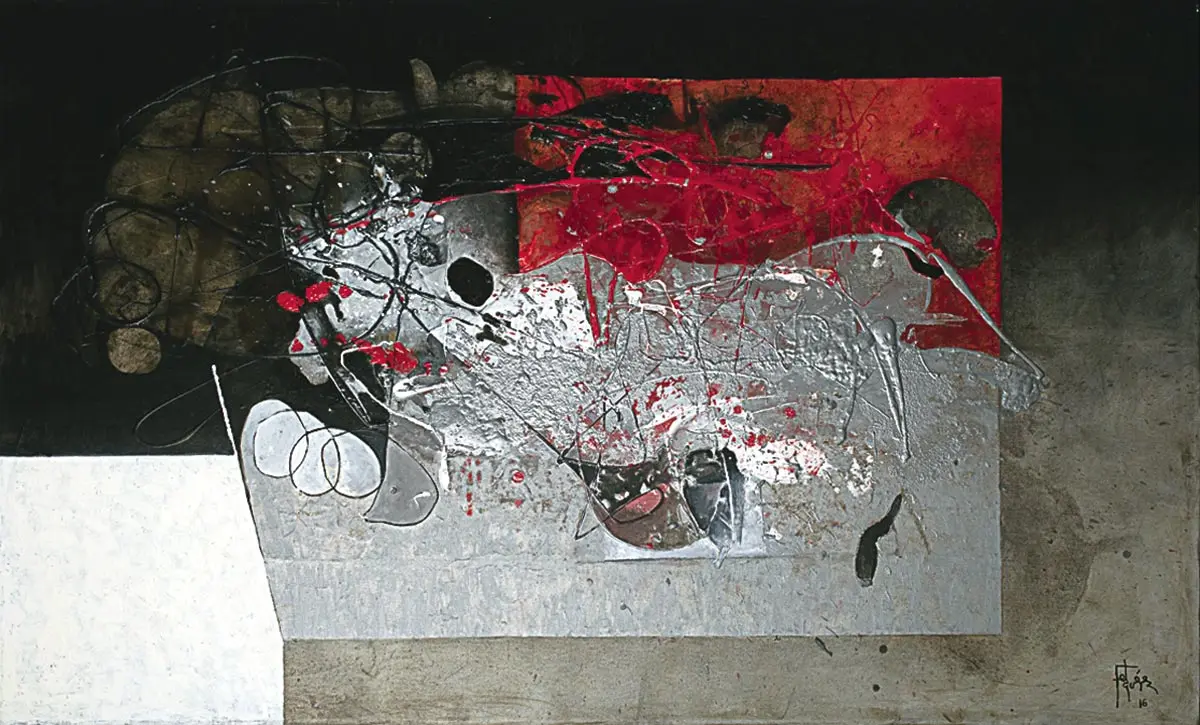
Critics have observed Felguérez’s intention to engage, from the fields of science, physics, and mathematics, those shifts and dynamics that traverse both nature and society. This has been a systematic concern in his work, as we can see in the works now on exhibit. These are works on which, from the poetic point of view, we find the expressive resources of informalism alongside those of an abstraction most tilted towards geometry—and informalism, according to Álvaro Medina, “made from blotches and textures conceived and created as expressions of the plasticity of matter and its transformations,”1 with a geometric emphasis “based on measurement and rigor, which as a metaphorical hypothesis (subject to verification), we can connect to the mathematical precision observed in the behavior of atoms, the invariant basis for the variable matter.” And it is that combination of informalism and geometric abstraction that Felguérez’s work finds its distinctive poetic accent.
The works in this exhibition, especially the paintings, like Sin título 5/16 (Untitled 5/16) and Sin título 9/16 (Untitled 9/16), seem to “assault” the viewer’s gaze with the suspense between the rational and the irrational, between the spiritual and the material. Indeed, the majority of the works speak to us with a mixture that includes, on the one hand, pictorial gestures of immediate energy, expressive outbursts brimming with a chaotic kind of kineticism, like that of matter on the verge of exploding, and, on the other, the calculated plan, the well-balanced measure implicit in the concept, reflection, and order. This is why the works project a convulsed appearance, like magma that spills, fragmented and undulating, all over the place. Yet, in turn, these works seem to set boundaries for such uncontrollable forces, as they demarcate the sudden space of the natural telluric gesture with equations about the equilibrium of a rational expression intended to redirect or channel the shapeless tidal wave of unknown matter.
The view of the world from a scientific-technical perspective that is present in Felguérez’s work is most emphasized by the sculptures in this exhibition, such as Al margen del tiempo (On the Margins of Time), Observando a la Osa (Observing the Bear), or Doble presencia (Double Presence), all from 2015. Here the artist becomes more thoughtful, with greater expressive constraint in his language’s syntax, something he avoids in his paintings. This syntax also has a more geometric structure that aspires to a greater degree of organization in its space-time dimensions.
Manuel Felguérez’s break with the Mexican School of Painting had two key consequences for the contemporary visual arts in Mexico. The first concerns the poetic realm: the dislodging of realism and figuration as the dominant modes for the representation of reality. The second consequence belongs to the order of discourse: a shift in perception, insensibility, when of comes to select the content to be represented. While a sensorial, retina-based realist naturalism dominates the Mexican School of Painting, Felguérez’s work, in turn, proposes a kind of painting that appeals, to be understood, more to the conceptual than to the senses. This painting is made not so much to be seen but to be thought. On the other hand, while the discourse of the Mexican School of Painting responds to a national history that is enveloped in political-revolutionary, economic, and social issues, the emphasis of Felguérez’s discourse, as part of the Generación de la Ruptura, is on the realm of research, and articulation of language that allows him to express issues related to the world of science, technological advancement, and individual freedom. Felguérez’s oeuvre, as a whole, has asserted a strongly individualized subject that has left behind the ideology of an agrarian, semi-feudal Mexico in order to explore visions of developmental capitalism fueled by the consolidation of the democratic State.
NOTE
1. Álvaro Medina, “El orden y el caos en la obra de Manuel Felguérez”. In: Catálogo con motivo de la muestra Manuel Felguérez, p. 66. Ed. Durban Segnini Gallery, Miami, 2016.
DENNYS MATOS